

Standard home depreciation models don't hold up within two miles of the ocean. When evaluating seaside real estate, understanding the hidden costs of buying coastal home investments requires looking past basic appraisal checklists and confronting the physics of marine microclimates. You're likely already anticipating elevated hazard premiums and routine exterior touch-ups. Even so, the compounded financial impact of airborne salt corrosion, changing flood mandates, and accelerated mechanical decay often catches seasoned buyers off guard.
Safeguarding your capital demands an analytical methodology rather than an emotional impulse. In this guide, you'll uncover the critical, overlooked expenses of oceanfront living, from premature HVAC failure to complex, layered insurance architectures, well before you remove loan or inspection contingencies. We'll examine hyper-local structural vulnerabilities, construct a realistic annual holding cost model, and establish an exacting due-diligence framework to shield your balance sheet during escrow negotiations.
Key Takeaways
- Recalibrate your annual operating budget by contrasting standard inland depreciation formulas against the accelerated capital expenditure schedules demanded by seaside microclimates.
- Identify the hidden costs of buying coastal home real estate, where persistent marine layer moisture and galvanic salt corrosion cut exterior system lifespans significantly.
- Structure a resilient insurance portfolio by evaluating carrier retrenchment, non-admitted market options, and carrier-of-last-resort programs like the California FAIR Plan.
- Anticipate regulatory friction by evaluating Coastal Commission oversight, development permit timelines, and strict limitations on protective shoreline armoring.
- Deploy a methodical pre-acquisition audit to pinpoint structural vulnerabilities, calculate reserve thresholds, and protect capital during purchase negotiations.
Myth vs. Reality: Why Coastal Purchase Budgets Consistently Fail
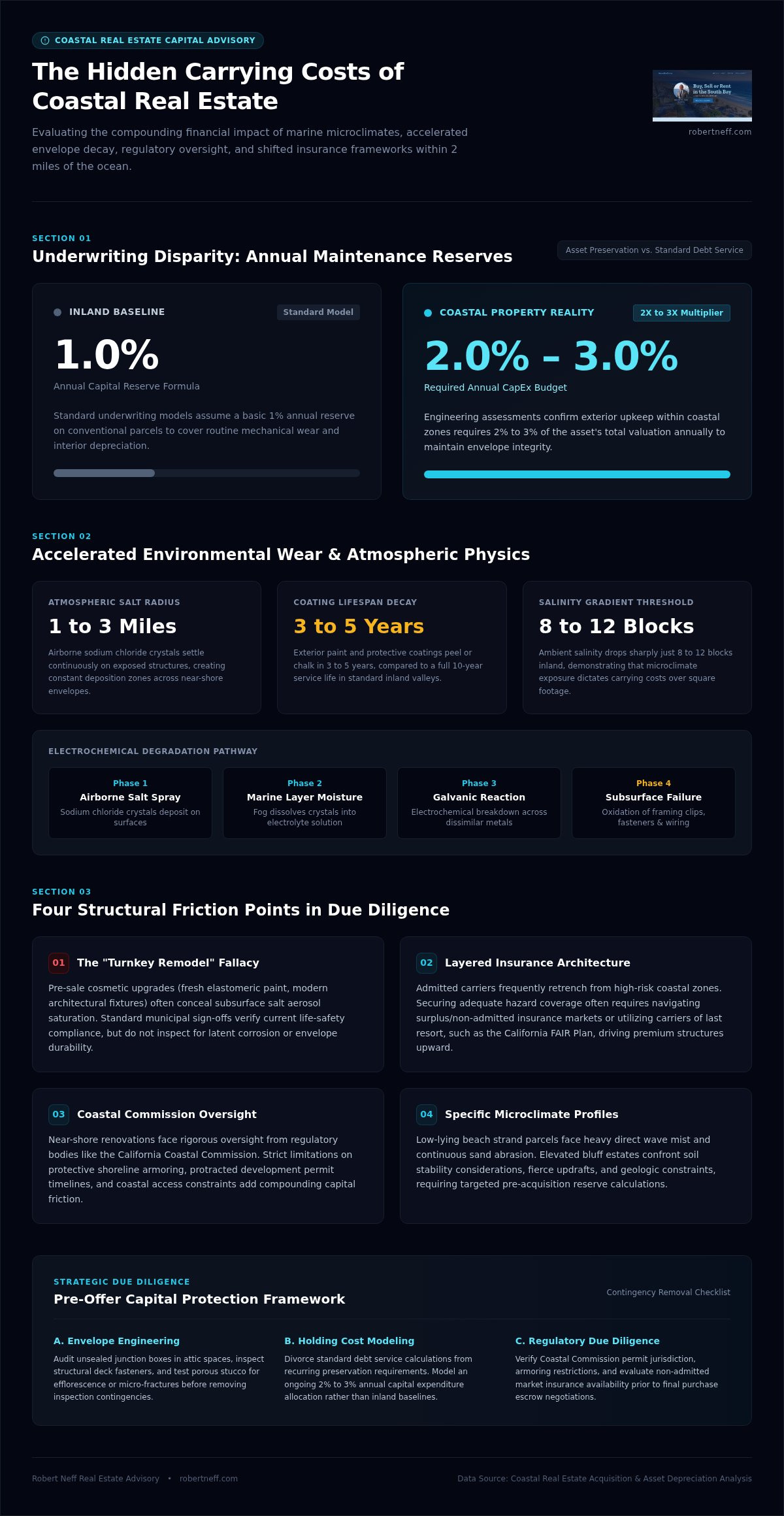
Conventional underwriting models treat oceanside estates like ordinary suburban parcels. Buyers often run standard debt-service calculators, factor in principal, interest, taxes, and conventional hazard insurance, and assume a basic 1% annual maintenance reserve will suffice. In near-shore environments, that baseline fails. Marine physics accelerates physical depreciation on a curve inland buyers rarely anticipate. Calculating the true carrying balance means divorcing debt service from recurring preservation expenses. Real estate engineering assessments show that exterior upkeep for coastal properties averages 2% to 3% of the asset's total value annually, doubling or tripling typical inland assumptions. Uncovering the hidden costs of buying coastal home assets requires looking past surface-level real estate metrics to analyze environmental exposure before drafting an initial purchase offer.
The Turnkey Fallacy in Oceanfront and Near-Shore Real Estate
A recent high-end remodel does not immunize a property against immediate capital demands. Sellers frequently apply cosmetic improvements, such as fresh elastomeric paint and modern architectural hardware, right before listing. These quick visual updates often conceal subsurface salt aerosol saturation within exterior envelopes. Without continuous preventative sealing, luxury finishes deteriorate rapidly under relentless marine conditions. Powder-coated exterior fixtures pit, untreated stainless steel hardware tarnishes, and framing connections oxidize behind pristine facade finishes. Even recent municipal building sign-offs offer little reassurance. Building inspectors verify compliance with local life-safety codes at a specific point in time; they don't test for latent salt degradation, long-term building envelope durability, or future galvanic corrosion.
The Macro Math vs. Microclimate Realities Across Coastal Enclaves
Atmospheric intensity changes within extraordinarily tight geographical radii. A property situated directly on an oceanfront walk encounters relentless wind-driven salt spray, persistent fog banks, and elevated ambient humidity. Move just eight to twelve blocks inland, and ambient salinity drops sharply. Low-lying beach strands endure direct wave mist and continuous sand abrasion, while elevated bluff properties face complex soil stability questions, fierce updrafts, and strict oversight from regulatory authorities such as the California Coastal Commission. When surveying coastal homes for sale South Bay CA, you quickly discover that microclimate exposure dictates long-term holding costs far more than gross square footage. Navigating these hidden costs of buying coastal home properties requires an empirical evaluation of site-specific elevation, prevailing winds, and regional topography.
Environmental Wear: Marine Layer, Salt Spray, and Atmospheric Corrosion
Atmospheric salt deposition creates an aggressive electrochemical reaction on near-shore building envelopes. Within one to three miles of open saltwater, airborne sodium chloride crystals settle continuously on exposed materials. Moisture from evening fog dissolves these salt particulates into a conductive electrolyte solution, driving rapid galvanic corrosion whenever dissimilar metals touch. Exterior coatings degrade at double to triple the rate seen in inland valleys, peeling or chalking in three to five years instead of lasting a full decade. Pervasive morning marine layers push deep into attic spaces and exterior walls, corroding unsealed electrical junction boxes and destabilizing subfloor framing. Deferring exterior maintenance under these conditions leads to compounding structural failure, transforming routine upkeep into one of the major hidden costs of buying coastal home properties.
Accelerated Oxidation and Building Envelope Deterioration
Standard architectural materials deteriorate quickly under marine air saturation. Standard galvanized framing clips, structural flashing, and deck fasteners oxidize prematurely, often losing structural capacity behind finished surfaces. Porous stucco and exterior masonry draw in airborne salt, sparking efflorescence, internal moisture retention, and micro-cracks that let driving rain penetrate the framing. Preserving envelope integrity requires non-negotiable material upgrades:
- Fasteners and Hardware: Specifying Grade 316 marine-grade stainless steel to resist localized pitting and chloride stress cracking.
- Protective Coatings: Applying specialized elastomeric sealants and sacrificial primers formulated specifically for high-salinity zones.
- Balcony Railings: Utilizing structural glass with anodized aluminum channels or passivated marine stainless systems to prevent rust run-off down exterior facades.
HVAC System Stress, Fenestration Fatigue, and Window Seals
Airborne salt crystals destroy exterior mechanical systems. While inland condenser units routinely operate for twelve to fifteen years, standard copper-fin heat pumps near the shoreline frequently suffer galvanic decay in just three to five years. Salt air eats the bonding between aluminum fins and copper tubing, causing early refrigerant leaks unless systems feature all-aluminum microchannel coils or factory-applied marine coatings. High-end multi-slide sliding glass doors face equal punishment. Airborne grit scores roller tracks, destroys weatherstripping, and ruptures insulated glass unit seals, causing permanent fogging between panes. Protecting indoor air quality also demands high-efficiency whole-home dehumidification systems paired with sealed mechanical filtration to block fine salt aerosol from settling inside.
Geotechnical Realities: Bluff Setbacks and Subterranean Water
Foundations in shoreline districts combat severe subsurface challenges. Bluff-top parcels confront relentless wave scouring and sub-surface groundwater migration that compromise slope stability. Geotechnical demands diverge widely between regions, as seen when comparing Palos Verdes vs Manhattan Beach living. Palos Verdes bluff properties require complex drainage management and deep-seated caissons to mitigate ancient landslide planes, whereas Manhattan Beach sand-dune topography demands shoring against shifting soils and strict compliance with local flood management codes. Basement retaining walls encounter heavy hydrostatic pressure, making multi-ply waterproofing membranes and active sump systems essential. Reviewing historical soil reports and aligning site conditions with National Flood Insurance Program guidelines helps prevent sudden financial exposure. Partnering with a skilled advisor through Robert Neff's buyer search and negotiation services gives you the technical oversight needed to uncover these hidden costs of buying coastal home assets before committing your capital.
The Shifting Economics of Coastal Insurance, Taxes, and HOA Reserves
Traditional insurance models have fractured across coastal California. Private admitted carriers continue to restrict capacity or withdraw entirely from near-shore and brush-adjacent zip codes, leaving high-value property owners with limited underwriting options. Relying on standard hazard policies is no longer feasible for oceanfront acquisitions. Buyers must instead engineer complex, layered coverage portfolios, which ranks among the most overlooked hidden costs of buying coastal home investments. These insurance restructurings, paired with escalating municipal infrastructure levies and stringent reserve obligations, demand early balance-sheet modeling before you submit an offer.
Navigating Hazard Coverage, Private Carrier Departure, and the FAIR Plan
When admitted carriers decline coverage, homeowners frequently turn to the California FAIR Plan as an insurer of last resort. Because the FAIR Plan provides basic property coverage primarily covering fire, lightning, and internal explosion, it leaves massive protection voids. Securing comprehensive protection requires pairing the policy with a standalone Difference in Conditions (DIC) policy or turning to surplus lines carriers. DIC coverage fills critical gaps, including water damage, theft, and liability. Specialized endorsements are also necessary to address wind-driven precipitation, which standard policies often exclude if wind does not breach the exterior envelope first. Securing binding quotes early in your contractual contingency period avoids escrow delays and prevents severe post-closing premium shocks.
HOA Reserve Shortfalls, Structural Mandates, and Special Assessments
Ocean-adjacent condominiums and planned unit developments carry unique collective liabilities. Salt moisture steadily attacks reinforced concrete, turning subterranean garage podium deck waterproofing into a major financial exposure. Heightened structural inspection protocols now force associations to commission rigorous reserve studies and eliminate deferred maintenance. When reserve funds sit below fully funded thresholds, boards must levy substantial special assessments across all unit owners to cover concrete spalling restoration, deck recoating, and seismic reinforcement. Reviewing at least three years of association meeting minutes, current reserve fund percentages, and pending engineering studies is critical before removing purchase contingencies.
Specialized Municipal Assessments, Coastal Drainage Bonds, and Property Taxes
Coastal tax bills extend far beyond standard county ad valorem calculations. Under California Proposition 13, transferring title triggers an immediate reassessment to current market value, resulting in significant adjustments to annual tax obligations. Coastal municipalities also frequently approve targeted parcel taxes, Mello-Roos districts, and infrastructure bonds to finance public seawall maintenance, stormwater outfall retrofits, and municipal bluff stabilization. Modeling long-term sea-level exposure and localized drainage risks using tools like the NOAA Digital Coast platform allows prospective buyers to cross-reference municipal vulnerability assessments with pending civic bonds, uncovering the true hidden costs of buying coastal home assets.
Regulatory Friction: Coastal Commission Oversight and Renovation Premiums
Remodeling an ocean-adjacent residence introduces regulatory complexity unknown in inland jurisdictions. Beyond conventional municipal planning departments, properties located within the designated coastal zone fall under the statutory authority of the California Coastal Act. Altering structural envelopes, expanding footprints, or modifying exterior elevations often triggers discretionary reviews that generate substantial soft costs. When evaluating the hidden costs of buying coastal home properties, buyers must factor in the timeline delays, legal fees, and architectural expenses required to secure regulatory approvals before swinging a single hammer.
The California Coastal Act and Coastal Development Permitting Realities
Simple interior paint jobs or cabinetry updates bypass state scrutiny, but exterior work rarely escapes oversight. Any modification affecting exterior volume, rooflines, grading, or shoreline protection typically requires a Coastal Development Permit (CDP). Properties adjacent to sensitive bluffs or environmentally sensitive habitat areas encounter rigorous public hearings and environmental impact reviews. Securing dual sign-offs from both the local municipality and the Coastal Commission can add twelve to twenty-four months to a project timeline. Strict municipal view-protection ordinances and tight lot-coverage limits further restrict your building envelope, meaning planned additions might be rejected outright or significantly downsized during public comment periods.
Specialized Coastal Construction Labor, Access Logistics, and Material Surcharges
Executing construction along the coast commands a significant premium from general contractors and specialized trades. Densely populated beach avenues, pedestrian walk-streets, and narrow alleyways turn routine material deliveries into complex logistical operations. Subcontractors regularly add surcharges to compensate for severe parking constraints, crane requirements, and restricted staging areas on compact thirty-foot parcels. Standard building components cannot survive this environment, forcing builders to use specialized materials:
- Marine Mechanical Fasteners: Utilizing hot-dipped galvanized or Grade 316 stainless structural hardware to prevent early framing failure.
- Architectural Cladding: Sourcing high-performance rain-screen assemblies, fluoropolymer-coated metals, and marine-formulated sealants that resist intense salt air.
- Hand-Carried Staging: Paying additional labor hours to transport materials by hand down pedestrian walks where standard delivery trucks cannot drive.
Before committing to an acquisition with significant renovation aspirations, connect with Robert Neff for analytical buyer search and negotiation services to thoroughly evaluate municipal permit histories, zoning restrictions, and hidden costs of buying coastal home real estate.
Strategic Due Diligence: A Precision Audit Before You Make an Offer
Relying on a standard general home inspection leaves significant financial blind spots when acquiring oceanfront real estate. Standard inspectors operate on visual checklists designed for inland tract homes; they don't conduct the rigorous diagnostic evaluations maritime structures require. Uncovering the true hidden costs of buying coastal home assets demands an engineering-grade audit before contractual contingencies expire. Translating identified structural wear and deferred maintenance into quantifiable balance-sheet line items gives you the empirical leverage needed to renegotiate purchase terms or secure substantial repair credits before close of escrow.
Specialized Engineering Inspections Beyond General Home Inspections
Evaluating complex near-shore architecture requires deploying licensed technical specialists. General inspectors cannot diagnose hidden moisture paths or subsurface shifts. Your pre-acquisition protocol should include targeted diagnostic assessments:
- Geotechnical and Structural Reviews: Engaging a structural engineer to evaluate seismic retrofitting, foundation settlement, and corrosion of concealed framing tie-downs.
- Infrared Thermal Imaging: Scanning exterior walls and ceilings after marine fog events to locate active envelope leaks and trapped interior condensation.
- Sub-Sewer Scoping: Running high-definition cameras through primary sewer laterals to check for pipe shearing caused by shifting coastal sands.
- Calibrated Water Intrusion Testing: Performing controlled hydrostatic spray rack tests against high-value multi-slide doors and architectural windows to verify flashing integrity.
Stress-Testing Holding Costs and Capital Expenditure Reserves
A sound financial model separates routine operating expenses from long-term capital replacement cycles. For coastal properties, mechanical components and exterior coatings degrade much faster than standard depreciation schedules predict. Establish a dedicated capital expenditure reserve funded annually to absorb early HVAC replacements, deck recoatings, and localized stucco restorations. Maintaining a dedicated liquid cash buffer also shields your personal cash flow from fluctuating insurance markets and civic assessments. For buyers evaluating whether full ownership aligns with their capital strategy, exploring high-end coastal rental options provides a flexible intermediate step to understand neighborhood microclimates without assuming long-term capital exposure.
Partnering with Research-Driven Advisory for Strategic Coastal Acquisition
Navigating coastal transactions requires disciplined market intelligence rather than emotional enthusiasm. When buyers fall in love with ocean views, they often dismiss subtle physical deficiencies that trigger massive capital liabilities later. Retaining an analytical advisor who pairs doctoral-level research methodology with street-level knowledge of municipal codes, bluff stability profiles, and microclimate variations ensures your interests stay protected. Reviewing the principles of strategic buyer representation highlights how exhaustive pre-purchase analysis turns hidden operational risks into strategic negotiation power, protecting your equity and exposing the real hidden costs of buying coastal home properties before you sign.
Mastering Coastal Asset Acquisition with Analytical Precision
Acquiring a seaside residence should elevate your lifestyle without compromising your balance sheet. By accounting for microclimate wear, navigating layered insurance portfolios, and auditing structural vulnerabilities early, you transform the hidden costs of buying coastal home real estate into manageable variables. Rigorous preparation replaces unexpected maintenance liabilities with complete operational clarity.
Protecting your capital requires dedicated advisory grounded in empirical data rather than sales rhetoric. Robert Neff, Ph.D. (DRE #02442812), affiliated with the Kaminsky Real Estate Group and eXp Realty, applies doctoral-level research methodology and microclimate analysis to evaluate high-value acquisitions across South Bay markets. With data-driven fiduciary representation on your side, you can negotiate with complete confidence and secure an enduring coastal investment. Schedule a Strategic Coastal Buyer Consultation with Robert Neff, Ph.D. to engineer your pre-acquisition audit today.
Frequently Asked Questions
How much more does it cost to maintain a coastal home compared to an inland property?
Coastal property maintenance typically runs two to three times higher than inland upkeep. While inland properties often require roughly 1% of property value annually for upkeep, coastal homes demand 2% to 3% to counteract continuous salt aerosol deposition and elevated humidity. These accelerated reserves are among the most persistent hidden costs of buying coastal home assets across South Bay communities like Hermosa Beach and Manhattan Beach.
Can regular home insurance policies cover structural damage caused by salt air corrosion?
Standard homeowners insurance policies explicitly exclude damage resulting from wear and tear, marring, rust, and gradual environmental corrosion. Because salt air decay develops over time rather than from a sudden, accidental peril, carriers will not pay to repair oxidized fasteners, corroded structural connections, or spalling concrete. Homeowners must fund these replacements out of pocket through dedicated capital reserves, making routine preventative maintenance vital for protecting structural integrity.
What is a Coastal Development Permit and when is it required for home renovations?
A Coastal Development Permit (CDP) is a specialized regulatory approval mandated by the California Coastal Act for development within the designated coastal zone. While basic interior remodels are usually exempt, a CDP is required whenever an owner alters structural envelopes, changes rooflines, increases gross square footage, or performs grading near bluffs. In cities like Redondo Beach and Torrance, securing a CDP can add substantial architectural design overhead and months to project timelines.
Why are property insurance premiums significantly higher in California coastal communities?
Heightened premiums stem from restricted private underwriting capacity, strict coastal building codes, and proximity to environmental hazard zones. In areas like the Palos Verdes Peninsula, homes often sit near designated high-fire severity or active bluff zones, prompting traditional admitted carriers to retreat. Buyers frequently must assemble layered policies, combining the California FAIR Plan with private Difference in Conditions (DIC) and excess flood policies, which substantially elevates annual carrying costs.
What specialized inspections should I order before buying a coastal or bluff-top home?
Buyers should commission a geotechnical engineering assessment, a structural frame inspection, and a closed-circuit sewer lateral camera inspection. In addition, moisture intrusion surveys using infrared thermography and calibrated window spray tests uncover hidden envelope leaks before purchase contingencies expire. In blufftop neighborhoods across Palos Verdes, updated geological soil reports are non-negotiable to assess subterranean water migration and slope stability. These diagnostic audits help uncover the hidden costs of buying coastal home parcels early.
How does marine fog and salt air impact solar panels and residential HVAC systems?
Airborne sodium chloride forms an abrasive film that diminishes photovoltaic solar panel efficiency and accelerates galvanic corrosion across copper-aluminum HVAC coils. Without frequent fresh-water rinses and specialized marine-grade coil coatings, exterior heat pump condensers can fail within three to five years. Solar racking systems also require Grade 316 stainless steel hardware and sealed microinverters to withstand persistent marine layer exposure in communities like El Segundo and Manhattan Beach.
What should buyers look for in the reserve studies of coastal condominium developments?
Buyers must verify the reserve fund percentage and examine scheduled structural component replacements, particularly for subterranean parking garage waterproofing, balcony decks, and exterior stucco recoating. Review at least three years of board meeting minutes for discussions regarding concrete spalling or impending special assessments. An underfunded coastal reserve study indicates deferred maintenance that will inevitably lead to sudden capital calls levied against individual unit owners.


