

For buyers weighing whether Manhattan Beach real estate is a good investment, the answer depends on the property type and investment plan. The market’s overall median sale price rose about 42% from Q1 2024 to Q1 2026, but that growth doesn’t make every property an equally strong fit. A condo may offer a different entry point than a detached home or townhome.
Manhattan Beach’s coastal setting and established appeal help explain why buyers consider it, while its high prices make the details matter. The condo figure sits close to the detached-home median, an important distinction for anyone assuming a condo is the lower-cost option.
This guide examines the area’s property appeal, price movement, rental potential, and the differences among condos, townhomes, and detached homes. Use these factors to assess how each option fits your plans before deciding what to explore further.
Key Takeaways
- Assess Manhattan Beach’s coastal appeal alongside the trade-offs of investing in a high-priced market.
- Read recent market movement in context, including the pace of sales and what price trends can, and can’t, tell you.
- Evaluate rental potential by weighing occupancy and yield against local rules and property-specific constraints.
- Compare condos, townhomes, and detached homes by more than purchase price to identify which type best fits your investment goals.
1. Why Buy Property in Manhattan Beach?
Manhattan Beach’s appeal combines coastal access, an established lifestyle, and proximity to downtown Los Angeles, about 20 miles away. The city has 2 miles of beach, and more than 3.5 million people visit annually. That steady visibility supports interest in homes, but it doesn’t guarantee appreciation for every property.
Neighborhood and location shape value. The Tree Section and Sand Section are sought-after areas, while Strand properties form a distinct coastal micro-market. Compare beachfront, ocean-view, and marina-adjacent properties carefully: views, access, exposure, and construction considerations can affect pricing and ownership costs. Limited housing inventory and a high-income tenant base also support buyer interest and rental demand. For a more accurate valuation, assess the specific property’s position, condition, and competing homes rather than relying on a neighborhood label alone.
Lifestyle can support demand beyond the summer season. Manhattan Beach has more than 100 volleyball nets, an average year-round temperature just under 70 degrees, and a Walk Score of 73. Those features appeal to residents seeking outdoor recreation and convenient local living. For investors, that appeal may help sustain rental interest, while over 28% of houses in the area are rental units. A coastal rental search should account for the property’s location and intended rental use. Short-term rental plans may face permit requirements or other limitations.
Waterfront ownership also carries risks. Coastal exposure can bring erosion, flooding, and storm-related concerns; tide lines, coastal regulations, and construction needs affect property evaluation. Insurance costs depend on location, building characteristics, coverage, and insurer underwriting, so include them in your investment calculation. Whether Manhattan Beach real estate is a good investment ultimately depends on how purchase value, potential income, upkeep, and resale prospects align with your goals.
2. Recent Manhattan Beach market activity and price growth
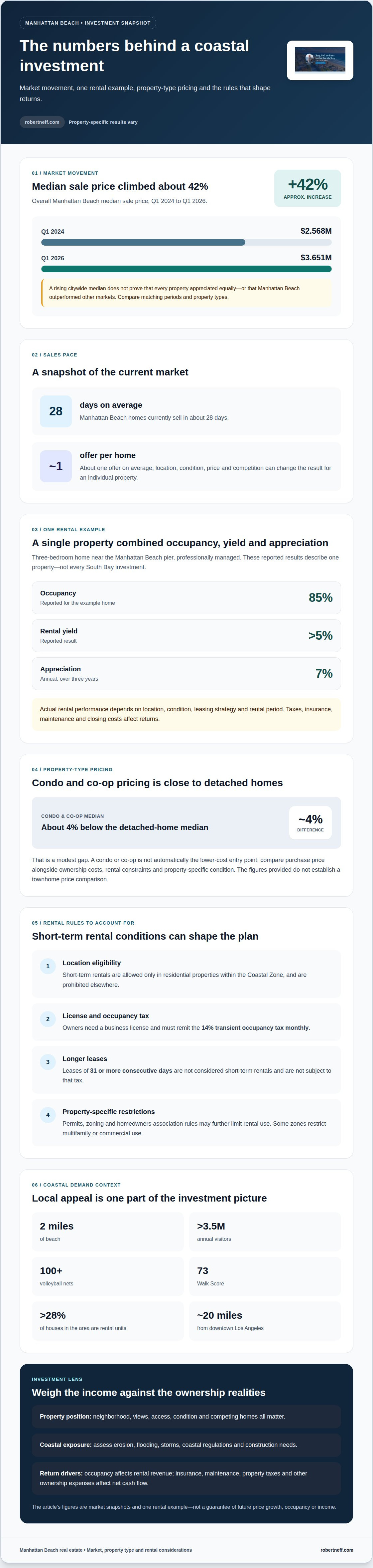
Manhattan Beach’s overall median sale price climbed from about $2.568 million in Q1 2024 to about $3.651 million in Q1 2026, an increase of roughly 42%. That’s a substantial rise, but it doesn’t prove the city outperformed Los Angeles County or every coastal market. A direct comparison needs matching periods and property types, since a shift in which homes sell can change median prices.
Manhattan Beach homes currently sell in about 28 days on average and receive about one offer. These measures help owners understand market pace, but they don’t guarantee the same result for each beach property. Location, condition, price, and current competition influence buyer response. A focused strategy compares recent sales with active inventory in the property’s immediate area, rather than assuming every coastal listing carries the same premium.
Hermosa Beach and Manhattan Beach both include coastal micro-markets, including Strand properties, but the available figures do not establish which has delivered stronger price growth. Redondo Beach offers a more accessible coastal investment market than Manhattan Beach, with a mix of condos and single-family homes. A lower purchase price may support cash-flow potential, but rental income and ownership expenses determine the actual outcome.
For a useful investment comparison, separate appreciation from cash flow. Review sale prices over the same period, then assess rental demand, likely operating costs, and the property’s condition. Inventory matters, too: fewer comparable homes can make pricing less straightforward, while more competing listings can affect selling time and negotiation. Local knowledge helps interpret differences across neighborhoods and property types, especially when a coastal location or distinctive view changes buyer interest.
A property-specific review can provide more information on local market value and help shape a purchase or selling strategy around current conditions.
3. Example occupancy, rental yield, and appreciation
A three-bedroom home near the Manhattan Beach pier achieved 85% occupancy with professional management. The example also reported rental yield above 5% and appreciation of 7% annually over three years. These figures show how occupancy, income, and value growth can combine, but they describe one property, not every South Bay investment. Rental trends depend on location, property condition, leasing strategy, and the rental period.
Short-term rentals in Manhattan Beach face specific restrictions. They’re allowed only in residential properties within the Coastal Zone and are prohibited elsewhere. Owners need a business license and must remit the 14% transient occupancy tax monthly. Leases of 31 or more consecutive days aren’t considered short-term rentals and aren’t subject to that tax. Permits or other limitations may apply, and homeowners associations can set additional rental rules.
Zoning also affects potential use. Certain Manhattan Beach zones restrict multifamily or commercial use, so a property’s location can limit rental plans. Seasonal stays and luxury vacation rentals may appeal to visitors, while longer leases can serve residents seeking a home in the community.
Property taxes, insurance, maintenance, and closing costs reduce returns by increasing ongoing expenses or the capital needed to buy. Compare those costs with expected rent and potential appreciation before buying. Rental income is only one part of the calculation: occupancy affects revenue, while upkeep and ownership expenses shape net cash flow. For a practical estimate, model different occupancy patterns and rental periods, then assess how each fits the property’s location and applicable rules.
4. Manhattan Beach condo prices compared with detached homes and townhomes
Manhattan Beach condos and co-ops aren’t automatically the lower-cost route into the local real estate market. That puts the condo and co-op median about 4% below the detached-home median, a modest difference for buyers weighing property type.
That lower median may create a different opportunity for buyers seeking proximity to Manhattan Beach’s coastal appeal. But medians do not compare like-for-like homes. Size, condition, location, views, and the specific neighborhood can shift value substantially within each category.
For a meaningful comparison, look beyond the purchase price. A condo’s association costs, reserves, rental restrictions, and anticipated assessments can affect ownership expenses and flexibility. A detached home may offer more control over the property, while a townhome may combine shared features with a different maintenance arrangement. Compare homes by matching condition and location to your intended use.
These figures also need context: one recent quarterly report recorded only 10 condo sales in Manhattan Beach. With a limited number of transactions, a few sales can influence the median. Treat the figures as a snapshot, then compare relevant properties and recent comparable sales before making an offer. Buyers should assess whether the price difference reflects features they value, rather than assuming condos always provide a substantial discount.
For first-time or relocating buyers, a structured property search can clarify which home type fits their priorities and budget. Explore buyer search and negotiation guidance to build a purchase strategy around the differences among condos, townhomes, and detached homes.
Robert Neff, Ph.D., Realtor®
Robert Neff, Ph.D., Realtor® helps buyers and owners weigh Manhattan Beach property decisions against their goals. For an investment purchase, Buyer Search & Negotiation Services can support property selection and offer strategy, while professional market analysis helps clarify pricing and local conditions. First-time and relocating buyers can also receive step-by-step guidance as they compare property types and neighborhoods.
If you’re considering a rental, Coastal Rental Search can help you explore coastal options. Owners preparing to sell can use Residential Property Listing & Marketing, including strategic pricing and home staging. The right next step depends on whether you’re buying, selling, relocating, or seeking a coastal rental.
Contact Robert Neff, Ph.D., Realtor® to discuss your Manhattan Beach property goals.
Turn Your Investment Goals Into a Clear Next Step
Whether Manhattan Beach real estate is a good investment depends on how a property fits your plans, finances, and intended use. Before moving forward, define what matters most: potential rental income, long-term ownership, flexibility to sell, or a home that also serves your household. Those priorities help focus your search and make trade-offs easier to assess.
A property-specific strategy can bring those goals into the decision, from identifying suitable homes to considering an offer or preparing to sell. The right choice may differ for an investor, a relocating household, or a first-time buyer. Robert Neff, Ph.D., Realtor® can help you work through those decisions with market analysis and step-by-step guidance. Individual outcomes depend on the property and your investment plan.
Contact Robert Neff, Ph.D., Realtor® to discuss your Manhattan Beach real estate goals and take the next step with a clearer plan.
Frequently Asked Questions
Why Buy Property in Manhattan Beach?
Manhattan Beach may suit buyers seeking coastal ownership, rental potential, or a home with long-term resale appeal. The right fit depends on investment priorities and property costs, not location alone. Compare its premium market with nearby options: Redondo Beach is described as more accessible, while El Segundo’s employer base supports rental appeal. Torrance, Hermosa Beach, and Palos Verdes offer different community and property considerations.
What are current median home prices and price trends in Manhattan Beach, California?
Manhattan Beach’s overall median sale price was about $3.651 million in Q1 2026, up from about $2.568 million in Q1 2024, a rise of roughly 42%. These are different reporting periods, so compare matching quarters and property categories when assessing movement. Median prices can also shift with the types of homes sold.
What are current rental rates and gross rental yields for Manhattan Beach properties?
A three-bedroom home near the Manhattan Beach pier provides one rental-performance example: it recorded 85% occupancy, a gross yield above 5%, and annual appreciation of 7% over three years. That result describes one property, not a current market-wide rate. Property condition and rental period influence income.
What is the long-term and short-term rental demand in Manhattan Beach?
Demand comes from both residents seeking longer leases and visitors drawn to coastal stays. More than 28% of houses in the Manhattan Beach area are rental units, indicating a meaningful rental presence. Short-term use has tighter location and tax conditions than longer leases. A lease lasting 31 or more consecutive days falls outside the city’s short-term rental category and transient occupancy tax.
How do neighborhood, proximity to the beach, schools, and property type affect investment value?
Beach proximity, views, and neighborhood position can distinguish otherwise similar properties, while property type affects ownership costs and rental flexibility. School access may matter to households considering a longer stay, though it should be weighed alongside the home’s condition and location. Compare nearby sales with similar features, then account for condo association obligations and shared-property arrangements before judging value.
What financing, tax, and landlord regulations should Manhattan Beach property investors know?
Financing terms affect cash flow and the capital required, while property taxes, insurance, maintenance, and closing costs reduce net returns. Short-term rentals in permitted areas require a business license and monthly remittance of the 14% transient occupancy tax. California landlords also face tenant-protection laws, and zoning or homeowners association rules can restrict rental use. Factor these obligations into the ownership plan.


