

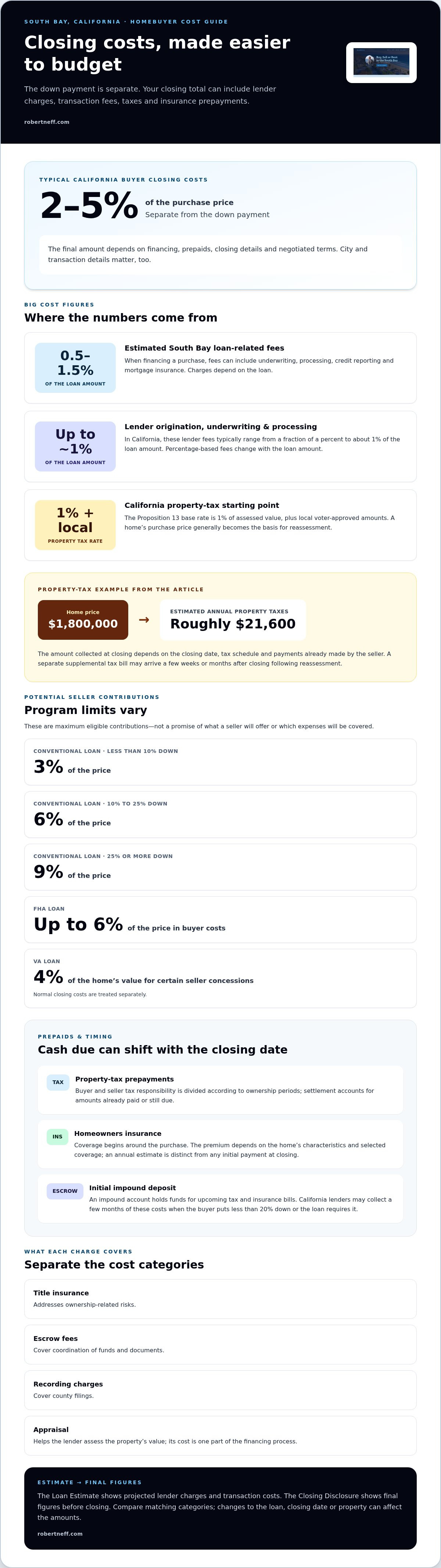
The down payment isn’t the only major cash figure to plan for. California home buyers typically pay closing costs of about 2% to 5% of the purchase price, separate from the down payment. Estimating South Bay CA home buyer closing costs means accounting for transaction charges as well as prepaids such as property taxes and homeowners insurance.
South Bay CA home buyer closing costs include one-time transaction charges and funds collected for expenses due after closing. This guide explains common items, from title and escrow fees to recording charges and appraisal costs, and how your loan, purchase price, and closing details affect your budget.
Key Takeaways
- Separate prepaid taxes and insurance from lender, title, escrow, and recording charges to understand what makes up your closing total.
- Closing dates can affect prepaid amounts because taxes and insurance are collected to cover upcoming bills and escrow reserves.
- Title insurance, escrow, and recording fees serve different purposes, from documenting the transfer to protecting ownership interests.
- An appraisal helps the lender assess the property’s value, and its cost is one part of the financing process.
- Loan type and seller contributions can influence which costs you pay and how much cash you need at closing.
How much are closing costs?
California buyers typically pay closing costs of about 2% to 5% of the purchase price, separate from the down payment. For South Bay CA home buyer closing costs, the final total depends on financing, prepaids, and negotiated terms.
Hermosa Beach and Redondo Beach examples show why city and transaction details matter. Manhattan Beach buyers could expect costs similar to Hermosa Beach at that price point, while Palos Verdes, Torrance, and El Segundo transactions reflect local market values.
Loan Origination Fees
A loan origination fee is a lender charge for processing and arranging a mortgage.
Underwriting and processing may appear as separate fees. In California, lender origination, underwriting, and processing fees typically range from a fraction of a percent to about 1% of the loan amount. For buyers estimating South Bay CA home buyer closing costs, comparing the itemized charges helps show what the lender is charging beyond origination.
A percentage-based fee changes with the loan amount. Review each charge alongside your planned down payment and other mortgage costs.
Comparing and Negotiating Loan Costs
The Loan Estimate shows projected lender charges and transaction costs; the Closing Disclosure shows the final figures before closing. Compare matching categories, including origination, underwriting, processing, appraisal, and discount points.
Ask your lender to explain differences between the estimate and final figures, and whether a fee can be adjusted. Seller credits may also be negotiated in the offer, subject to loan-program limits and the purchase agreement.
Use the Loan Estimate to plan your cash needs, then compare it with the Closing Disclosure. Changes to the loan, closing date, or property can affect the amounts listed.
Seller Contribution Limits
Seller contributions can offset eligible buyer costs, but the limit depends on the loan program and down payment. For conventional loans, the caps are 3% of the price with less than 10% down, 6% with 10% to 25% down, and 9% with 25% or more down.
The U.S. Department of Housing and Urban Development states that FHA loans allow sellers to cover up to 6% of the price in buyer costs. VA loans cap certain seller concessions at 4% of the home’s value, while normal closing costs are treated separately.
These limits determine the maximum eligible seller contribution, not what the seller will offer or which expenses that contribution will cover.
Mortgage and Loan-Related Costs
Other mortgage charges may include underwriting, processing, credit reporting, and mortgage insurance. South Bay loan-related fees are estimated at 0.5% to 1.5% when financing a purchase, with charges depending on the loan.
Buyers who need private mortgage insurance may pay the first month’s premium at closing. FHA loans require an upfront mortgage insurance premium, while VA loans may include a funding fee.
Separate lender charges from third-party costs and prepaids when reviewing an estimate. This itemized view helps explain why loan offers can result in different cash-to-close totals.
Prepaid property taxes and homeowners insurance
Prepaids are funds collected at closing for property taxes and insurance due after purchase. Their timing affects how much cash you need to complete a South Bay transaction. The amount depends on the closing date, upcoming bills, and whether the lender collects reserves through an impound account.
Property Tax Prepayments
Property-tax prepayments cover taxes attributable to the period after closing. Buyers and sellers divide tax responsibility according to their ownership periods, and the settlement accounts for amounts already paid or still due.
California’s base property tax rate under Proposition 13 is 1% of assessed value, plus local voter-approved amounts, according to the California State Board of Equalization. A home’s purchase price generally becomes the basis for reassessment, so the seller’s existing tax bill may not reflect the buyer’s future bill.
For a $1,800,000 South Bay home, an example estimates annual property taxes at roughly $21,600. The amount collected at closing depends on the closing date, tax schedule, and any payments already made by the seller. A separate supplemental property-tax bill may arrive a few weeks or months after closing following reassessment to the purchase price. Plan for that later bill as well as the closing adjustment.
Insurance Prepayments
A prepaid homeowners insurance premium funds coverage beginning around the purchase. Insurance protects the home, and the lender may require coverage as part of the mortgage transaction.
The home’s characteristics and the coverage you select affect the premium. An annual estimate is distinct from any initial payment collected at closing, which depends on the policy’s billing arrangement and transaction timing.
Keep insurance charges separate from property-tax deposits when reviewing closing figures. They cover different obligations, even when both are collected in the same settlement or impound account.
Tax Prepayments and Impound Accounts
An impound account holds funds for upcoming property-tax and insurance bills, which the lender pays when due. Its initial deposit can increase the cash due at closing beyond a tax proration or insurance payment.
California lenders may collect a few months of property taxes and homeowners insurance at closing when the buyer puts less than 20% down or the loan requires it. The deposit depends on the closing date and upcoming bills.
Separate the recurring mortgage payment from the initial impound deposit when reviewing costs. Sellers preparing for a transaction can use residential listing and marketing guidance to account for property-tax prorations in sale planning.
Title insurance, escrow, and recording fees
Title insurance, escrow fees, and recording charges cover different parts of a home purchase. Title insurance addresses ownership-related risks, escrow coordinates funds and documents, and recording fees cover county filings. Amounts depend on the purchase price, loan, and transaction details. Review each category separately to see what each charge pays for.
Title insurance can help address risks related to property ownership. The owner’s policy protects the buyer’s ownership interest, while the lender’s policy protects the lender’s interest in the property. These are example amounts, not universal rates.
Escrow is the transaction process for handling documents and funds until the sale is ready to close. The escrow holder coordinates steps such as receiving funds and distributing them according to the closing instructions.
Title insurance and escrow or closing fees together are estimated at 0.25% to 0.75% of the purchase price in the Bay Area. The comparison shows why a purchase-price percentage and an individual transaction estimate may not match exactly. The amount depends on the transaction’s services and allocation.
Recording fees cover the county filing of documents that establish or update property records. California Legislative Information states that the California SB 2 recording fee is $75 per document, capped at $225 per transaction. Documents recorded for a California home sale that pays documentary transfer tax are generally exempt from the state’s $75 recording fee.
Transfer taxes are separate from escrow charges and recording fees, and their amount depends on location. Some California cities add a local documentary transfer tax on top of the county tax. This variation can change the settlement statement, so review the property’s location alongside the itemized charges.
Appraisal costs
An appraisal is an independent estimate of a property’s value, commonly used by a mortgage lender during a purchase. This charge is separate from inspections, title insurance, and escrow fees.
The lender uses the appraisal to assess whether the property supports the proposed mortgage amount. An appraiser considers the home’s features and compares it with relevant property sales. The report helps the lender evaluate the loan’s collateral. It is not the same as a home inspection, which examines physical condition rather than estimating market value.
Appraisal charges vary with the property and assignment. A standard South Bay residential appraisal may differ in cost from a broader or more complex valuation assignment. Property type, size, location, and comparable sales can influence the work required. The report’s purpose is to provide the lender with a documented value opinion for the property being financed.
These figures are useful for budgeting, but the lender’s Loan Estimate and later Closing Disclosure show the charge for your specific transaction. Compare the appraisal line item with other third-party charges rather than grouping it with origination fees.
An appraisal can matter beyond its fee. If the appraised value is lower than the agreed purchase price, the lender may calculate the mortgage using the appraisal rather than the contract price. That difference can affect your financing and the cash needed to complete the purchase. You and the seller may then discuss the price or other contract terms, subject to your agreement.
Keep appraisal costs separate from a credit report charge. Each serves a different purpose in the lender’s review. Itemized estimates help you identify whether a fee relates to valuation, credit information, or another loan service.
When reviewing the appraisal entry, note its amount, who collects it, and whether it appears among lender or third-party charges. Compare it with the final Closing Disclosure before signing. If the appraisal affects the loan amount, revisit your cash-to-close calculation alongside the down payment and other transaction costs. This puts the valuation charge in context rather than treating it as the only financing expense.
Typical California buyer closing-cost range
California buyer costs vary with purchase price, financing, and whether estimates include prepaids and escrow deposits. In Santa Clara County, first-time buyers may reduce eligible costs through seller contributions. FHA loans allow sellers to cover up to 6% of the price in buyer costs, according to the U.S. Department of Housing and Urban Development.
A useful comparison separates nonrecurring charges from upfront reserves. The range is a broad estimate, not a fixed amount owed by every buyer. Your mortgage structure and the property’s transaction details affect the final calculation.
That distinction matters: when comparing estimates, check whether property-tax and insurance deposits are included in the total or listed separately as cash-to-close items.
The market range of $9,800 to $16,000, with a median of about $11,000, offers another point of reference. It reflects an aggregate of market offers, not a personalized estimate for a particular purchase. Compare it with your own itemized documents, since loan charges, title work, recording, appraisal, and prepaid items can vary across transactions.
To make estimates useful, compare the same categories and assumptions. Check the purchase price, loan amount, expected closing date, and whether each estimate includes prepaid taxes and insurance. Then distinguish one-time charges from ongoing mortgage payments. This helps prevent a lower estimate from seeming more favorable simply because it leaves out costs shown elsewhere.
Closing-cost assistance can affect the amount you need at signing, but the form of assistance matters. Seller contributions reduce eligible buyer costs within applicable loan-program limits. They do not automatically cover every expense, and the purchase agreement must account for the contribution. Include any agreed credit in your cash-to-close calculation, without subtracting it twice from separate line items.
For a clearer purchase plan, align your target price, mortgage loan, and expected transaction costs before making an offer. Explore buyer search and negotiation services to discuss offer terms and how eligible seller contributions fit your buying strategy.
Robert Neff, Ph.D., Realtor®: Buyer Search & Negotiation Services
Robert Neff, Ph.D., Realtor® provides buyer search and negotiation support to help South Bay buyers assess homes, shape offers, and consider transaction terms. This can be useful when you’re comparing properties and weighing how closing costs fit your purchase plan.
For first-time buyers and people relocating to the area, Robert Neff, Ph.D., Realtor® provides step-by-step guidance through the home-buying process. Discussing your priorities and budget early can help you approach property searches and offer decisions with a clearer plan in Redondo Beach, Hermosa Beach, Manhattan Beach, El Segundo, Torrance, or Palos Verdes.
If you’re preparing to buy in the South Bay, contact Robert Neff, Ph.D., Realtor® to discuss your search.
Plan Your Next Move With Confidence
Understanding South Bay CA home buyer closing costs gives you a clearer starting point. Next, consider how those costs fit your priorities, financing, and offer strategy. Bring these pieces together before committing to a purchase so you can assess the full transaction, not just the price.
Robert Neff, Ph.D., Realtor® provides buyer search and negotiation support, as well as step-by-step guidance for first-time and relocating buyers. For homeowners preparing to sell before buying, he also offers home staging, pricing, and marketing. The right guidance depends on where you are in the process and what you need to decide next.
Contact Robert Neff, Ph.D., Realtor® to discuss your South Bay real estate plans. A considered plan can help you move forward with greater clarity and confidence.
Frequently Asked Questions
What is the documentary transfer tax in California?
California documentary transfer tax is a charge tied to transferring property, and local rates can affect the amount. A California county example uses $1.10 per $1,000 of property value, while some cities impose an additional local tax. For a South Bay purchase, the property’s location matters: identify the county and city charges separately on the settlement statement rather than treating transfer tax as one statewide total.
What is typically the most expensive closing cost?
No single cost is largest in every purchase; the biggest item depends on the loan, price, and closing date. For a financed purchase, loan charges or upfront tax and insurance reserves may take the largest share. Compare the amounts on your Loan Estimate and Closing Disclosure, then distinguish one-time costs from funds deposited for later bills. This makes the major cash requirements easier to identify.
What closing costs do home buyers pay in South Bay, California?
South Bay buyers may pay lender charges, appraisal costs, title and escrow fees, recording charges, and prepaid property taxes or insurance. The mix depends on whether the purchase uses a mortgage and which services the transaction requires. To interpret an estimate, group entries into lender charges, property and title services, government charges, and prepaids. This can also help you spot an item listed under an unfamiliar label.
How much are typical buyer closing costs in South Bay CA as a percentage of the purchase price?
California buyers typically pay about 2% to 5% of the purchase price in closing costs, separate from the down payment. Treat that percentage as a planning range, not a final quote. For example, compare the estimated costs against the agreed price, then account separately for prepaids and escrow deposits if they aren’t included. Your cash needed at signing can therefore differ from the percentage estimate alone.
What are current South Bay CA title, escrow, and recording fees for buyers?
California Legislative Information states that the California SB 2 recording fee is $75 per document, capped at $225 per transaction. Recording charges and transfer taxes are separate line items, so review each entry individually.
Who pays for title insurance, escrow fees, and transfer taxes in South Bay home sales?
The purchase agreement and closing documents determine how costs are allocated between buyer and seller. Allocation varies by transaction, so don’t assume that the party paying one title policy also pays every escrow or transfer-tax charge. Review the signed agreement alongside the settlement statement. If the deal includes a seller credit, confirm which eligible costs it offsets and how it appears in the final accounting.
What California property taxes and prepaid costs are due at closing for South Bay home buyers?
Closing funds may include property-tax prorations, an initial impound deposit, and prepaid homeowners insurance. California’s base property tax rate under Proposition 13 is 1% of assessed value, plus local voter-approved amounts, according to the California State Board of Equalization. A purchase-price reassessment can also lead to a supplemental tax bill weeks or months after closing, so plan for that later obligation separately.
What lender fees, appraisal costs, and loan-related closing costs should South Bay buyers expect?
Mortgage-related charges can include origination, underwriting, processing, credit reporting, and appraisal fees. Check whether discount points or mortgage insurance also appear, since they can change the loan’s upfront cost.


