
Broad housing forecasts consistently collapse the moment they reach the Pacific coastline. If you feel caught between national commentary on mortgage rates and the reality of competitive local open houses, you aren't alone. Macro-level data simply cannot capture the nuanced South Bay real estate market trends shaping our individual neighborhoods. A subtle inventory shift in Torrance or El Segundo rarely mirrors the supply dynamics of Manhattan Beach or the Palos Verdes Peninsula.
Relying on broad brushstrokes creates unnecessary friction, leaving buyers and sellers vulnerable to mispricing or misreading their negotiating leverage. This guide delivers a data-backed, micro-market perspective on South Bay property values, inventory patterns, and strategic timing for 2026. Ahead, we break down localized supply-and-demand mechanics, examine whether the coming year favors buying, holding, or listing, and provide an objective framework to help you make well-informed decisions with quiet confidence.
Key Takeaways
- Understand how localized South Bay real estate market trends diverge from broader Southern California patterns, insulated by strict coastal inventory limits and premier municipal anchors.
- Explore micro-market nuances across Manhattan Beach, Hermosa Beach, Redondo Beach, and the Palos Verdes Peninsula to evaluate distinct supply dynamics.
- Examine how prominent aerospace and tech employment hubs near El Segundo reinforce neighborhood equity and ongoing housing demand.
- Deconstruct common timing misconceptions around mortgage rates, gaining tactical leverage whether you plan to buy, list, or hold in 2026.
- Adopt a disciplined evaluation framework that pairs objective data with street-level insight to remove guesswork from high-stakes property decisions.
South Bay Real Estate Market Landscape: 2026 Macro Overview
Southern California housing headlines often present a uniform narrative of fluctuating buyer demand, yet coastal enclaves follow an entirely different rhythm. The South Bay operates as a self-sustaining, supply-constrained micro-climate. While inland counties periodically absorb sharp inventory swings, this coastline remains shielded by high barriers to entry and steady institutional equity. Understanding South Bay region overview dynamics requires stepping away from generic Los Angeles County averages and evaluating the distinct economic drivers that anchor local property values.
High-earning employment corridors reinforce this stability. Silicon Beach expansion, commercial aviation, and defense technology hubs surrounding El Segundo provide an enduring base of well-capitalized buyers. These professionals seek proximity to top-ranked school districts and immediate beach access, creating sustained demand across shifting economic cycles.
Defining the 2026 South Bay Geographic Footprint
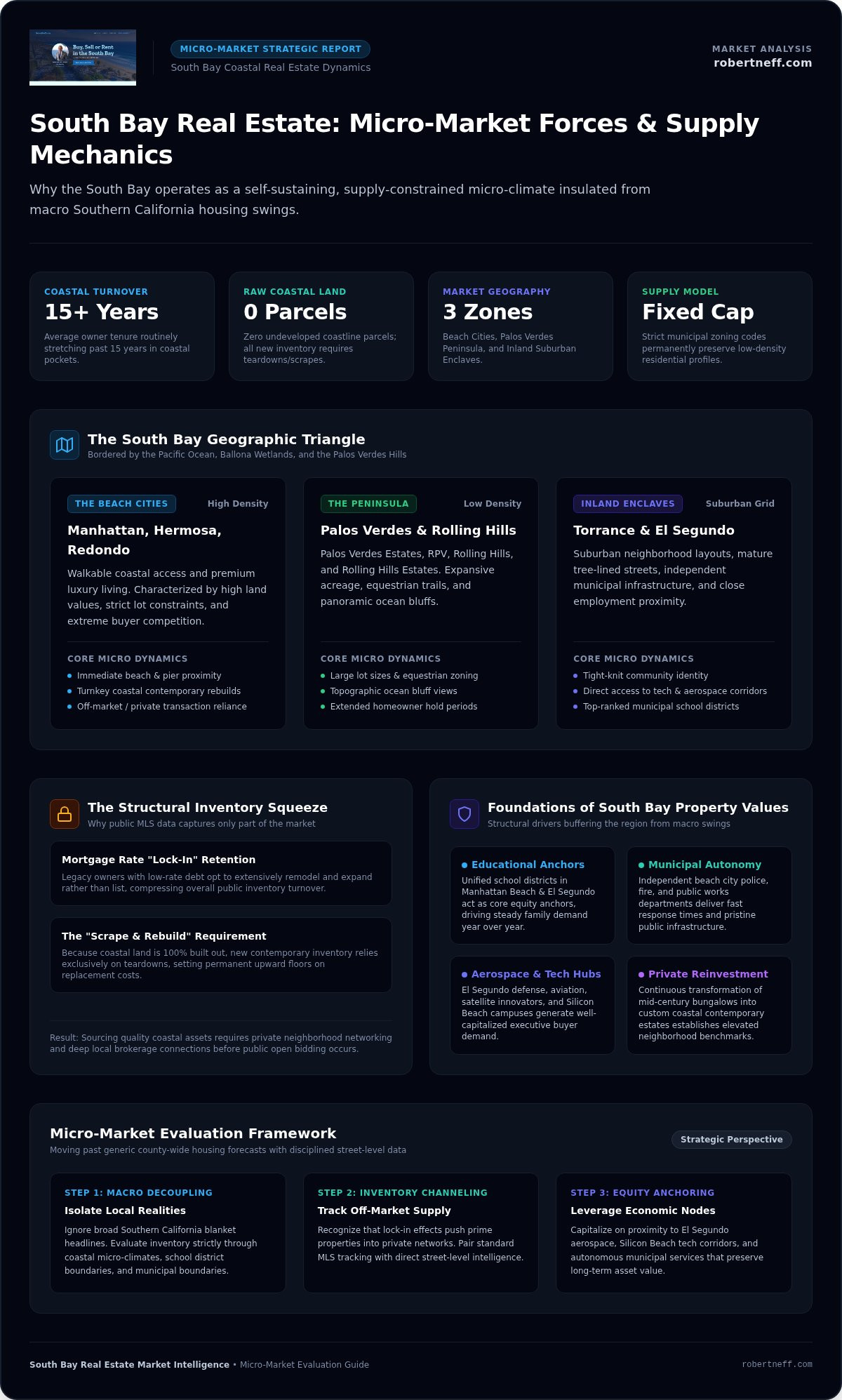
The South Bay footprint forms a distinct geographic triangle bordered by the Pacific Ocean, the Ballona Wetlands, and the Palos Verdes hills. This market divides cleanly into three primary environments:
- The Beach Cities: Manhattan Beach, Hermosa Beach, and Redondo Beach deliver walkable coastal access and high-density luxury living.
- The Palos Verdes Peninsula: Expansive acreage, equestrian trails, and panoramic ocean bluffs across Palos Verdes Estates, Rancho Palos Verdes, Rolling Hills, and Rolling Hills Estates.
- Inland Enclaves: Torrance and El Segundo offer suburban neighborhood layouts, mature tree-lined streets, and tight-knit community identities.
Strict municipal zoning codes preserve these low-density residential profiles. With no undeveloped parcels remaining along the coast, new inventory requires scraping existing structures, permanently capping overall supply.
The Structural Inventory Squeeze
Inventory compression remains the single most influential variable governing modern South Bay real estate market trends. The mortgage rate environment keeps existing owners firmly rooted in place. Many legacy residents who secured historical low-rate debt have chosen to remodel rather than list, pushing turnover rates down across established pockets.
Tenure lengths routinely stretch past fifteen years in premium coastal neighborhoods. Because active public inventory remains scarce, traditional MLS alerts capture only part of the opportunity set. Serious buyers must rely on disciplined off-market sourcing, private neighborhood networking, and deep local brokerage connections to locate quality assets before they encounter open bidding wars.
Underlying Forces Driving South Bay Property Values
Home values in coastal Southern California rest on tangible structural foundations rather than fleeting market speculation. While the broader market absorbs shifts outlined in the 2026 California Housing Market Forecast, South Bay real estate market trends reflect strong local fundamentals. Independent municipal structures, elite public school systems, and high-density employment corridors create an enduring floor for regional asset valuations.
Ongoing reinvestment continuously elevates neighborhood baselines. Homeowners regularly execute architectural modernizations, replacing dated mid-century bungalows with turnkey coastal contemporary residences. This extensive private capital expenditure sets elevated pricing benchmarks across individual blocks, insulating neighboring homes from broader economic turbulence.
Educational Anchors and Municipal Autonomy
Unified school districts in Manhattan Beach and El Segundo act as core equity anchors for local real estate. Academic performance consistently draws relocating families who prioritize public educational excellence over private school tuition. This dynamic sustains robust buyer competition across every school year.
Municipal independence further strengthens local stability. Beach cities maintain their own dedicated police, fire, and public works departments rather than relying on broader county infrastructure. Fast emergency response times, meticulously maintained parks, and pristine public beaches protect property desirability across generations.
Proximity to Regional Employment Centers
High-income career opportunities surround the South Bay basin. El Segundo has transformed into a dominant technology and aerospace powerhouse, hosting major defense contractors, satellite innovators, and creative tech campuses. This cluster generates steady executive-level housing demand just minutes from the shoreline.
Commuting preferences heavily influence where professionals choose to settle. Leaders want short drives to the office paired with immediate access to surf breaks, running paths, and vibrant downtown dining districts. A strategic approach to buyer search and negotiation services helps prospective homeowners identify which quiet neighborhood pockets offer optimal proximity to these economic engines.
Micro-Market Breakdown: Beach Cities, Peninsula, and Inland Enclaves
General market summaries blur the distinct boundaries that define South Bay property values. In practice, a half-mile shift inland transforms lot dimensions, architectural freedom, and price elasticity. Official California demographic data highlights ongoing population shifts toward mature coastal employment hubs, but local topography and parcel scale ultimately govern daily living. Prospective buyers navigating coastal homes for sale South Bay CA must weigh specific lifestyle preferences against hyper-local inventory constraints.
Evaluating South Bay real estate market trends demands a segmented approach across three core micro-environments.
The Beach Cities: Walkability and High Density
Manhattan Beach, Hermosa Beach, and Redondo Beach represent high-density living where lot utility dictates market behavior. Manhattan Beach separates into distinct pockets: the Sand Section offers direct strand proximity on narrow parcels, the Tree Section features larger residential yards, and the Hill Section provides panoramic coastal views. Hermosa Beach delivers intense pedestrian connectivity near Pier Avenue, attracting buyers who value immediate surf access.
Redondo Beach presents a split dynamic. North Redondo features higher-density townhomes and flexible floor plans, while South Redondo offers classic single-family parcels close to the Riviera Village.
Palos Verdes Peninsula: Space, Topography, and Views
Ascending the Palos Verdes Peninsula introduces expansive acreage, strict equestrian easements, and protected view corridors. Palos Verdes Estates features winding roads designed around Mediterranean architecture, while Rancho Palos Verdes offers sprawling blufftop layouts. Rolling Hills maintains a private, guard-gated perimeter with multi-acre zoning.
Acquisitions here require technical diligence. Buyers must carefully navigate geological stability surveys, coastal commission oversight, and neighborhood art jury approvals that regulate exterior modifications.
Inland Hubs: Community Cohesion and Strategic Value
Inland neighborhoods provide compelling alternatives for those prioritizing lot width and community roots. El Segundo balances a self-contained downtown corridor with immense corporate strength, creating exceptional long-term stability as outlined in this guide on the cost of living El Segundo CA.
Torrance offers diverse housing styles, spanning historic pre-war properties in Old Town to coastal-influenced homes in the Hollywood Riviera. These inland enclaves deliver an ideal bridge between coastal recreation and daily logistical ease.
Strategic Guidance: What 2026 Trends Mean for Buyers and Sellers
Timing the market around future mortgage rate movements often creates a false sense of security. When rates tick downward, sidelined capital aggressively re-enters the market, driving up contract terms and eliminating buyer leverage. Prevailing South Bay real estate market trends demonstrate that waiting for broader macroeconomic relief typically increases competition for prime coastal inventory rather than improving affordability.
Clarity replaces hesitation when you replace speculative forecasts with disciplined transaction strategies.
Buyer Strategy in an Inventory-Constrained Market
Acquiring a coastal home requires shifting from passive browsing to active sourcing. Because premier inventory trades quietly, buyers must secure pre-market access through seasoned broker relationships rather than relying on public portals. Contract structure matters just as much as purchase price.
Strengthening an offer involves several tactical levers:
- Shortening contingency timelines through upfront property investigation and loan pre-underwriting.
- Structuring appraisal gap coverage to provide sellers with closing certainty.
- Implementing proven El Segundo real estate negotiation tactics to uncover seller motivations beyond contract price.
Focusing on street-level quality, lot orientation, and long-term livability ensures your investment compounds steadily over time.
Seller Positioning and Pricing Discipline
Aspirational pricing presents a severe risk in today's selective market. Even in supply-constrained coastal enclaves, buyers quickly identify and penalize mispriced properties, leading to prolonged days on market and unnecessary price reductions. Modern purchasers prioritize turnkey conditions and clear architectural execution.
Maximizing market response requires meticulous preparation. Sellers must pair strategic valuation models with curated architectural staging, tailored floor plans, and high-definition visual storytelling. Understanding how to sell coastal home for top dollar involves treating preparation as an investment rather than an expense. Aligning pre-sale enhancements with neighborhood-specific expectations ensures your property commands immediate attention during its initial market debut.
Whether you plan to acquire your next home or prepare a current asset for market, an objective consultation provides the clarity needed to proceed. Connect with Robert Neff for dedicated buyer search and residential listing services built on research-backed advisory.
Navigating South Bay Real Estate with Methodical Precision
High-stakes property transactions demand more than instinct. While public headlines focus on macro shifts, micro-market realities require rigorous evaluation. Interpreting South Bay real estate market trends effectively means pairing empirical data modeling with deep, street-level immersion. Subtle factors like morning coastal fog patterns, school traffic flow on specific avenues, and unrecorded view easements significantly alter a property's true value.
A research-driven advisory model strips away the emotional friction and high-pressure sales tactics common across the brokerage industry. Grounded analysis enables clients to evaluate timing, valuation, and capital allocation with clarity and poise.
The Analytical Advantage: Research Meets Local Groundwork
Applying doctoral research discipline transforms raw market metrics into actionable intelligence. Instead of relying solely on automated valuations or backward-looking reports, this approach isolates street-specific variables across Redondo Beach, Manhattan Beach, El Segundo, and the Palos Verdes Peninsula. Every parcel has a unique profile:
- Evaluating how micro-pocket topography and building envelope restrictions influence view corridors.
- Assessing recent permit history and local infrastructure plans along adjacent corridors.
- Leveraging the collaborative network of Kaminsky Real Estate Group and eXp Realty to access private listing inventories before public dissemination.
Blending statistical precision with daily on-the-ground observation ensures you negotiate from an informed position.
Your Next Steps: Developing a Tailored Real Estate Roadmap
Successful real estate execution starts with a structured plan tailored to your timeline. Rather than rushing into open transactions, a confidential market consultation establishes clear parameters based on objective equity analysis and thorough due diligence.
The advisory process follows three sequential stages:
- Asset and Equity Assessment: Review your current property's localized position against comparable micro-pocket sales to establish real baseline equity.
- Strategic Profile Development: Build a custom acquisition or disposition roadmap, incorporating precise zoning parameters, architectural preferences, and private sourcing channels.
- Disciplined Execution: Navigate offer terms, inspection hurdles, and contract contingencies with steady guidance focused on long-term capital preservation.
Whether you need buyer search and negotiation services or comprehensive residential listing and marketing, a structured framework protects your interests at every step.
Chart Your 2026 South Bay Real Estate Strategy
Navigating coastal property decisions requires looking past broad regional narratives. Moving through 2026, understanding South Bay real estate market trends means recognizing that tight inventory, autonomous municipal services, and enduring aerospace and tech corridors continue to insulate home values across our communities. Whether you're considering the walkable vibrancy of the Beach Cities, the panoramic acreage of the Palos Verdes Peninsula, or the neighborhood stability of El Segundo and Torrance, micro-pocket dynamics should govern your timing.
Sound real estate decisions rely on pairing empirical analysis with street-level perspective. As a licensed Realtor® (DRE #02442812) affiliated with the Kaminsky Real Estate Group at eXp Realty, Robert Neff, Ph.D., brings scholarly rigor and objective advisory to every step of your journey. You don't have to navigate competitive coastal transactions with guesswork. Schedule an analytical South Bay market consultation to evaluate your neighborhood equity position and plan your next move with quiet confidence.
Frequently Asked Questions
How do mortgage interest rate changes affect South Bay home values in 2026?
Mortgage rate adjustments influence transaction velocity far more than baseline asset pricing in coastal California. While higher rates expand negotiation room on properties needing cosmetic updates, turnkey homes in prime enclaves retain strong pricing power due to chronic inventory shortages. Modern South Bay real estate market trends show that rate declines typically trigger an immediate influx of competitive capital, quickly offsetting any perceived financing savings through intensified bidding.
Why do South Bay coastal properties maintain high value during broader market corrections?
Coastal properties remain insulated because physical geography strictly prevents new residential construction. Bordered by the ocean and mature neighborhoods, communities like Manhattan Beach and Hermosa Beach cannot expand outward. Combined with robust local balance sheets, top-tier municipal services, and persistent buyer demand from thriving aerospace and technology corridors, this absolute supply constraint creates a resilient pricing floor that withstands regional market downturns.
What is the key difference between buying in the Beach Cities versus the Palos Verdes Peninsula?
Lifestyle density and lot topography form the primary distinction between these regions. The Beach Cities emphasize walkable living, immediate oceanfront access, and compact parcels where square footage is optimized vertically. The Palos Verdes Peninsula prioritizes expansive acreage, quiet equestrian trails, and sweeping blufftop views. Peninsula properties require specialized due diligence regarding hillside stability, coastal commission rules, and architectural guidelines governed by local homes associations.
How far in advance should I prepare my South Bay home before listing it for sale?
Homeowners should ideally begin pre-listing preparation three to six months before coming to market. This runway allows sufficient time to complete strategic cosmetic updates, resolve deferred maintenance, and conduct preliminary inspections without pressure. Meticulous planning enables precision architectural staging and curated visual marketing, ensuring the property commands optimal positioning against competing inventory from its first weekend on the market.
Are off-market pocket listings common in Manhattan Beach and Hermosa Beach?
Off-market transactions represent a significant share of premium coastal sales. Many high-profile homeowners prefer discretion, opting to market their properties quietly through private brokerage networks rather than public listing portals. Successfully discovering these private opportunities requires working with an advisor who maintains deep, active ties to local broker communities and neighborhood networks across the Beach Cities.
How do local school districts impact long-term property appreciation in the South Bay?
Top-rated public school systems serve as enduring equity anchors across South Bay communities. Districts in Manhattan Beach and El Segundo consistently attract long-term residents seeking educational excellence without private school tuition. Understanding South Bay real estate market trends reveals that homes located within highly ranked, autonomous school districts maintain higher baseline demand, shorter marketing times, and consistent multi-generational appreciation through every economic cycle.
What should relocating professionals know before choosing between El Segundo and Torrance?
The choice between El Segundo and Torrance centers on neighborhood scale and daily commute patterns. El Segundo offers a compact, small-town coastal feel with immediate proximity to major aerospace and tech headquarters near the airport corridor. Torrance provides significantly diverse housing stock, larger lot dimensions, and distinct pockets like the Hollywood Riviera, offering easy access to coastal beaches alongside established retail hubs.


