

Waiting for the traditional spring rush is often the most expensive mistake a coastal buyer can make. If you are searching for the best time to buy a home in South Bay, the common advice to follow the crowd into aggressive April bidding wars simply doesn't hold up. You've likely felt the frustration of watching inventory vanish in premier school districts while mortgage rates fluctuate, leaving you wondering whether to jump in immediately or hold out for greater negotiating power.
Securing genuine leverage requires moving past broad regional headlines to examine local inventory rhythms across Los Angeles County's coastal corridor. In this guide, you'll discover how South Bay seasonal cycles, inventory swings, and local micro-markets dictate the optimal time to buy. We'll identify the calendar windows offering maximum buyer leverage, compare distinct micro-markets between the beach cities and inland neighborhoods, and establish an actionable six-month purchasing timeline backed by local real estate data.
Key Takeaways
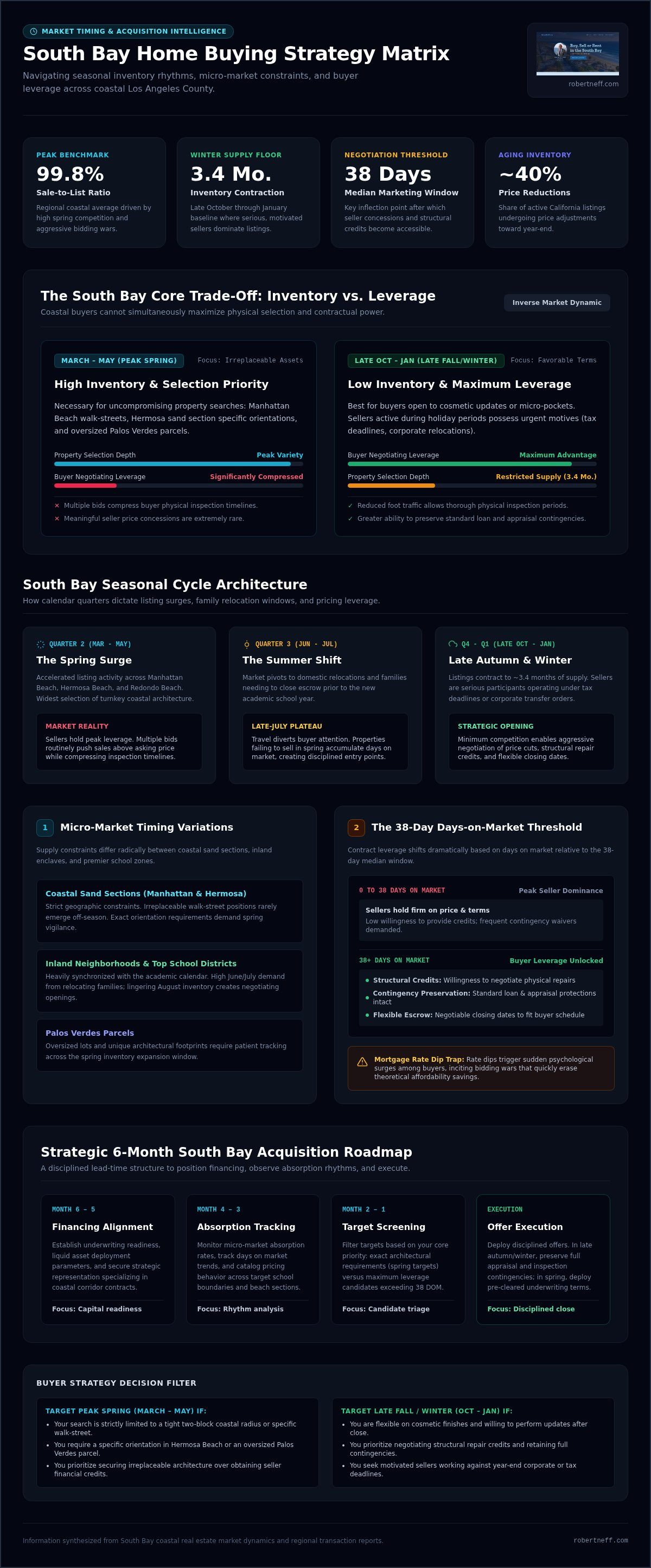
- Pinpointing the best time to buy a home in South Bay requires balancing broad property selection against intense competition, as peak spring listing surges rarely produce meaningful seller concessions.
- Late autumn and mid-winter present quieter transaction windows where motivated sellers and lingering inventory create distinct advantages for patient buyers.
- Coastal sand sections operate under vastly different supply constraints than inland neighborhoods and top-tier school districts, making micro-market awareness essential.
- Mortgage rate fluctuations directly shift buyer psychology, meaning rate dips frequently spark sudden bidding wars that erode expected affordability gains.
- A structured six-month preparation roadmap gives you the necessary lead time to track inventory absorption, align financing, and secure strategic representation.
Seasonal Dynamics of the South Bay Real Estate Market
National housing models typically assume a deep winter freeze followed by an explosive spring thaw. In coastal Southern California, temperate year-round weather softens those dramatic seasonal swings. While Northern California buyers track how Santa Clara County's economic landscape shapes Silicon Valley tech hubs, coastal Los Angeles County moves to an entirely different cadence. Reviewing historical South Bay real estate market trends reveals that local shifts stem from academic calendars and buyer psychology rather than climate. Pinpointing the best time to buy a home in South Bay requires dissecting how inventory and buyer urgency fluctuate across each calendar quarter.
Spring Surge: Peak Inventory and Maximum Competition
Listing activity accelerates rapidly between March and May across coastal enclaves like Manhattan Beach, Hermosa Beach, and Redondo Beach. Spring delivers the widest selection of premier turnkey properties and distinctive coastal architecture. However, expanded inventory invites aggressive buyer competition. Multiple bids routinely compress inspection timelines and push sale prices above initial asking figures. Sellers hold peak leverage during these months, making meaningful price concessions rare.
Summer Shift: Transition Windows for Relocating Families
Activity pivots during June and July toward domestic relocations and families determined to close escrow before the new school year starts. The market temporarily plateaus in mid-summer as travel schedules divert buyer attention. Properties that fail to sell during the initial spring rush begin to accumulate days on market by late July. For analytical buyers, late summer creates an opening to submit disciplined offers on lingering inventory without facing intense bidding pressure.
Fall and Winter: Strategic Opportunities for Disciplined Buyers
Available listings contract significantly from late October through January, with regional inventory often settling near 3.4 months of supply. Even with fewer options, discerning purchasers frequently find that late autumn through mid-winter represents the best time to buy a home in South Bay. Sellers active during the holiday season are rarely testing the market; they are motivated by tax planning, corporate relocations, or personal deadlines. Reduced foot traffic gives you room to conduct thorough physical inspections and negotiate meaningful price reductions.
Inventory vs. Leverage: When Do Coastal Buyers Gain an Advantage?
Every home purchase forces a balance between property selection and transaction leverage. You cannot maximize both simultaneously. In premier coastal markets, high listing volume attracts intense buyer traffic, driving the regional sale-to-list price ratio to 99.8%. While broader California housing affordability trends show how macro constraints shape statewide purchasing power, local dynamics dictate terms on the ground. Deciding the best time to buy a home in South Bay hinges on whether your priority is securing an irreplaceable architectural footprint or negotiating protective terms.
High-Inventory Months: Prioritizing Exact Neighborhood and Lot Criteria
Buyers who require specific attributes must target the peak spring window between March and May. Uncompromising requirements like a Manhattan Beach walk-street location, a specific orientation in Hermosa's sand section, or an oversized Palos Verdes parcel rarely appear off-cycle. In these scenarios, paying near list price is often a rational trade to secure scarce real estate. You trade contract leverage for access to superior physical assets.
Low-Inventory Months: Prioritizing Favorable Contract Terms and Pricing
Purchasers who can remain flexible on cosmetic finishes or micro-pockets gain substantial negotiating power in late fall and winter. Across California, nearly 40% of active listings have undergone price reductions as listings age toward the end of the year. Sellers with properties lingering past the 38-day median marketing window show greater willingness to negotiate structural credits, preserve standard loan and appraisal contingencies, and accommodate flexible closing dates.
To determine your personal strategy, evaluate these core priorities:
- Location specificity: If your search is restricted to a tight two-block coastal radius or a single school boundary, focus on spring inventory.
- Contract protection: If preserving complete inspection rights and appraisal contingencies is non-negotiable, target the November-to-January period.
- Financial concession goals: If closing below asking price or securing seller concessions matters most, off-peak months offer the best time to buy a home in South Bay.
Partnering with dedicated buyer search and negotiation services ensures your transactional strategy aligns precisely with whether current conditions favor choice or leverage.
Micro-Market Timing: How Neighborhoods Differ Across the South Bay
Broad regional metrics offer useful context, but they can obscure reality on specific streets. The South Bay is not a uniform housing market. Instead, it functions as a collection of distinct submarkets shaped by geography, lot configurations, and institutional drivers like aerospace hiring and public school calendars. Exploring available coastal homes for sale South Bay CA highlights these physical contrasts, ranging from dense sand-section walk streets to terraced hillside parcels. Consequently, the best time to buy a home in South Bay depends heavily on the specific community you target.
The Beach Cities: Manhattan Beach, Hermosa Beach, and Redondo Beach
Each beach enclave moves to its own micro-rhythm:
- Manhattan Beach: Highly constrained by Manhattan Beach Unified School District enrollment deadlines. New listings peak aggressively between March and May, drawing intense competition that makes off-peak windows rare for prime turnkey properties.
- Hermosa Beach: Less dependent on school calendar pressures, Hermosa experiences steady demand driven by lifestyle, walkability, and younger professionals. Activity remains resilient well into summer.
- Redondo Beach: Offering diverse price points, this market shows clear segmentation. South Redondo mirrors coastal beach dynamics, while North Redondo experiences higher turnover, a 43-day median marketing period, and roughly 40% of listings taking price cuts.
Inland and Hillside Havens: El Segundo, Palos Verdes, and Torrance
Moving inland or up the peninsula shifts both buyer demographics and supply patterns. In El Segundo, low turnover and strong corporate presence from local defense and tech campuses create brief, highly competitive spring listing bursts. Families compete fiercely to secure homes before summer ends.
On the Palos Verdes Peninsula, expansive parcels and panoramic ocean views follow a different rhythm. Winter and early spring offer optimal clarity for evaluating view corridors and ocean sightlines, free from summer marine haze. Inland, Torrance maintains reliable listing volume throughout the year. Its diverse neighborhoods, ranging from West Torrance to historic Old Town, provide stable entry points less vulnerable to dramatic seasonal pricing spikes. Understanding these distinctions helps clarify the best time to buy a home in South Bay based on your preferred neighborhood profile.
Financial and Macroeconomic Indicators to Track Before Buying
Timing your acquisition requires tracking macroeconomic shifts alongside neighborhood patterns. Many prospective purchasers delay entering the market while waiting for interest rates to fall. That instinct often backfires. When 30-year fixed conforming rates drop, sidelines clear instantly, igniting aggressive multiple-offer scenarios that inflate sale prices beyond whatever monthly interest savings you hoped to achieve. Evaluating broader economic variables helps you determine whether today's financing climate makes this the best time to buy a home in South Bay for your financial profile.
Mortgage Rates vs. Housing Competition Dynamics
Interest rate fluctuations and buyer leverage have an inverse relationship. Moderate rate environments keep speculative bidders away, enabling disciplined buyers to negotiate effectively. You can always refinance a mortgage when debt markets ease, but your initial purchase price remains fixed forever. Securing a property during a quiet borrowing window locks in long-term equity growth before lower rates re-ignite broad price competition.
Local Financial Factors: Property Taxes, HOA Reserves, and Insurance
Strategic timing also requires preparing for localized financial obligations that arise during escrow and settlement:
- Proposition 13 baseline adjustments: California reassesses property tax value based entirely on your new purchase price, resulting in supplemental tax bills during your first year of ownership.
- HOA reserve solvency: When considering coastal condominiums or townhomes, reviewing reserve studies reveals whether upcoming special assessments for roof or stucco maintenance could strain your liquidity.
- Coastal property insurance underwriting: Securing comprehensive wind, moisture, and fire coverage along the Pacific coastline demands early attention, as carrier restrictions can delay closings if left to the final contingency period.
- Loan structure boundaries: Conventional programs permit down payments as low as 3%, while the Los Angeles County conforming loan limit accommodates higher financing thresholds before requiring jumbo portfolio loans.
Careful financial preparation prevents unexpected hurdles and positions you to move decisively when the right home emerges. To evaluate current market indicators and build a customized financing approach, schedule an initial consultation through our relocation and first-time buyer guidance services to determine your best time to buy a home in South Bay.
Strategic Preparation: Crafting Your South Bay Acquisition Timeline
Capitalizing on the best time to buy a home in South Bay requires methodical execution long before you attend an open house. Rushing into coastal escrow without thorough preparation invites compromise on location or terms. By establishing a structured six-month runway, you insulate yourself from emotional decisions and enter negotiations with measurable strength.
Months 6 to 3: Financial Underwriting and Neighborhood Reconnaissance
Begin by assembling your core advisory team, pairing a dedicated direct lender with an analytical real estate advisor. Complete a comprehensive credit audit, organize liquid assets for down payment and closing reserves, and secure a fully underwritten pre-approval rather than a basic pre-qualification letter.
Simultaneously, conduct street-level research across candidate neighborhoods. Spend time in prospective micro-pockets during morning commutes, weekend afternoons, and school pick-up hours. This groundwork clarifies practical differences between coastal enclaves:
- Observe street parking congestion and foot traffic near beach corridors.
- Track afternoon sun exposure and marine layer clearing patterns across hillside lots.
- Establish rigid criteria dividing non-negotiable structural requirements from cosmetic preferences you can renovate later.
Months 2 to 1: Active Off-Market Scouting and Offer Calibration
As your target purchase window approaches, your focus shifts to actionable deal sourcing. Tap into established brokerage networks to evaluate pocket listings and coming-soon properties before they hit the open market. Scrutinize hyper-local comparable sales, paying close attention to price-per-square-foot variations on individual blocks.
When preparing offers, identify terms that solve specific seller friction points, such as offering a complimentary 30-day rent-back or flexible escrow periods. Implementing proven frameworks for strategic buyer representation allows you to craft compelling, clean purchase agreements that protect your contingencies while standing out against competing buyers.
A successful coastal acquisition is the product of deliberate planning and objective data analysis. Partnering with Robert Neff, Ph.D., Realtor® provides the scholarly rigor and local market guidance needed to navigate high-stakes negotiations calmly, ensuring that you strike decisively when the best time to buy a home in South Bay aligns with your household vision.
Transforming Market Insight into Coastal Leverage
Pinpointing the best time to buy a home in South Bay is ultimately an intentional choice between inventory breadth and negotiating control. While competitive spring weeks supply prime architectural assets, quieter autumn and winter windows provide unmatched opportunities to secure favorable pricing and protective terms. Success in our coastal market requires aligning that seasonal rhythm with your household's personal timeline and target micro-neighborhood.
You don't have to navigate these complex variables alone. Pairing rigorous academic research with street-level coastal insight, Dr. Robert Neff provides calm, data-backed guidance throughout the entire transaction. Backed by eXp Realty and the award-winning Kaminsky Real Estate Group, our practice delivers dedicated representation tailored specifically for first-time, move-up, and relocating buyers. When you're ready to evaluate micro-market data and calibrate your timeline, schedule a strategic buyer consultation with Dr. Robert Neff to make your next coastal move with complete confidence.
Frequently Asked Questions
What is traditionally the cheapest month to purchase a home in the South Bay?
December and January historically offer the lowest median purchase prices across coastal Los Angeles County. During these mid-winter weeks, market activity drops significantly and sellers who keep active listings usually carry authentic urgency. Buyers face minimal competition, allowing room to negotiate seller credits, repair allowances, and price reductions that are unavailable during the spring. This winter window consistently provides the best time to buy a home in South Bay if your primary goal is maximizing transaction discounts.
Does it make sense to wait for mortgage interest rates to drop before buying?
Waiting for rates to decline rarely saves money over the long term. When interest rates drop, sidelined buyers flood the market simultaneously, producing intense bidding wars that quickly inflate home prices. You can always refinance your interest rate when debt markets become more favorable, but your entry purchase price remains permanent. Purchasing during moderate-rate periods allows you to acquire property with less competition and stronger contractual protections.
How do local school district calendars affect home prices in Manhattan Beach and El Segundo?
School calendars create sharp demand spikes between March and June as families scramble to secure residency before August registration deadlines. In high-demand districts like Manhattan Beach Unified and El Segundo Unified, listings command premium pricing during late spring. Once August arrives, buyer pressure eases, often leaving remaining homes open to counteroffers from buyers who aren't bound to strict academic enrollment schedules.
Is buying off-market or pocket listings more advantageous during the winter season?
Winter is particularly advantageous for securing off-market and private pocket listings. Many high-net-worth homeowners in areas like Hermosa Beach or the Palos Verdes Peninsula prefer to avoid public holiday open houses and signage. Accessing these off-market properties through established brokerage networks lets you negotiate privately without facing public bidding wars, giving you exclusive access to quality residences before the broader spring inventory influx arrives.
How far in advance should relocating buyers begin their South Bay home search?
Relocating professionals should begin structured preparation at least four to six months prior to their target move date. This timeline gives you adequate runway to secure a fully underwritten pre-approval, study micro-market nuances between beach cities and inland pockets, and track neighborhood-level price trends. Starting early ensures that when the right home hits the market, you can execute a clean, decisive offer without logistical delays.
Are beachfront and sand-section homes subject to the same seasonal price fluctuations?
Sand-section and beachfront homes experience much less seasonal price fluctuation due to absolute geographic scarcity. Because walk-street parcels and frontline oceanfront properties in Manhattan Beach and Hermosa Beach are severely constrained, sellers rarely drop prices simply because the calendar turns to autumn. For these irreplaceable assets, identifying the best time to buy a home in South Bay is less about seasonal discounts and more about acting when rare architectural inventory surfaces.
What key contingencies should buyers protect when purchasing during competitive spring months?
Even amid competitive spring offer deadlines, buyers should firmly preserve their structural property inspection and title contingencies. While sellers often push to shorten investigation windows from 17 days to 7 or 10 days, completely waiving inspection rights on coastal properties exposes you to undisclosed ocean-air moisture intrusion, foundation settling, or unpermitted work. Adjusting timeline speed rather than waiving your rights keeps your investment properly protected.


