

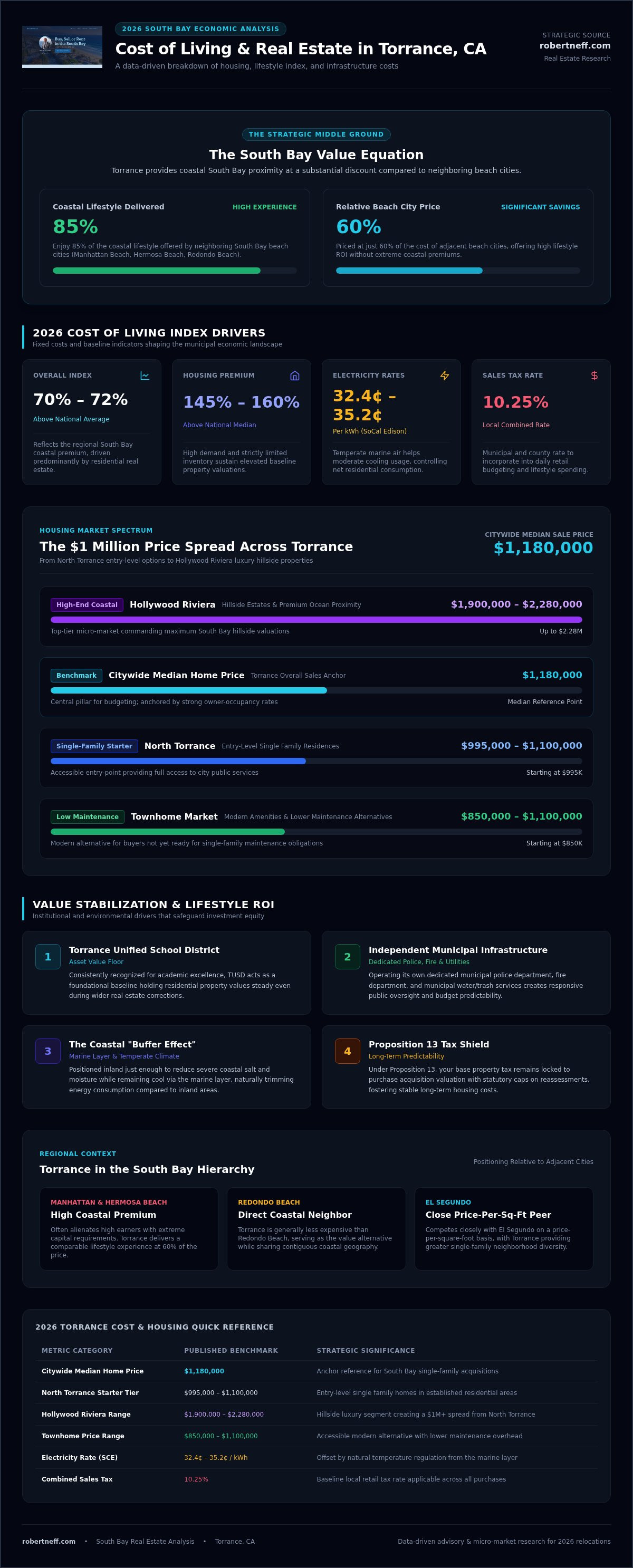
What if you could enjoy 85 percent of the California coastal lifestyle at just 60 percent of the price of neighboring beach cities? Torrance represents the South Bay’s strategic middle ground, yet the cost of living in Torrance CA remains a source of anxiety for many prospective homebuyers. You likely feel the weight of California's reputation for high taxes and expensive real estate, especially when facing a citywide median home sale price of $1,180,000. It is normal to worry about hidden expenses like the 10.25 percent sales tax or the nuances of neighborhood-specific utility rates.
This 2026 analysis provides a data-driven breakdown of housing, lifestyle, and infrastructure costs to help you plan your relocation with professional precision. I will guide you through the $1 million price spread between North Torrance and the Hollywood Riviera while explaining how the Torrance Unified School District maintains local property values. We will examine everything from Southern California Edison rates to the impact of Proposition 13 on your new tax base. This guide ensures you move forward with a clear, predictable budget and total confidence in your investment decision.
Key Takeaways
- Discover why Torrance serves as the strategic middle ground of the South Bay, offering coastal proximity at a significant value compared to Manhattan or Hermosa Beach.
- Navigate the $1 million price spread between North Torrance and the Hollywood Riviera to understand how the cost of living in Torrance CA varies by micro-market.
- Learn to calculate your true property tax obligation under Proposition 13 and prepare for the 10.25 percent local sales tax rate.
- Identify how the local marine layer and municipal utility services create a more predictable monthly budget for water, trash, and electricity.
- Gain the professional precision needed to evaluate townhome markets and single-family residences against the backdrop of 2026 interest rates and loan limits.
Understanding the Torrance Cost of Living Index in 2026
To understand the cost of living in Torrance CA, one must view the index as a strategic roadmap rather than a barrier. In 2026, the city sits roughly 70 percent to 72 percent above the national average. From an academic perspective, this index is heavily weighted by the local real estate market. My "Expert Guide" approach treats these figures as a baseline for calculating the "coastal premium" you pay for safety, top-tier schools, and a temperate climate. It's a structured way to evaluate if the investment aligns with your long-term financial goals.
Torrance remains the ultimate value play in the South Bay. While Manhattan Beach prices often alienate even high-income buyers, Torrance provides a citywide median home sale price of $1,180,000. You gain access to a similar lifestyle for a fraction of the capital investment. This price-to-quality ratio is why many of my clients choose to settle here instead of paying the extreme premiums found just a few miles north. It's about finding the sweet spot where professional ambition meets residential comfort.
The primary drivers of the 2026 index are housing and energy. Housing expenses in Torrance are 145 percent to 160 percent higher than the national median. This reflects the intense demand for South Bay property and limited inventory. Additionally, Southern California Edison electricity rates currently average between 32.4 cents and 35.2 cents per kWh. These fixed costs require precise budgeting before you begin your home search. Understanding these numbers allows you to move forward with a realistic plan.
Torrance vs. The National Average: A Realistic View
Headlines focusing on a high cost of living often mislead high earners. They ignore the "lifestyle ROI" inherent to the South Bay. You are investing in a region with a Mediterranean climate that naturally limits your utility consumption compared to the extreme weather found in other states. The Torrance cost-benefit ratio in 2026 centers on the idea that paying more for a home here yields higher long-term appreciation and a better daily experience than cheaper inland alternatives. It's a calculated trade-off for a superior quality of life.
The South Bay Hierarchy: Where Torrance Fits
Within the South Bay hierarchy, Torrance offers a distinct advantage. It is more affordable than the beach cities but maintains higher standards than the surrounding industrial corridors. The city benefits from a "buffer effect," sitting slightly inland to avoid the highest moisture levels while remaining close enough to catch the marine layer. Reviewing a Torrance, California community profile reveals a city with its own police, fire, and school systems, which anchors its value. While it is generally less expensive than Redondo Beach, it competes closely with El Segundo on a price-per-square-foot basis. You can compare these nuances in my analysis of the Cost of Living in El Segundo, CA: A Strategic Analysis for 2026 Relocations to see which community fits your financial strategy.
Housing Costs: The 2026 Torrance Real Estate Landscape
The 2026 real estate market in Torrance is defined by its strategic diversity. While national trends fluctuate, the citywide median home sale price of $1,180,000 reflects a robust demand for coastal proximity. This figure serves as the central pillar for the cost of living in Torrance CA. Buyers often find that the market is bifurcated. Entry-level starter homes in North Torrance range from $995,000 to $1,100,000. Meanwhile, the hillside estates of the Hollywood Riviera frequently command prices between $1.90 million and $2.28 million. This wide range allows for varied entry points, provided you understand the specific nuances of each micro-market.
Property values are anchored by the Torrance Unified School District. The district's reputation for academic excellence creates a consistent floor for home prices, even during broader market corrections. According to the U.S. Census Bureau Torrance QuickFacts, the city maintains high rates of owner occupancy, which fosters neighborhood stability. For those not ready for a single-family home, the growing townhome market provides a modern alternative. These properties offer updated amenities and lower maintenance, often sitting within the $850,000 to $1.1 million range. If you are navigating these options, my buyer search and negotiation services provide the data-driven clarity needed to make a competitive offer.
Buying vs. Renting in the Current Market
Deciding between buying and renting in 2026 requires a five-year outlook. The citywide median rental price currently sits at $3,150 per month. For a three-bedroom single-family residence, that figure often climbs to $4,500 or more. When you account for current mortgage rates near 6.95 percent and the $1,249,125 conforming loan limit, the break-even point for buyers typically occurs around the five-year mark. High-earners often use coastal rentals as a temporary measure while waiting for specific inventory in South Torrance or Walteria. This "test the waters" approach is common for those relocating from out of state.
Property Taxes and Mello-Roos Explained
California’s Proposition 13 provides significant long-term benefits by capping annual tax increases. However, new buyers must prepare for an immediate reassessment at the purchase price. Your effective tax rate in Torrance will generally fall between 1.12 percent and 1.25 percent of the assessed value. To calculate your obligation, multiply your purchase price by 0.0125. While most of the city avoids Mello-Roos assessments, some newer developments and specific gated communities include these additional parcel taxes. Identifying these costs early prevents the sticker shock that often accompanies a high-stakes coastal relocation.
Daily Lifestyle Expenses: Utilities, Groceries, and Transport
Daily expenses often surprise relocators who focus solely on mortgage payments. While housing is your largest capital outlay, the recurring cost of living in Torrance CA is shaped by regional utility structures and transportation logistics. You must account for the "Coastal Premium" that affects everything from a gallon of milk to a monthly gym membership. Local services, including childcare and dining, reflect the high demand for quality within the South Bay. Understanding these variables allows you to build a resilient household budget that accounts for the 10.25 percent local sales tax on retail goods.
Regional price shifts for groceries and services remain a critical factor for families. According to the BLS Los Angeles Area Consumer Price Index, the cost of food away from home and household energy continues to trend higher than national benchmarks. This data underscores the importance of a structured financial plan. A dinner for two in the Hollywood Riviera or a boutique fitness class in South Torrance will typically cost 15 percent to 20 percent more than similar services in inland Los Angeles County. These costs are the price of admission for the safety and community amenities Torrance provides.
Energy and Water: Managing the "California Surcharge"
Southern California Edison (SCE) residential rates currently range from 32.4 cents to 35.2 cents per kWh. This is significantly higher than the national average, yet Torrance residents enjoy a unique geographic advantage. The coastal marine layer acts as a natural climate control system. You'll likely use far less air conditioning than residents in the San Fernando Valley. Many homeowners are also adopting solar power as a long-term cost-mitigation strategy. For a typical 2,000 square foot home, expect a combined monthly utility bill of $450 to $520. This estimate includes SCE electricity, SoCalGas service, and the bimonthly municipal bill for water and refuse.
Transportation and the Commute Strategy
Commuting from Torrance requires a calculated approach to both time and money. If your professional life takes you to Downtown Los Angeles or Silicon Beach, you'll face a "commute tax" in the form of fuel and vehicle depreciation. California's 2026 gas tax adjustments keep local pump prices among the highest in the country. Many residents pivot to electric vehicles to leverage the city's expanding charging infrastructure. If you work locally, Torrance Transit and an increasing network of bike lanes offer a way to bypass these expenses entirely. Choosing a home near major thoroughfares like Hawthorne Boulevard or PCH can significantly reduce your annual transportation overhead.
Neighborhood Variations: From Hollywood Riviera to North Torrance
To understand the cost of living in Torrance CA, you must look past citywide averages. The market is defined by its micro-neighborhoods. Each pocket offers a different balance of coastal proximity, square footage, and price. One of the most critical factors in local valuation is the concept of "Quiet Streets." Much like the sought-after residential pockets in neighboring cities, Torrance homes located away from major thoroughfares like Hawthorne Boulevard or Western Avenue command a premium. This tranquility adds a layer of value that generic real estate platforms often miss, as quietude remains a top priority for families and professionals alike.
The city's geographic layout creates a natural price gradient. As you move from the inland borders toward the Pacific, the "coastal premium" increases. This variation allows me to help clients find a home that fits their specific financial strategy, whether they prioritize a large backyard in North Torrance or a hillside view in the Riviera. Each neighborhood functions as its own distinct market with unique inventory levels and competition rates.
The Hollywood Riviera: The Coastal Gold Standard
The Hollywood Riviera represents the peak of the Torrance market. With median sale prices between $1.90 million and $2.28 million, this neighborhood offers a unique hillside lifestyle. It often provides better value than adjacent Redondo Beach, where similar ocean views frequently cost 15 percent more. The "Village" lifestyle allows residents to walk to dining and shopping, which can actually lower discretionary transportation spending. This area remains resilient during market volatility because of its finite inventory and high desirability. It is the gold standard for those seeking a coastal legacy home with professional precision.
North Torrance: The Gateway to Affordability
If your priority is maximizing square footage, North Torrance is the logical starting point. The 90504 zip code offers median prices between $995,000 and $1,100,000. You will find a significant price-per-square-foot advantage here compared to South Torrance or Walteria. The trade-off involves a longer commute to the beach and slightly higher ambient noise from proximity to major transit corridors. However, for first-time buyers, this area provides an accessible entry into the Torrance Unified School District. Navigating these trade-offs requires a partner who understands the local landscape. For a deeper look at these dynamics, read my guide on Strategic Buyer Representation in the South Bay: Navigating the 2026 Coastal Market.
South Torrance and Walteria sit in the middle of this spectrum. Median prices here range from $1.30 million to $1.50 million. These areas are prized for their proximity to top-rated schools and the rolling hills of Palos Verdes. If you are ready to identify the best value for your specific needs, my relocation and first-time buyer guidance can help you secure the right property at the right price.
Strategic Financial Planning for Your Torrance Move
Planning a relocation to the South Bay requires more than a simple spreadsheet. It demands a structured, academic approach to market dynamics. My "Expert Guide" methodology focuses on reducing the stress of complex transitions by providing a clear, logical framework for your purchase. When you evaluate the cost of living in Torrance CA, you must look beyond the immediate sticker price and consider the long-term trajectory of your equity. A professional market analysis is the only way to ensure you aren't overpaying for a property based on emotional appeal or outdated data from generic listing sites.
Finding "quiet" value often involves identifying off-market opportunities or properties that have been overlooked due to poor marketing. I use a methodical process to find these undervalued pockets, ensuring my clients secure a strategic foothold in the community. To ensure a financially sound relocation, follow this structured checklist:
- Audit Parcel-Specific Taxes: Confirm the exact 2026 assessment and any potential parcel charges for your specific address.
- Quantify the Commute: Track peak-hour travel times to your place of employment to calculate the true impact on your lifestyle.
- Analyze School District Resilience: Review the historical price stability of homes within the Torrance Unified School District boundaries.
- Perform a Comparative Investment Study: Contrast your potential Torrance purchase against similar inventory in Redondo or El Segundo to verify the value proposition.
Maximizing Your Investment with Professional Guidance
Success in the 2026 coastal market depends on data-driven decision-making. I utilize nuanced market analysis to help you identify which micro-neighborhoods are poised for growth. Strategic negotiation and professional staging also play vital roles in protecting your long-term equity. If you are currently a homeowner looking to trade up to a larger coastal property, you may find my guide on How to Sell Your South Bay Coastal Home for Top Dollar in 2026 helpful for maximizing your current asset's value.
Next Steps: Your Personal South Bay Consultation
I invite you to connect for a structured, academic-style market consultation. My "listen-then-act" philosophy ensures that your individual needs and financial goals remain the primary focus of our search. We will move at a steady, deliberate pace to ensure you never feel rushed or overwhelmed by the high-stakes nature of California real estate. Contact me today for a personalized cost of living in Torrance CA assessment. Together, we will create a well-defined strategy to find your perfect fit within this vibrant coastal community.
Navigating Your South Bay Transition with Professional Precision
Success in the 2026 real estate market depends on your ability to synthesize complex data into a clear plan of action. You now understand that the cost of living in Torrance CA is not a monolithic figure but a spectrum of opportunities across distinct micro-neighborhoods. From the coastal prestige of the Hollywood Riviera to the accessible entry points in North Torrance, this city remains the South Bay’s most strategic middle ground. By accounting for the 10.25 percent local sales tax and the long-term benefits of Proposition 13, you can establish a household budget that supports both your financial goals and your lifestyle aspirations.
A successful relocation requires a partner who values long-term relationships over quick transactions. I provide a structured, academic approach to market analysis that generic websites simply cannot replicate. As a coastal specialist (DRE #02442812) with a Ph.D., I apply intellectual rigor to every negotiation and property search. Schedule Your Strategic South Bay Market Consultation with Dr. Robert Neff today to begin your journey with confidence. Your perfect fit within our vibrant community is waiting for a well-defined strategy.
Frequently Asked Questions
Is Torrance more expensive than Redondo Beach in 2026?
No, Torrance is generally more affordable than Redondo Beach. While the Hollywood Riviera neighborhood in Torrance commands high prices due to its ocean views, the citywide median home sale price of $1,180,000 remains lower than Redondo’s coastal benchmarks. This price difference allows buyers to secure more square footage or a larger lot while remaining within minutes of the same beaches and amenities. It is a strategic choice for value-conscious coastal buyers.
What is the average property tax rate for a new homeowner in Torrance?
New homeowners should budget for an effective property tax rate between 1.12 percent and 1.25 percent of the purchase price. Under Proposition 13, your base levy is fixed at 1.00 percent, with the remainder composed of local voter-approved bonds for the Torrance Unified School District and municipal levies. It's vital to calculate this based on your 2026 purchase price rather than the previous owner's tax bill to avoid financial surprises.
How much should I budget for utilities in a typical South Bay single-family home?
A typical budget for a 2,000 square foot single-family home ranges from $450 to $520 per month. This estimate covers Southern California Edison electricity, SoCalGas natural gas, and the bimonthly municipal bill for water, sewer, and refuse. While electricity rates average 32.4 to 35.2 cents per kWh, the temperate coastal climate reduces the need for heavy air conditioning usage compared to inland regions. This geographic advantage keeps energy volumes relatively modest throughout the year.
Are there specific neighborhoods in Torrance that offer better value for families?
North Torrance and Walteria are frequently cited as high-value neighborhoods for families. North Torrance offers an accessible entry point with median prices between $995,000 and $1,100,000, while Walteria provides a balanced blend of proximity to the Palos Verdes hills and top-rated schools. These areas allow families to maximize their investment in the cost of living in Torrance CA by securing larger homes within the highly regarded Torrance Unified School District.
How does the Torrance Unified School District affect the cost of living?
The Torrance Unified School District acts as a primary anchor for local property values. Because the district consistently outperforms broader regional averages, homes within its boundaries maintain high demand and price resilience. While this creates a higher entry price for buyers, it also offers a form of financial protection through steady appreciation and lower market volatility compared to adjacent cities with less prestigious school systems. It is an investment in long-term equity.
What are the hidden costs of relocating to the South Bay from out of state?
Hidden costs include the 10.25 percent sales tax on retail goods and the immediate property tax reassessment upon purchase. Out-of-state relocators often overlook California's specific vehicle registration fees and the impact of the "commute tax" on fuel and maintenance. It is also important to account for the coastal premium on local services like childcare and fitness, which often trend 15 percent higher than national averages. Precise budgeting prevents these recurring expenses from overwhelming your transition.
Is it cheaper to live in North Torrance or South Torrance?
North Torrance is significantly more affordable than South Torrance. Median home prices in the North typically sit between $995,000 and $1,100,000, whereas South Torrance medians range from $1.30 million to $1.50 million. This price gap reflects the South’s closer proximity to the coast and the Palos Verdes Peninsula. Choosing the North allows buyers to reduce their overall cost of living in Torrance CA while still accessing the same high-quality city services and schools.
What is the 2026 outlook for home appreciation in the Torrance market?
The 2026 outlook for appreciation remains positive due to structurally tight inventory. With less than two months of supply currently available, home prices remain buoyant even with mortgage rates near 6.95 percent. The city's diverse economy and the desirability of its school district continue to drive demand. While rapid double-digit gains are less likely, the market shows a steady, sustainable growth pattern that favors long-term residential investors seeking stability over speculation.


