

What if the right yard for your household isn’t the biggest one? When searching for El Segundo homes for sale with a yard, listing photos and descriptions may not show how much of the space is usable, what condition it’s in, or how it would fit your routine. A compact private yard may serve you better than a larger space that needs more upkeep.
It’s reasonable to want outdoor space for relaxing, gardening, or spending time together. But a private yard, patio, courtyard, and shared outdoor area offer different levels of privacy, access, maintenance, and flexibility. Looking beyond the label helps you compare homes on the features that matter to your household.
This guide will help you define what “the right yard” means for you, assess outdoor spaces using consistent criteria, and identify property details to investigate before making an offer. You’ll also learn how to weigh upkeep and practical use alongside the home itself, so your search reflects the way you want to live in El Segundo, not just what looks appealing in a listing.
Key Takeaways
- Start your search by deciding how you want to use outdoor space, then separate essential features from preferences you can compromise on.
- When comparing El Segundo homes for sale with a yard, look beyond the listing description to how the layout supports your routines.
- During a property visit, note visible conditions and details to investigate, including boundaries, drainage, fencing, and outdoor improvements.
- Evaluate the yard alongside the entire home, and use buyer representation to weigh trade-offs and organize your search.
What counts as a yard in El Segundo homes for sale?
“A yard” can mean very different things across listings. One home may have a privately accessible area of lawn or planting beds; another may offer a paved patio, a shared green, or a courtyard. Each can provide outdoor space, but the options differ in privacy, access, and potential uses. That distinction matters when comparing El Segundo homes for sale with a yard.
At a glance: A useful yard is outdoor space you can access and use in a way that suits your household. Consider whether it’s private or shared, how you reach it, and whether its layout supports the activities you have in mind.
El Segundo’s setting is part of the appeal for many buyers. For general background on the city’s geography and history, see About El Segundo, California. For a home search, focus on the specific property: listing wording and photographs may suggest outdoor space without establishing its exact boundaries or whether use is exclusive.
Private yard, patio, or shared outdoor space: what is the difference?
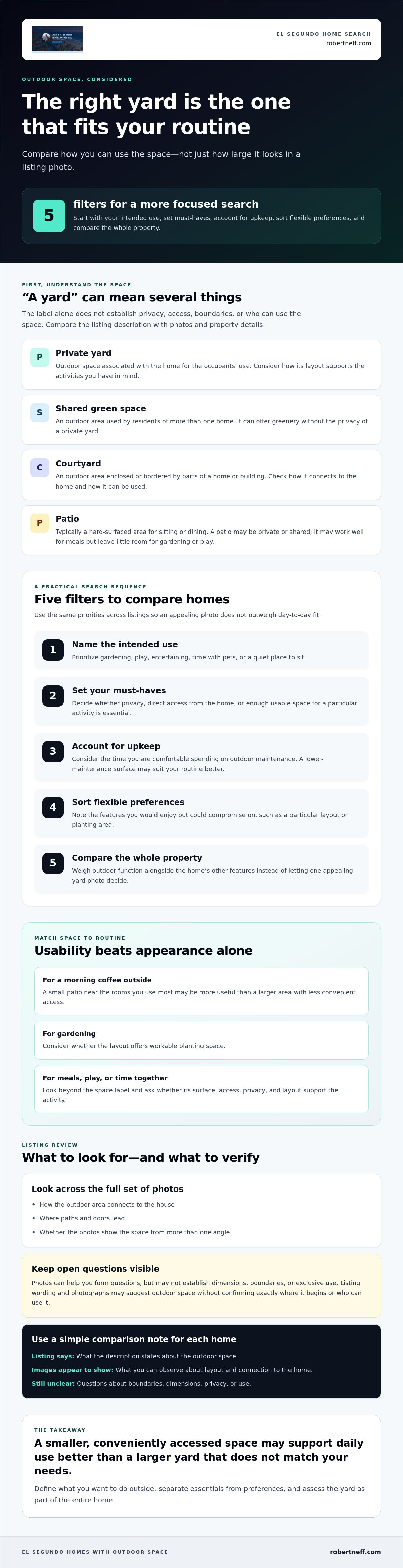
A private yard is outdoor space associated with the home for the occupants’ use. A shared green space is an outdoor area used by residents of more than one home. A courtyard is an outdoor area enclosed or bordered by parts of a home or building, while a patio is typically a hard-surfaced area for sitting or dining. A patio may be private or shared, so the label alone doesn’t tell the whole story.
Compare the description with the photos and property details. Look for where the space sits, how it connects to the home, and whether the listing explains who can use it. A shared lawn may offer greenery without the privacy of a private yard; a patio may work well for outdoor meals but leave little room for gardening or play.
Which yard features matter most for your household?
Start with the activities you want the space to support: gardening, play, entertaining, time with pets, or a quiet place to sit. Then rank the features that make those activities practical. Direct access from the home or privacy may be essential, while a particular surface or extra planting area could be flexible.
Think through a typical day. If you want to step outside with a morning coffee, a small patio near the rooms you use most may be more useful than a larger area with less convenient access. If gardening is central, consider whether the layout offers workable planting space. The best fit depends on how the space functions for you, not just how large it appears in a photograph.
How to search for El Segundo homes with a yard that fits your needs
A focused search starts with your routine, not a photo of a landscaped lawn. Decide what you want the outdoor space to make possible, then use those priorities to assess listings and compare trade-offs. This keeps a striking image from outweighing whether the home and yard work for you day to day.
Turn your outdoor-space priorities into search criteria
Use this sequence to shape your search for El Segundo homes for sale with a yard:
- Name the intended use. Decide whether you’re prioritizing gardening, play, entertaining, time with pets, or a quiet place to sit.
- Set your must-haves. Identify requirements such as privacy, direct access from the home, or enough usable space for a particular activity.
- Account for upkeep. Consider how much time you’re comfortable spending on outdoor maintenance, and whether a lower-maintenance surface may suit your routine better.
- Sort flexible preferences. Note features you’d enjoy but could compromise on, such as a particular layout or planting area.
- Compare the whole property. Weigh outdoor function alongside the home’s other features instead of letting one appealing yard photo decide.
This ranking helps you recognize a genuine fit. A smaller space with convenient access may support daily use better than a larger area that doesn’t match your needs. Stay open to secondary features if the home meets your core priorities.
Read El Segundo listing photos and descriptions with care
Review the full set of listing photographs rather than relying on a single wide-angle view. Look at how the outdoor area connects to the house, where paths and doors lead, and whether the photos show the space from more than one angle. Read the description alongside available property details and records. Photos can help you form questions, but they may not establish dimensions, boundaries, or exclusive use.
Keep a short comparison note for each promising home: what the listing says, what the images appear to show, and what remains unclear. This gives you a practical starting point for an in-person visit without assuming that a listing term guarantees a specific kind of outdoor space.
If you’re weighing coastal options across the region, the buyer guide on coastal homes for sale in the South Bay offers another perspective on the search. Compare El Segundo with other South Bay communities, including Redondo Beach, Hermosa Beach, Manhattan Beach, Palos Verdes, and Torrance, using the same priorities. Inventory changes, so treat each listing as a current possibility rather than assuming a particular yard feature will always be available. Discuss your El Segundo home search when you’re ready to consider your next steps.
How to compare yard size, privacy, condition, and maintenance
A listing may emphasize yard size, but dimensions alone don’t show how much space you can comfortably use. A narrow area with a clear path to the kitchen may suit outdoor dining better than a larger space divided by planting beds or awkward access. Compare each property against your intended activities, then note questions to examine more closely during a visit.
| Use | Privacy | Access | Upkeep | Questions to investigate |
|---|---|---|---|---|
| Gardening | Consider exposure to neighboring views | Look for a convenient route from the home | Note existing planting and visible care needs | Where are planting areas, and what shade do they receive? |
| Outdoor dining | Check sightlines from nearby windows | Notice the path between the kitchen and seating area | Consider the surfaces and landscaping to maintain | Is there a usable spot for the seating you have in mind? |
| Play or time with pets | Observe fencing and views into the space | Consider how easily household members can reach it | Assess visible lawn, planting, or paved areas | Does the layout suit your needs, and what boundaries require clarification? |
| Quiet outdoor time | Look for screening and neighboring windows | Consider whether access feels convenient and comfortable | Think about the care needed to keep the area usable | Where might shade fall, and what nearby activity is noticeable? |
Evaluate whether a yard works for your daily routine
During a property visit, trace the route from the rooms you use most to the outdoor area. A direct, simple path can make it easier to carry food outside or keep an eye on play. Then picture the space with the furniture, pots, or play area your household would actually use. Separate features already in place from changes you might choose to make later; don’t assume a future alteration will be simple or appropriate without investigating it.
Balance privacy, condition, and ongoing care
Look across the yard toward nearby windows and shared boundaries. Observe fencing, landscaping, shade, and the condition of visible surfaces. Notice whether water appears to collect or run toward the home, but treat that as an observation to investigate, not a diagnosis based on a viewing or photograph. Consider how much time you want to spend caring for plants, lawn, or other outdoor features.
For buyers comparing El Segundo homes for sale with a yard, these observations help distinguish apparent size from practical fit. The right balance depends on your routines, privacy preferences, and appetite for upkeep.
Takeaway: The best yard is the one that supports your intended use and comes with manageable upkeep.
What to investigate before buying a home with a yard in El Segundo
A listing gives you an initial picture, but a property visit and its records help put that picture in context. Compare what the listing describes with what you can observe on site, then note any differences for follow-up. A fence may appear to mark the yard’s edge, for example, but appearance alone doesn’t establish the legal boundary or who has the right to use the area.
For buyers considering El Segundo homes for sale with a yard, review relevant disclosures, available property records, and inspection findings together. Yard-related questions can involve distinct issues, from visible condition to boundaries and past improvements. Keep observations separate from conclusions so you can identify what needs clarification before making an offer.
Check boundaries, access, and outdoor improvements
Compare the apparent yard area with available property records and disclosures. Note where fences, gates, paths, and planting beds sit in relation to the home, and whether the way you enter the space matches the listing’s description. Records and visual clues may raise questions, but don’t assume they establish a boundary or an exclusive-use arrangement on their own.
Make a note of visible outdoor improvements, such as a covered structure, retaining feature, or built-in area. Their presence doesn’t establish whether they were permitted or whether they meet current requirements. Permit and zoning questions depend on the specific property, its location, and the work involved. El Segundo’s Planning Division is the official source for local planning information, and property-specific questions should be evaluated in that context.
Assess condition and location during a property visit
Observe the space in person. Notice the slope, where water appears to flow or collect, how much shade falls across the yard, and how exposed it feels. These are observations, not a diagnosis of drainage or structural conditions. Also consider street activity and nearby surroundings: noise, sightlines, and neighboring windows can affect how comfortable the space feels at different times.
Keep a concise checklist alongside the property documents:
- Do fences and apparent yard edges align with the available records?
- How do you reach the outdoor area, and are there any access questions?
- Are there visible signs of water pooling, worn fencing, or landscaping that needs attention?
- What do disclosures and inspection findings say about the property and its outdoor improvements?
- Which permit or zoning questions need property-specific review?
Organizing these details can make it easier to weigh the yard alongside the home’s other features. Robert Neff provides buyer search and negotiation representation for South Bay coastal properties. Discuss your El Segundo home search to consider how your priorities fit the available options.
Find the right El Segundo home with a yard and move forward confidently
A clear process can make a yard-focused search more manageable: define how you’ll use the space, compare properties against the same priorities, investigate details, then weigh the yard as part of the whole home. For buyers looking at El Segundo homes for sale with a yard, that sequence keeps outdoor appeal in perspective alongside the home’s layout, condition, and fit for daily life.
Build a short list around your priorities
Use one set of essential yard and home criteria for every candidate. Record each property’s strengths, open questions, access and privacy, and likely upkeep. A simple comparison makes trade-offs easier to see: one home may offer more privacy, while another may provide a more convenient connection between the kitchen and patio. As new listings come up, revisit your priorities and note which compromises feel acceptable.
Prepare for a thoughtful offer
Before deciding how to proceed, review property-specific information, disclosures, and inspection findings alongside what you observed during a visit. Clarify which questions about the yard remain unresolved, and consider how those details affect your plans for the property. An offer strategy should reflect your goals, timeline, and understanding of the home, rather than focusing on outdoor space in isolation.
Buyer representation can help organize the search, compare properties consistently, and assess how yard-related trade-offs fit your broader priorities. It also brings search and negotiation decisions into one measured process. For further guidance, explore the South Bay buyer representation and negotiation guide.
If you’re ready to take the next step, discuss your El Segundo home search with Robert Neff. A considered plan can help you move forward with greater clarity and confidence.
Choose outdoor space that fits the way you live
The strongest search for El Segundo homes for sale with a yard begins with how you’ll use the space, not how it looks in a listing photo. Compare each property’s privacy, access, condition, and upkeep, then review relevant records and disclosures before deciding how the yard fits into the whole home.
Buyer representation can help you organize those priorities, assess property trade-offs, and approach offer decisions with a clear understanding of your goals. Robert Neff, a California Realtor® (DRE #02442812), provides buyer search and negotiation representation in the South Bay, with structured guidance for first-time and relocating buyers.
Ready to discuss your El Segundo search? Talk with Robert Neff about your home search. A thoughtful plan can help you find outdoor space that supports your routines and move ahead with confidence.
Frequently Asked Questions
Are there homes for sale in El Segundo with a yard?
Yes, El Segundo listings may include homes with private yards as well as patios, courtyards, or shared outdoor areas. Available properties change, and a listing’s use of the word “yard” doesn’t establish that the space is private or define its boundaries. Review the description and photographs, then compare them with property details and disclosures to understand what outdoor space is associated with the home.
How can I find El Segundo homes for sale with a yard?
To find El Segundo homes for sale with a yard, begin by deciding how you want to use the space, then rank essentials such as privacy, direct access, and manageable upkeep. Use search filters as a starting point, not a final judgment. Compare descriptions, photos, and available property information for each candidate. If you’re also considering Redondo Beach, Hermosa Beach, Manhattan Beach, Palos Verdes, or Torrance, apply the same criteria across locations.
What should I look for when viewing a home with a yard?
Look at how the outdoor space connects to the rooms you use and whether its layout suits your plans for seating, gardening, play, or time with pets. Observe privacy, fencing, shade, visible landscaping condition, slope, and where water appears to flow or collect. Consider nearby windows and street activity, too. Treat visible concerns as questions to investigate, not conclusions about the property’s condition.
Is a private yard better than a patio or shared outdoor space?
Not necessarily. A private yard may offer more privacy and flexibility, while a patio can provide a convenient, lower-maintenance place to sit or dine. Shared outdoor space may offer greenery without exclusive use. The best choice depends on your household’s routines, desired access, privacy preferences, and willingness to maintain the area. Compare each option by how you’ll use it, rather than treating the labels as interchangeable.
What should I check about a yard before making an offer?
Compare the listing with the property’s visible condition, available records, disclosures, and inspection findings. Pay attention to apparent boundaries, access, fencing, drainage, landscaping, and outdoor improvements. A fence or structure doesn’t by itself establish a boundary or approval status. Write down anything unclear and review it in the context of the specific property before deciding how to proceed with an offer.
Does a larger yard always add more value to an El Segundo home?
No. A larger yard doesn’t automatically make a home a better fit or determine its value. Usable layout, access, privacy, condition, and maintenance needs can matter more than the stated or apparent size. Consider how the outdoor area supports your routines and weigh it alongside the home’s overall condition, layout, and other features. A yard should be assessed as one part of the property, not in isolation.
Can I add a fence or make changes to a yard after buying?
Possibly, but the rules depend on the property, the location of the work, and the improvement. El Segundo’s regulations distinguish fence and wall height by placement: up to 42 inches is allowed in any part of a residential lot, while a fence or wall up to six feet high may be located behind the required front yard. Verify how requirements apply to the specific property with the City’s Planning Division before planning changes.


