

An oceanfront view can be the easiest part of a Strand purchase to evaluate. The harder question is whether a home’s exact setting, condition, layout, and records fit your plans. Hermosa Beach Strand properties for sale may look similar in photographs, but important differences can be hard to assess, especially when search results also include nearby Manhattan Beach listings.
Comparing these homes takes more than weighing the view against the asking price. Use the same criteria for each property, separate listing claims from verified details, and review available disclosures before deciding whether to move forward. A consistent process can bring clarity without rushing a high-stakes decision.
This guide explains what distinguishes a Hermosa Beach Strand property and how to compare its location, features, condition, and property-specific records. It also covers how local market analysis and buyer representation can support a considered offer strategy. The goal is to help you assess each opportunity against your needs and decide whether it suits you.
Key Takeaways
- Distinguish Hermosa Beach’s beachfront Strand area from broader listing language before comparing homes.
- Use the same criteria for location, layout, condition, outdoor space, and verified listing details when reviewing Hermosa Beach Strand properties for sale.
- Compare nearby coastal options on their own city-specific facts. Keep details for Hermosa Beach and Manhattan Beach separate.
- Before making an offer, clarify your priorities, review listing information and disclosures, and assess terms based on evidence rather than assumptions.
- Robert Neff’s buyer representation can help organize relevant listings, market analysis, property comparisons, and negotiation next steps.
What makes Hermosa Beach Strand properties for sale distinct?
A Hermosa Beach Strand property is a home located along the city’s beachfront area beside The Strand, the paved path that runs along the beach. The phrase can refer to a specific location or appear more loosely in listing language. Distinguish direct Strand frontage from a nearby home described as being in a beach area. The label alone doesn’t establish a property’s exact position, view, condition, or features.
Proximity to the beach shapes a home’s setting, but it doesn’t make every property equivalent. Two listings may differ in their relationship to the path and sand, orientation, surrounding activity, interior layout, and maintenance needs. Assess each home on its own rather than treating it as representative of the whole beachfront area. Because inventory and property details change, base comparisons on current listing information, not assumptions drawn from past listings.
How should buyers interpret “The Strand” in a listing?
Start with the address and map pin. A headline or description may use “Strand” as a location signal, but the address and mapped position help show whether a home is directly on the beachfront path or set back in the surrounding neighborhood. The Hermosa Beach, California Wikipedia page provides context on the city and identifies The Strand as a paved beach path. It doesn’t establish the boundary or frontage of an individual property.
For a specific home, compare its location details with current mapping and available public records. Confirm the city and the property’s position in relation to the beachfront path instead of relying on broad labels such as “beachfront” or “beach area.” This matters when a search combines nearby coastal communities or uses filters that cover more than direct Strand frontage. Precise geography gives you a fair basis for comparing listings.
What does the beachfront setting mean for a home search?
The setting may be central to your reasons for buying, but it doesn’t guarantee a particular view, level of privacy, or day-to-day experience. At the property, consider its orientation, its relationship to beach access and the path, and what surrounds it. Compare those conditions with your preferences, including how much you value coastal access versus a sense of retreat.
Separate the appeal of the location from the evidence about the home itself. Review listing-specific information about layout, condition, and features, and note what still needs review. A striking beachfront setting doesn’t answer practical questions about how rooms function or what upkeep a property may require. A useful comparison gives location its due without letting it stand in for an assessment of the individual home.
Which Hermosa Beach Strand property features deserve the closest comparison?
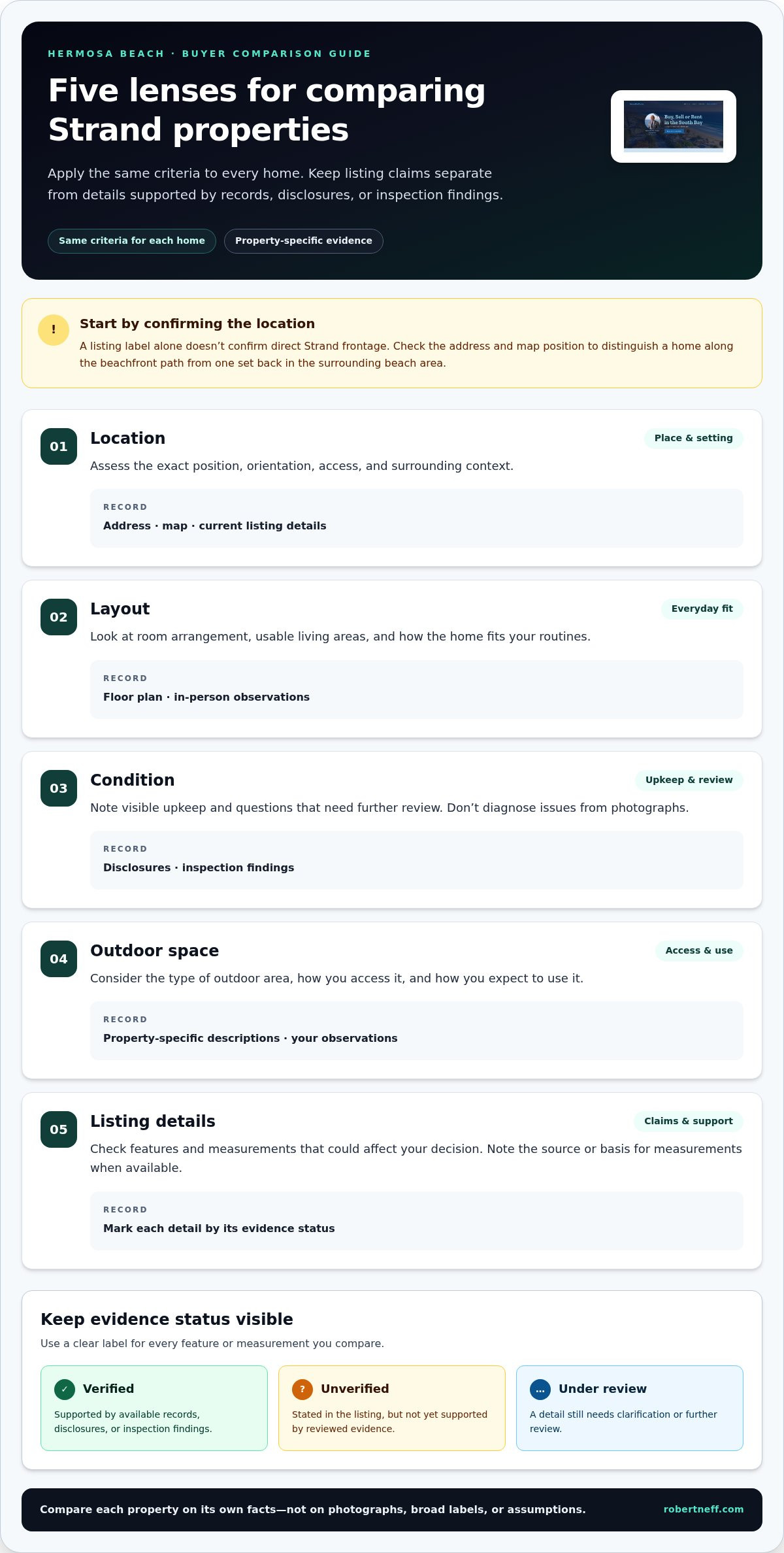
Start with the same questions for every home, not with whichever listing has the most striking photographs. For Hermosa Beach Strand properties for sale, assess location, usable layout, condition, outdoor space, and the reliability of the details presented. Architectural style is largely a matter of taste. Whether the rooms suit your daily needs, and what the property’s condition means for your plans, require closer review.
Use a consistent framework to record your observations. Keep what the listing says separate from what disclosures, records, or inspection findings support. This helps prevent an appealing description from being mistaken for a verified feature.
| Comparison area | What to assess | Evidence to record |
|---|---|---|
| Location | Exact position, orientation, access, and surrounding context | Address, map, and current listing details |
| Layout | Room arrangement, usable living areas, and fit with your routines | Floor plan and in-person observations |
| Condition | Visible upkeep and questions that merit further review | Disclosures and inspection findings |
| Outdoor space | Type of area, access, and how you expect to use it | Property-specific descriptions and observations |
| Listing details | Features and measurements that influence your decision | Mark each detail as verified, unverified, or still under review |
How do layout, condition, and outdoor space affect fit?
Start with your own needs. A room count alone won’t tell you whether the arrangement works for hosting, working from home, or accommodating household members. Compare how living areas connect and whether the usable space supports your routine. During a visit, note visible maintenance concerns, but don’t diagnose a problem from photographs. Review disclosures and inspection findings for evidence. For outdoor areas, consider the described access and practical use, then compare those details with what you observe at the property.
How can buyers compare listing details without being misled?
Apply the same criteria and measurement context to each home. If a listing gives an area measurement, record its source or basis when available. Avoid treating figures as directly comparable if they may have been measured differently. Label claims as listing-stated until disclosures, records, or inspection findings support them. Comparable criteria make property differences clearer because each home is judged against the same needs and evidence.
For a broader framework on coastal-home decisions across the region, consult this South Bay coastal homes buyer reference. Robert Neff’s buyer representation and market analysis can help organize listing comparisons and identify useful next steps. If you’re weighing Strand options, explore buyer guidance with Robert Neff as you shape your search.
How does a Hermosa Strand home compare with other coastal options?
A Hermosa Beach Strand home is one option in a broader South Bay coastal search, not an automatic match for every buyer drawn to the beach. Nearby homes can differ in their exact relationship to the shoreline, neighborhood setting, layout, condition, and verified property details. Start with your priorities, then assess each individual home against them.
Keep the geography precise. Hermosa Beach and Manhattan Beach are separate cities, and their listings, records, and market data should remain distinct. Search results that combine both can help surface possibilities, but they don’t make the homes directly comparable. Confirm each property’s city and location, then assess its own evidence rather than applying one city’s market context or characteristics to another.
When might a buyer prefer a Strand address?
Direct beachfront context may appeal if being close to the beach and its path is central to how you hope to use your home. Consider whether that setting fits your daily routines and long-term priorities instead of assuming an address guarantees a particular view, level of privacy, or experience. Compare the specific home’s position and surroundings with your expectations. A nearby coastal property may suit you better if its layout, condition, or setting supports the way you plan to live.
What should buyers compare with nearby coastal homes?
Use consistent criteria across your shortlist. Compare exact location and surroundings, functional layout, property condition, and details supported by current listing information or records. Note which differences matter most to you and which are simply preferences. One buyer may prioritize a home’s relationship to the beachfront, while another may place greater weight on room arrangement or condition. Neither preference makes one home a universal winner.
Separate city-level market context from a property’s individual merits. A market report can help explain broader trends, but it can’t determine the value or fit of a specific home on its own. The 2026 South Bay market trends analysis offers wider context for interpreting local conditions. Use it alongside current, property-specific information. For Hermosa Beach Strand properties for sale, comparisons are most useful when the location, evidence, and criteria are clear.
Once a home stands out, bring the comparison into your offer planning. Robert Neff’s buyer search and negotiation guidance can help organize property evidence and next steps. The South Bay buyer representation and negotiation strategy provides additional perspective on preparing an offer. For tailored buyer representation, explore buyer guidance with Robert Neff.
What should buyers verify before offering on a Strand property?
A beachfront setting doesn’t, by itself, establish a home’s condition, legal status, permitted use, or exposure to particular hazards. Before deciding whether to make an offer, follow a deliberate sequence that separates your priorities from what the property records and disclosures show.
- Clarify your priorities. Identify the features and trade-offs that matter most, such as layout, location, condition, or intended use.
- Review listing facts. Check the current listing’s status, address, described features, measurements, and other material details. Treat descriptions as claims to assess, not as a substitute for supporting evidence.
- Examine disclosures and records. Review available disclosures, title information, and relevant property records. Flag questions about legal matters, permitting, or hazards for verification against authoritative sources.
- Assess offer terms. Consider the terms in light of your priorities, financing readiness, and verified market evidence.
Before making an offer, organize your priorities, current listing facts, available disclosures, title and property records, verification questions, financing readiness, and the market evidence relevant to your proposed terms.
Which property records and disclosures belong in the review?
Gather the seller’s available disclosures, title information, and records relevant to the property. Compare those materials with the listing details and note any gaps or conflicting information. A coastal location alone doesn’t prove that a particular restriction, hazard, or permitting issue applies. Property-specific conclusions require authoritative verification. Keep a written list of open questions so you can consider each one before deciding how to proceed.
Robert Neff’s step-by-step buyer guidance can help organize this review and connect the available evidence to your decision. His role is to support an orderly purchase process, not to replace authoritative records or specialist determinations where those are needed.
How should buyers prepare an offer strategy?
Ground proposed terms in your priorities, financing readiness, and market evidence relevant to the specific home. Current and comparable property information can help frame your assessment, but no market analysis can promise that an offer will be accepted or produce a particular result. Consider how the terms fit your circumstances, what evidence supports your position, and which unresolved questions could affect your decision.
For Hermosa Beach Strand properties for sale, a clear record of what you know, what you still need to verify, and why you’re proposing particular terms can make the decision more considered. Robert’s buyer search and negotiation service helps buyers organize property evidence and offer decisions. Work with Robert Neff on your buyer strategy.
How can Robert Neff guide your Hermosa Beach Strand purchase?
A focused search begins with your priorities, not a stream of listings. Robert Neff, Ph.D., is a licensed California Realtor® who represents buyers across the South Bay, including Hermosa Beach. His buyer guidance brings structure to the search: clarify what matters, identify relevant homes, compare available evidence, and plan next steps. For a distinctive purchase like a Strand home, this process helps keep the decision grounded in your needs and the facts available for each property.
Market analysis and negotiation guidance can support informed decisions. They don’t promise that a particular listing will be available, an offer will be accepted, or a transaction will have a specific outcome. Base current property status and details on up-to-date listing information.
What does a guided Strand property search involve?
The search can move through a clear sequence:
- Clarify your goals. Discuss your preferred location, practical needs, timing, and the trade-offs you’re prepared to consider. This helps distinguish essential criteria from preferences that may be flexible.
- Identify relevant listings. Use those priorities to focus on properties that align with your search. Listing status and property details can change, so assess any home under consideration using current information.
- Compare the evidence. Review each candidate against consistent criteria, including its setting, layout, condition, and available property-specific information. Robert’s market analysis can help put a listing in context without treating broad market patterns as a substitute for individual facts.
- Plan next steps. Consider what further review may be needed and how a property fits your goals. If you decide to proceed, negotiation guidance can help you assess offer terms in light of your priorities and the evidence.
This approach keeps the search responsive without assuming a particular home will be on the market. It also gives you a practical way to revisit priorities as you learn more, compare options, and decide which questions need attention before moving forward.
How can a buyer take the next step?
Begin by sharing what you hope to find in Hermosa Beach, what matters most in a Strand setting, and your preferred timing. You don’t need to have every decision settled. A conversation can help organize your goals and identify a useful starting point for the search.
Robert provides buyer representation, market analysis, and negotiation guidance for buyers considering Hermosa Beach Strand properties for sale. Together, you can review relevant listing information, compare property evidence, and determine a considered path forward, with each step shaped by your circumstances rather than pressure to act.
If you’re ready to discuss your priorities and timing, discuss your Hermosa Beach Strand search with Robert.
Set a Clear Course for Your Strand Search
Before a listing captures your attention, define what would make a property worth pursuing. Write down the conditions that would prompt a closer look, the trade-offs you’re comfortable making, and the questions you’ll want answered before committing. Separate firm requirements from flexible preferences. This personal decision framework can keep your search steady as Hermosa Beach Strand properties for sale enter or leave the market, without treating every new listing as an opportunity you must pursue.
As your priorities become clearer, refine the search and respond thoughtfully when a property aligns with them. Robert Neff, a licensed California Realtor® (DRE #02442812), provides buyer search and negotiation services, professional market analysis, and step-by-step guidance to support informed decisions. His role is to help you shape a considered path forward, not rush you toward a particular home.
Discuss your Hermosa Beach Strand purchase with Robert and take your next step with a clear plan and a steady guide.
Frequently Asked Questions
Are there currently Hermosa Beach Strand properties for sale?
A citywide count can’t establish whether a home directly on The Strand is currently available. Hermosa Beach Strand properties for sale are a narrow segment, and listing status can change between searches. Check current listing information, confirm the address and mapped location, and distinguish direct Strand frontage from nearby beach-area homes. Robert Neff’s buyer search can help you follow relevant opportunities using up-to-date property details.
How much do Hermosa Beach Strand properties cost?
Prices vary substantially. Direct Strand homes broadly range from about $4 million to more than $15 million, with some listings exceeding $23 million. These figures describe a high-end segment, not a prediction for any particular home. Asking price, sale price, and current availability are different measures. Compare recent, relevant Hermosa Beach sales and a property’s verified features before judging whether its asking price fits your plans.
Can buyers find different architectural styles on The Strand in Hermosa Beach?
Yes, individual homes can have distinct architectural character, finishes, and renovation choices. A style label may help you identify the look you prefer, but it won’t tell you whether a home’s rooms suit your needs or what condition its components are in. Review property-specific photographs and descriptions, then assess the home in person. Treat style as a preference, not as evidence of quality, upkeep, or long-term suitability.
What should I review before making an offer on a Strand property?
Review the current listing, available seller disclosures, title information, and relevant property records. Keep a written list of details that affect your intended use, questions that remain unresolved, and terms you may want to discuss. Distinguish a feature stated in marketing materials from one supported by records. Verify legal, permitting, title, or hazard questions through authoritative sources before relying on an assumption in your decision.
Can I rent out a Hermosa Beach Strand property after buying it?
Don’t assume rental use is permitted simply because a property is near the beach. Short-term rental rules are complex. A March 2026 court ruling found Hermosa Beach’s ban unenforceable in the Coastal Zone without California Coastal Commission approval; legal operation requires a city business license and payment of Transient Occupancy Tax. Verify the rules for the specific property and intended rental period with authoritative city and Coastal Commission sources before relying on rental income.
How can I keep track of new Hermosa Beach Strand listings?
Set up a focused search using Hermosa Beach, a clearly defined Strand location, and the features that matter to you. Review listing status and address details regularly, since a new result or status change may affect your shortlist. If you’re open to other South Bay options, keep separate searches for Redondo Beach, Manhattan Beach, El Segundo, Palos Verdes, and Torrance so their listings don’t blur a Hermosa-specific comparison.
Is every home described as beachfront actually on The Strand?
No. “Beachfront” can be used broadly in listing language and doesn’t by itself prove that a property directly fronts The Strand. Check the street address and map position, then compare them with the listing’s description and available property records. A nearby home may offer a coastal setting without being on the beachfront path. Confirming the exact location helps you understand what the label means for the particular property.


