

The home with an ocean view may not be the one that makes your workday easier. Choosing South Bay CA real estate for remote workers means looking beyond listing photos to consider how a home functions during calls, focused work, and life after hours.
A spare room may look like an office online, but photos can’t tell you how sound carries or what internet options serve that specific address. Coastal and inland communities also offer different day-to-day surroundings. The right fit depends on your work habits and lifestyle, not a one-size-fits-all checklist.
This guide offers a practical way to compare South Bay communities and homes by the workday they can support. Learn what to assess in a workspace, how to investigate address-level connectivity and noise, and how to weigh daily routines against future flexibility. Whether you’re relocating, buying for the first time, or looking for a home that better fits your work, a clear framework can make your search more focused.
Key Takeaways
- Start your South Bay CA real estate for remote workers search by defining the workday and lifestyle your next home needs to support.
- Assess each property beyond its listing description, including whether the layout can accommodate focused work and what internet options serve the exact address.
- Compare Redondo Beach, Hermosa Beach, Manhattan Beach, El Segundo, Palos Verdes, and Torrance against your priorities rather than relying on a universal ranking.
- Use an address-level checklist to separate details you can verify from preferences you need to experience, then revisit your strongest contenders.
- For first-time and relocating buyers, local search and negotiation guidance can help connect property choices with workday and lifestyle needs.
South Bay CA Real Estate for Remote Workers: Start With Your Workday
A home needs to do more than look appealing in a listing. It should support focused work, fit the people and routines you share it with, and still feel like home after you close your laptop. That balance can be difficult to judge from photos, especially when comparing South Bay communities. The region includes distinct cities and coastal and inland settings, as outlined in the South Bay Los Angeles County Wikipedia overview.
For your search, consider four parts of remote-work fit: a usable workspace, suitable connectivity, surroundings that suit your focus, and a location that supports your personal routine. A remote-work-ready home is one whose layout, connectivity options, and surroundings support your work habits without promising a distraction-free day.
Turn your remote-work routine into home requirements
Start with your actual workweek, not an idealized version of it. Someone who leads frequent video calls may need a room with a closing door. Someone who works independently may be comfortable with a desk in a shared space. A scenic outlook can be a welcome preference, but it may not replace privacy when calls are part of the daily routine.
Factor in household schedules and the practical details of your setup. Consider where monitors, documents, and equipment will go, whether you need storage nearby, and how others will use the home during work hours. If you work remotely full time, a dedicated workspace may be central to your search. For occasional work from home or a hybrid schedule, a flexible nook might be enough.
Before browsing, write down and rank these requirements:
- Workspace essentials, such as a closing door, room for equipment, or convenient storage
- Call frequency and the level of privacy your routine requires
- Household schedules that may overlap with your work hours
- Connectivity needs to investigate for each property
- Preferences such as natural light, an outdoor area, or a particular view
Set priorities before comparing South Bay homes
Rank the features that connect your workday to life outside it. Consider outdoor access, everyday errands, likely commute destinations, and the surroundings you prefer, whether that’s a coastal setting or a quieter-feeling residential area. The right balance depends on your routine. Decide in advance which tradeoffs you can accept, such as choosing a more compact work area in exchange for easier access to places you value.
A consistent scorecard makes it easier to compare shortlisted properties. Use the same questions for each home and rate the answers using your own scale:
- Does the layout provide a practical place to work?
- Can the household use the home comfortably during work hours?
- Do the surroundings match your preferred daily routine?
- How well does the location fit errands, outdoor access, and commute needs?
- Which details are facts to verify, and which are personal preferences?
Use the scorecard to guide your search, not make the decision for you. For South Bay CA real estate for remote workers, define your workday first, then compare homes against the life you want them to support.
Evaluate South Bay Homes for Workspace, Connectivity, and Focus
A listing’s bedroom count and square footage can help narrow your search, but they don’t show whether a room will work as a comfortable office. A bedroom may have limited outlets or share a wall with a busy living area. A den may offer privacy but little daylight. For remote work, the room’s details and its relationship to the rest of the home matter as much as its label.
“Advertised internet availability describes a service area; verified service depends on the specific property address.” Check service options for each home you’re considering instead of assuming coverage is consistent across a neighborhood. For broader context on remote work in California, the Legislative Analyst’s Office discusses labor-market impacts in its California Remote Work Labor Market Report.
Check whether a room can function as a real workspace
Look beyond staging. Check whether a door closes, whether outlets are conveniently placed, and whether natural light suits the way you work. Consider ventilation and how separated the room feels from shared areas where people cook, relax, or move through the home. A bedroom, den, or flexible room may work, depending on your equipment, privacy needs, and household schedule.
If practical, visit during the hours you expect to work. Notice the light, how sound carries, and whether the room feels usable for a full work session rather than just a brief showing.
Verify connectivity and test the surroundings
Look up internet service options using the exact address and verify what is available for that property. A neighborhood map or listing note may not reflect address-level service. On site, consider where you’d place your desk and whether the home’s layout or construction materials could affect wireless coverage. Test the connection in the intended workspace when possible.
Noise can change through the day. If practical, visit at different times and listen for nearby traffic, construction, household activity, or other recurring sounds. These observations can’t predict every workday, but they may reveal conditions a listing photo can’t show.
| Factor | What to assess | How to evaluate it |
|---|---|---|
| Workspace | Privacy, outlets, daylight, ventilation, and desk placement | Imagine your equipment in the room and spend time there during a likely work hour. |
| Connectivity | Service options for the property and signal where you’d work | Check availability by exact address and test on site when possible. |
| Noise | Sound from household activity and the surrounding area | Visit at different times and listen from the intended workspace. |
| Flexible room use | Whether a bedroom, den, or other room can serve work needs | Consider privacy, household routines, and how the room may need to function over time. |
Use this comparison when evaluating South Bay CA real estate for remote workers. Record what you observe rather than relying on assumptions. If you’re weighing homes against your work routine, Robert Neff’s buyer search and negotiation guidance can help you assess property choices alongside your lifestyle priorities.
Compare Redondo Beach, Hermosa Beach, Manhattan Beach, El Segundo, Palos Verdes, and Torrance
No single South Bay community suits every remote worker. A buyer who values coastal surroundings may weigh options differently from someone who prioritizes errands, a particular commute destination, or a quieter-feeling setting. Compare the same factors across areas, then visit the neighborhoods and properties that rise to the top. A city name is a starting point, not a guarantee about every block.
Match coastal and inland options to your preferred routine
Consider how often you want to spend time near the coast, where you’ll handle everyday errands, and which places you expect to visit regularly. In Redondo Beach, Hermosa Beach, and Manhattan Beach, weigh coastal proximity against your other priorities. Explore the distinct settings of El Segundo, Palos Verdes, and Torrance as well. For broader context on coastal property considerations, see this South Bay coastal homes buyer reference.
| Area | Workspace potential | Daily errands | Surroundings to consider | Commute destinations |
|---|---|---|---|---|
| Redondo Beach | Compare room layouts and privacy across individual homes. | Map the errands you make most often from each address. | Explore coastal and inland parts of the city. | Test routes to your regular destinations at relevant times. |
| Hermosa Beach | Check whether the available room setup fits your work pattern. | Note how nearby services fit your weekly routine. | Decide how important a coastal setting is to you. | Consider the trips you make beyond the neighborhood. |
| Manhattan Beach | Assess each home’s dedicated or flexible work area. | Compare access to the places you use regularly. | Visit specific areas to identify your preferred feel. | Evaluate routes to work, clients, or other destinations. |
| El Segundo | Look for a layout that can separate work from shared living space. | Check how errands fit your typical day. | Decide which neighborhood setting feels comfortable. | Map regular trips using current route information. |
| Palos Verdes | Review room placement and flexibility property by property. | Consider where routine errands fall in your schedule. | Explore the specific surroundings you’d experience daily. | Compare routes for occasional office or regional travel. |
| Torrance | Check whether the home supports your equipment and privacy needs. | Map essential stops from the address. | Compare individual neighborhoods rather than relying on the city label. | Test likely routes and timing for regular destinations. |
Compare commute needs even when work is mostly remote
Remote work may reduce regular commuting, but occasional trips can still influence your location choice. List the places you expect to travel to, such as an office, client locations, an airport, or other regional destinations. Compare routes from shortlisted addresses using current information, and consider the times you’d actually travel. If relocation planning includes broader lifestyle and budget questions, the El Segundo cost-of-living analysis can add useful context.
Use the table as a visit plan, not a ranking. For South Bay CA real estate for remote workers, compare how each address fits your work setup, everyday routine, preferred surroundings, and occasional travel. Robert Neff’s buyer search and negotiation guidance can help first-time and relocating buyers assess those priorities property by property.
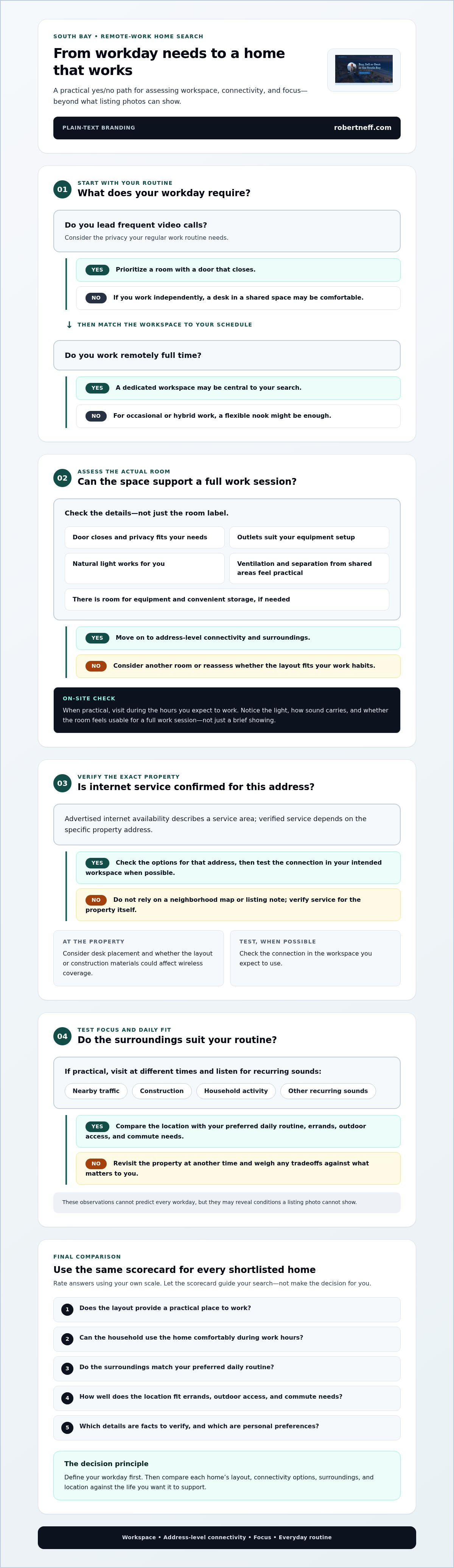
Use an Address-Level Checklist Before Choosing South Bay Real Estate
A repeatable review process makes it easier to compare homes on more than appearance. Listing photos and descriptions can help identify possibilities, but they can’t show how a home feels during your workday or confirm every detail at a particular address. Separate verifiable facts, such as internet service options and property details, from personal preferences, such as daylight or the feel of a room. This helps focus follow-up research where it matters.
Professional market analysis from Robert Neff can add local context to your search, but it doesn’t replace a property-by-property assessment.
Follow a repeatable property review process
Apply the same sequence to every candidate. This helps prevent an appealing photo or memorable showing from outweighing your ranked needs, and gives you a clear record to revisit as the search develops.
- Score the listing against your priorities. Use your ranked work and lifestyle requirements to record what the description shows, what it leaves unanswered, and which features appear to fit. Treat listing details as starting points for review, not proof that a room or setting will work for you.
- Verify address-specific facts. Review the property details and check internet service options for that exact address. Note other conditions you can research or observe, such as nearby activity or access to places you use regularly. Keep factual checks separate from judgments about comfort or appeal.
- Visit finalists and use the same checklist. Walk through the work area, notice its light and separation from household spaces, and observe the surroundings. Record what you see and hear, along with the time of the visit, so you can compare observations consistently rather than relying on memory.
- Review tradeoffs before moving forward. Identify which needs each home meets, which preferences it offers, and which compromises remain. Decide whether a shortcoming affects a non-negotiable or a flexible preference before choosing which property merits further consideration.
Reduce uncertainty beyond the listing
Online descriptions and images present selected views. They can’t establish the full experience of working in a room, how surroundings feel at different times, or which internet options serve a specific address. Address-level research and in-person visits help narrow those unknowns, though no review can eliminate every uncertainty about future conditions.
Keep notes factual and specific. “The desk wall has limited nearby outlets” is more useful than “the office feels difficult,” while “the room gets afternoon light” records an observation without assuming it will suit everyone. Revisit finalists with the same questions and compare what you’ve verified against what remains a matter of preference.
This disciplined approach is central to evaluating South Bay CA real estate for remote workers. For purchase strategy and negotiation context, explore strategic South Bay buyer representation. To apply a structured search to your workday and property priorities, explore buyer search and negotiation guidance.
Plan Your South Bay Remote-Work Home Search With Local Buyer Guidance
A focused home search follows a practical sequence: define your workday, assess each address, then weigh the location. That order keeps an attractive view or well-presented listing in perspective. The best fit depends on how you work, who shares your home, and what you want daily life in the South Bay to feel like.
For first-time and relocating buyers, translating priorities into a property search takes planning. Robert Neff, Ph.D., provides buyer search and negotiation services, professional market analysis, and step-by-step guidance. His local buyer representation can help connect your work and lifestyle needs with the homes and communities you evaluate, without assuming every remote worker needs the same setup.
Bring your remote-work priorities into the buyer conversation
Start by describing an ordinary workweek. How often are you on calls? Does your household share the home during work hours? Do you need room for equipment, or do you occasionally travel to an office, client, or other destination? These details turn broad preferences into useful search criteria. A ranked checklist can also distinguish essentials, such as a private workspace, from preferences, such as a particular outlook or outdoor feature.
Use your list to compare locations with a clear purpose. One buyer may value coastal surroundings, while another may prioritize errands or access to regular destinations. Discussing these differences helps narrow the search around your priorities rather than a general ranking of South Bay communities.
Move from comparison to a tailored search
Once your requirements are clear, buyer representation can help organize the process: identify properties to consider, evaluate them against your criteria, and develop a negotiation approach as you move through the search. Professional market analysis adds context to property decisions, while step-by-step guidance can be especially useful if you’re buying for the first time or relocating to the area.
Bring your notes, questions, and list of tradeoffs to an initial conversation. You don’t need to settle every preference before beginning. A focused discussion can help clarify which criteria matter most and where you have room to adjust. From there, you can assess South Bay CA real estate for remote workers with a consistent framework that reflects both your workday and life beyond it.
When you’re ready to discuss your priorities and shape a considered home search, explore South Bay home search guidance.
Make Your Next Home Search More Intentional
Your next step doesn’t need to be a rushed decision. Start with a short list of what matters most in your workday and home life, then use it to guide a focused conversation about the South Bay communities and properties worth exploring. This gives your search direction while leaving room to refine priorities as you learn more.
For South Bay CA real estate for remote workers, Robert Neff, Ph.D., offers buyer search, negotiation, and relocation guidance informed by professional market analysis. As a licensed California Realtor® (DRE #02442812), he provides step-by-step support for evaluating options and shaping a search around your needs.
Discuss your South Bay home search with Robert Neff and take a thoughtful next step toward a home that fits both your work and the life you want beyond it.
Frequently Asked Questions
Can I verify internet service before buying a home in the South Bay?
Yes. Use internet providers’ address-lookup tools for the specific property and review current service information as part of your due diligence. Availability and performance can vary by address, provider, and plan, so a neighborhood coverage claim doesn’t establish what you’ll experience inside a particular home. If possible, test the connection where you expect to work. Treat advertised speeds or service descriptions as details to verify, not a guarantee of performance.
Is the South Bay a good place to live if I work remotely?
It can be a good fit, depending on your preferred surroundings, housing needs, work routine, and regular destinations. Compare Redondo Beach, Hermosa Beach, Manhattan Beach, El Segundo, Palos Verdes, and Torrance against what matters in your week. For example, weigh coastal access against errands or occasional travel. Don’t assume a city name tells you what a particular block or home will feel like. Assess specific properties and surroundings before deciding.
What should I look for in a home office when buying a South Bay home?
Look for a space that suits your daily tasks, not just one labeled “office” in a listing. Consider whether you need a door for calls, where equipment could fit, and whether lighting and outlets work for your setup. Room count alone won’t show whether a space supports focused work. Think through your schedule and equipment, then view the room in person and compare its layout with your actual needs.
Can I work remotely from a smaller South Bay home?
Yes, a smaller home may suit remote work if its layout and household routines fit your needs. A flexible room or carefully placed work area could be practical, but consider how sound travels, where supplies can be stored, and whether others are home during your work hours. Picture a typical workday in the actual property, including calls and breaks. The right fit depends on how the space functions for your household, not its size alone.
Do remote workers still need to consider commute access when choosing South Bay real estate?
Yes. Occasional office days, client visits, airport trips, and regional travel can still influence where you choose to live. List the destinations you expect to visit, then compare routes from candidate addresses at the times you’d usually travel, using current information. How much commute access matters depends on your job and household. Balance less frequent trips against features you’ll rely on every day, such as workspace, errands, and neighborhood surroundings.
Should I prioritize a dedicated office or an extra bedroom when buying a home?
Choose based on how often you work from home, your household’s space needs, and how you may use the room later. A dedicated office may offer more separation, while an extra bedroom can serve multiple purposes. Compare the actual room dimensions, door placement, light, and household schedules in each property. A flexible room might meet your needs, but there’s no single rule for every buyer or floor plan.


