

The listing with the clearest ocean view may not be the one that puts you closest to the beach. When comparing South Bay oceanfront homes for sale, the difference between direct oceanfront, beachfront, bluff-top, and ocean-view can shape how a property fits your priorities.
Listing labels and polished photos can make those differences hard to judge. South Bay coastal communities also vary in setting and property type, so a home that looks ideal online may offer a different day-to-day experience than you expect.
This guide explains what a listing’s coastal position means, how to compare communities from Manhattan Beach and Hermosa Beach to Redondo Beach and Palos Verdes, and how to assess homes with a focused buyer strategy. Narrow your search by location, property format, and lifestyle before weighing individual listings. Robert Neff, Ph.D., provides local market analysis and buyer representation to help buyers clarify priorities and approach the search and negotiation process with care.
Key Takeaways
- Distinguish oceanfront, beachfront, bluff-top, and ocean-view descriptions before deciding whether a listing matches your desired coastal position.
- Compare Manhattan Beach, Hermosa Beach, Redondo Beach, Hollywood Riviera, and Palos Verdes by setting and the property formats you may encounter.
- When reviewing South Bay oceanfront homes for sale, separate essential location priorities from preferences such as property type, privacy, and outlook.
- Use a focused checklist to assess a listing’s location and property details before deciding which homes merit a closer look.
- Use local market analysis and buyer guidance to turn broad search goals into clear criteria and a considered negotiation strategy.
South Bay Oceanfront Homes for Sale: What Does 'Oceanfront' Really Mean?
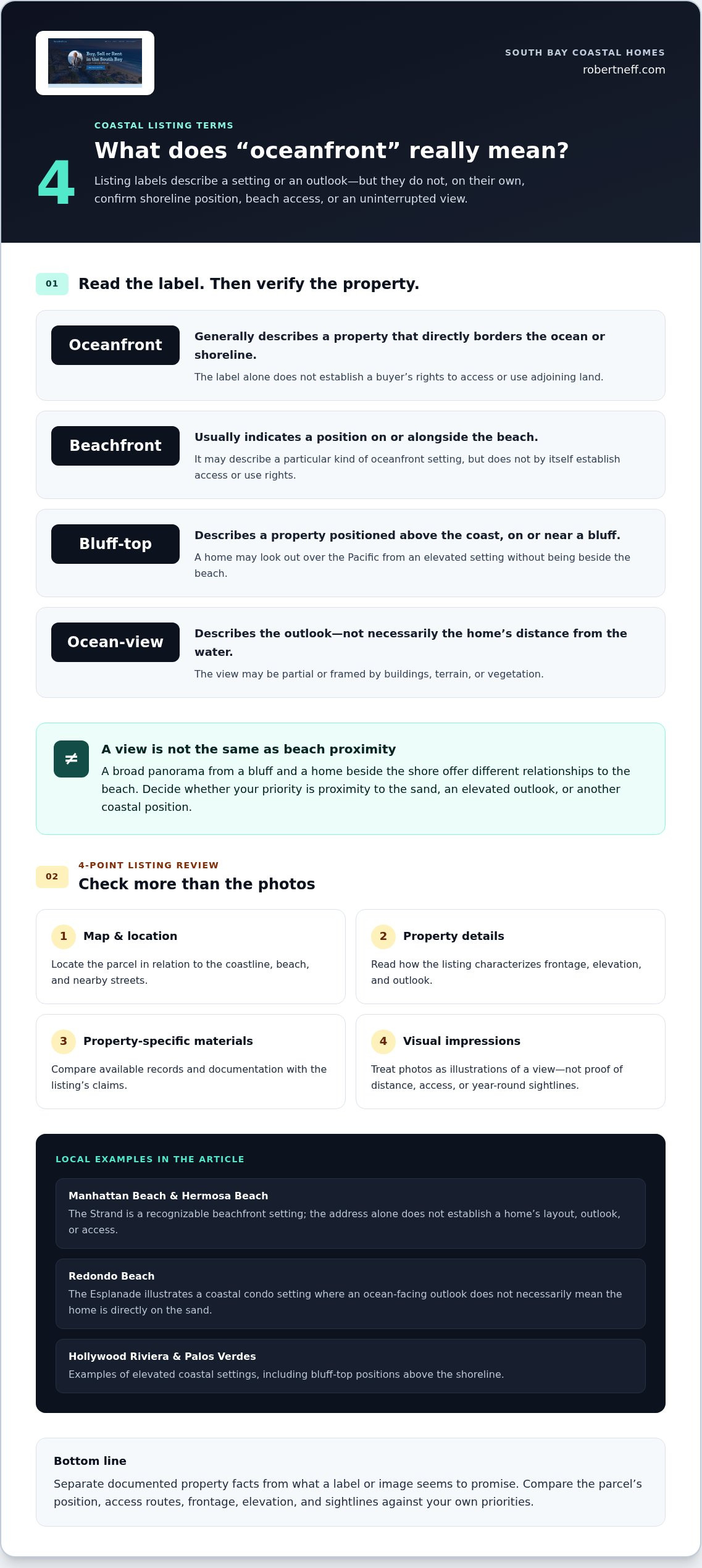
For buyers seeking direct coastal proximity, a listing term can shape expectations. “Oceanfront” may suggest a home beside the shore, while “ocean-view” may describe a property farther inland or above the coastline. These terms describe a setting, but they do not guarantee shoreline position, beach access, or an uninterrupted outlook. Read them carefully, then compare South Bay oceanfront homes for sale based on the property’s actual location and features.
Oceanfront, beachfront, bluff-top, and ocean-view: how to read the terms
Oceanfront generally describes a property that directly borders the ocean or shoreline. Beachfront usually indicates a position on or alongside the beach and may describe a particular kind of oceanfront setting. Neither label alone establishes a buyer’s rights to access or use adjoining land.
Bluff-top describes a property positioned above the coast on or near a bluff. In Palos Verdes, a home may look out over the Pacific from an elevated setting without being beside the beach. Ocean-view describes the outlook, not necessarily the home’s distance from the water. A view may be partial or framed by surrounding buildings, terrain, or vegetation.
These categories are useful descriptions, not a substitute for confirming a property’s precise location and characteristics. The California Coastal Commission provides an overview of the state agency involved in coastal land use and public access. That broad context does not establish the details of an individual property.
Why the exact property position matters to buyers
Position shapes the lived experience. A home beside the shore offers a different relationship to the beach than a residence elevated above it. Frontage, elevation, access routes, and sightlines all matter. A broad ocean panorama from a bluff may appeal to one buyer, while someone whose priority is proximity to the sand may prefer another setting.
Review several details together rather than relying on a single photograph or label:
- Map and location: Identify where the parcel sits in relation to the coastline, beach, and nearby streets.
- Property details: Read the listing description closely and note how it characterizes frontage, elevation, and outlook.
- Property-specific materials: Compare available records and other documentation with the listing’s claims.
- Visual impressions: Treat photos as illustrations of a view, not proof of distance, access, or year-round sightlines.
Photos can emphasize one angle or moment. They may not show intervening land, the route to the shore, or how the outlook differs from other parts of the property. Separate documented facts from what an image seems to promise. That review gives you a clearer basis for comparing coastal locations and deciding which properties merit closer evaluation.
South Bay Oceanfront Property Types: From Strand Homes to Coastal Condos
A coastal address can describe very different ways of living. A detached home beside the beach, a condo with an ocean-facing outlook, and a bluff-top residence may all appeal to buyers seeking a connection to the Pacific. They differ, however, in setting, privacy, and how shared spaces fit into daily life. Compare property format and coastal position together: the format describes how the home is arranged, while its precise position shapes its relationship to the shore.
Detached beachfront homes and Strand properties
The Strand is a recognizable beachfront setting in Manhattan Beach and Hermosa Beach. Detached homes here offer a different residential experience from a condo or townhome, but the label alone does not establish a particular home’s layout, outlook, or access to the beach.
Look beyond the address. Consider how the rooms are arranged, where outdoor areas sit, and how nearby buildings or public spaces affect privacy. A property’s exact position along the Strand and its surroundings can shape the experience as much as its detached format.
Oceanfront condos and bluff-top homes
Redondo Beach’s Esplanade illustrates another format: condos in a coastal setting where an ocean-facing outlook does not necessarily mean the home is directly on the sand. Condominiums may include shared areas or building features, so understand which spaces belong to the individual residence and which are common. Details vary by property.
Hollywood Riviera and Palos Verdes offer examples of elevated coastal settings, including bluff-top positions. These homes may face the ocean from above the shoreline rather than sit beside the beach. An ocean-facing view and a direct beachfront position are distinct attributes, even when both are described as coastal living.
Townhomes offer another format to consider. They can have multi-level layouts and may include shared walls or common areas, but those features vary by property. Detached homes may offer a different balance of separation and private space, while a condo may suit a buyer comfortable with shared building areas. Do not assume that one format guarantees more privacy or a particular view.
As you compare South Bay oceanfront homes for sale, rank what matters most: proximity to the shore, a detached layout, fewer shared spaces, or an elevated outlook. Then assess each home’s position and details against those priorities. Robert Neff’s South Bay buyer guidance can help you turn preferences into focused search criteria and compare options with a clear strategy.
Compare South Bay Oceanfront Locations by Setting and Lifestyle
Choosing a coastal area is not just a matter of finding the nearest point on a map. South Bay communities differ in their relationship to the beach, shoreline elevation, and residential surroundings. Use the comparison below to identify settings worth exploring, then assess each property rather than assuming every home in a city shares the same features.
| Location | Coastal setting | Commonly encountered property format | Buyer priorities to consider |
|---|---|---|---|
| Manhattan Beach | Beachfront Strand and nearby residential areas | Detached homes in Strand settings; other residential formats in the wider area | Proximity to the beach, desired neighborhood setting, and the home’s specific position |
| Hermosa Beach | Beachfront Strand and surrounding residential areas | Detached homes along the Strand; other formats in the broader community | Beach relationship, layout, privacy, and surrounding context |
| Redondo Beach | Coastal settings that include the Esplanade | Condos in Esplanade-area settings, alongside other residential formats across the city | Condo layout, shared spaces, outlook, and distance from the shore |
| Hollywood Riviera | Elevated coastal and bluff-top settings | Homes positioned above the shoreline | Elevation, sightlines, and preference for an ocean-facing outlook over direct beachfront position |
| Palos Verdes | Distinct coastal terrain that includes elevated positions | Homes in varied settings, including bluff-top locations | Topography, the specific outlook, and the desired relationship to the beach |
Manhattan Beach and Hermosa Beach coastal settings
Both cities are associated with Strand settings, but that shared beachfront reference does not make them interchangeable. Compare each home’s precise location, layout, and immediate surroundings, along with how close you want daily life to be to the beach. Nearby residential areas may feel different from a Strand address. Neither city is universally better; the right fit depends on your priorities and the property itself.
Redondo Beach, Hollywood Riviera, and Palos Verdes
Redondo Beach’s Esplanade-area condos represent a different format and coastal position from elevated homes in Hollywood Riviera or Palos Verdes. Bluff-top settings can offer an ocean-facing outlook without being directly on the beach. Palos Verdes has distinct coastal terrain, not a single beachfront setting. Compare the property’s topography and position rather than relying on a city name to predict its experience.
As you narrow South Bay oceanfront homes for sale, decide whether your priority is a beach-adjacent setting, an elevated outlook, or a particular residential format. Then compare those criteria with each property’s details. For a wider geographic frame, explore this coastal homes buyer reference. The South Bay real estate market trends analysis can also provide broader context, while property-specific evaluation remains central to your decision.
How to Evaluate a South Bay Oceanfront Listing Before You Pursue It
A compelling view or coastal label can draw you in, but a consistent review helps establish whether a home fits your plans. Before pursuing South Bay oceanfront homes for sale, move from your priorities to the property’s location and details, then note what needs closer review. This sequence keeps attractive photography from taking the place of careful evaluation.
Set search priorities before comparing listings
Separate essentials from preferences. Direct shoreline position may be a must-have, while an ocean view, detached layout, or particular community could be flexible. Consider how you expect to use the home and which coastal setting suits your day-to-day routine. A clear framework helps you compare meaningful trade-offs instead of judging each listing by a different standard.
Review the listing, location, and property details together
Once your priorities are clear, assess each candidate in a consistent order. Robert Neff’s buyer search and market analysis can help organize the review around your criteria and current South Bay market context, rather than broad assumptions about value or availability.
- Define your non-negotiables. Decide whether direct frontage is essential or an elevated outlook could meet your needs. Note preferences such as a condo, townhome, or detached home separately so you can recognize reasonable alternatives.
- Narrow the communities. Identify which South Bay coastal areas align with your preferred setting and routine. Decide what matters most about the surrounding neighborhood, while allowing for individual properties to differ from general city descriptions.
- Locate the property precisely. Review a map alongside the listing rather than relying on a headline. Consider the home’s relationship to the shoreline and surrounding streets, and distinguish a beachfront position from an ocean-facing outlook.
- Compare the description with available materials. Review listing details, photographs, maps, and property-specific documents together. Note which materials establish facts and which offer only an impression. For a condo or townhome, pay attention to details about private and shared areas.
- Record questions and decide what merits follow-up. Keep a concise list of unresolved property-specific points for buyer representation and transaction review. Use it to guide a closer assessment before deciding whether to proceed.
Negotiation is more grounded when it follows a clear understanding of the home and your priorities. The South Bay buyer representation strategy offers broader context for that process. For individualized help refining your search and evaluating listings, work with Robert on your South Bay home search.
Find South Bay Oceanfront Homes with a Local Buyer Strategy
A focused search begins with your priorities, not a long list of listings. South Bay oceanfront homes for sale differ in coastal position, property format, and neighborhood setting, so broad interest in “living by the ocean” needs to become a set of practical criteria. Robert Neff, Ph.D., a licensed California Realtor®, provides buyer search, market analysis, and step-by-step guidance to help buyers shape that process.
Turn oceanfront preferences into a focused property search
First, clarify what coastal living means to you. Is direct frontage essential, or could an ocean-facing outlook meet your needs? Would you consider a condo or townhome, or is a detached home central to your plans? Then identify preferred communities, such as Manhattan Beach, Hermosa Beach, Redondo Beach, El Segundo, Palos Verdes, or Torrance, and consider how each setting fits your routine.
Robert’s buyer search and market analysis connect those preferences with relevant local property information. Rather than treating every coastal listing as comparable, the search can distinguish location, property type, and the features that matter most to you. Market analysis adds context for evaluating individual opportunities, with conclusions tied to the property and current information rather than assumptions about an entire city.
Your criteria can evolve as you see real options. A buyer who initially prioritizes a particular format may discover that location matters more, or that an elevated outlook is an acceptable alternative to direct beach proximity. Revisiting your criteria as you compare properties keeps the search responsive without losing sight of essential needs.
Move from a promising listing to an informed next step
Finding a candidate is only one stage. Buyer representation brings the search, property review, and negotiation into a coherent process. For first-time buyers, step-by-step guidance can make the sequence of decisions easier to follow. For relocating buyers, local comparisons connect unfamiliar place names and property descriptions with a clearer understanding of the options.
As a listing becomes a serious possibility, review its property-specific information against your original priorities. Note what is established, what needs closer transaction review, and which trade-offs you would be making. Robert helps buyers compare a property with other relevant local options and organize questions around the home and its setting.
Negotiation guidance should reflect the particular property, its available information, and the buyer’s goals. It can help you approach decisions with a strategy, but no negotiation can promise a particular result. The aim is a considered next step grounded in clear priorities and an informed reading of the opportunity.
If you’re beginning a coastal search or refining one already underway, you can discuss a South Bay home search with Robert at a pace that feels right for you.
Let Your Coastal Priorities Guide the Next Move
Turn your search into a decision framework you can apply consistently. Decide which qualities are essential, which are negotiable, and what new information would change your priorities. That clarity can help you assess South Bay oceanfront homes for sale without letting a striking view or appealing description make the decision for you.
A thoughtful search can evolve as you compare real properties and refine the balance between location, outlook, and home format. Robert Neff, a licensed California Realtor® (DRE #02442812), brings local perspective to buyer search, market analysis, and negotiation across South Bay coastal communities. He helps you consider available information and pursue a strategy grounded in your goals, without promising a particular result.
Whether you’re beginning to explore or ready to define your criteria, take the next step when it feels right. Start a thoughtful South Bay coastal home search with Robert and move forward with a clearer sense of what fits.
Frequently Asked Questions
Is an oceanfront home the same as a beachfront home in the South Bay?
Not necessarily. The terms often describe closely related coastal settings, but their use in a listing does not establish the property’s exact boundary or beach access. A home described as oceanfront may border the shore, while beachfront commonly signals a position alongside the beach. For a specific home, compare the address and parcel location with the listing details and available property materials. Treat each label as a starting point for review, not a complete description.
Can South Bay oceanfront homes include condos as well as detached houses?
Yes. Coastal searches can include condos, townhomes, and detached houses, depending on the community and the particular property. For example, Redondo Beach’s Esplanade is associated with coastal condo settings, while the Strand in Manhattan Beach and Hermosa Beach is known for beachfront homes. Compare each residence’s layout, private and shared areas, and position relative to the shore to see how it suits your needs.
How do I find oceanfront homes for sale in Manhattan Beach or Hermosa Beach?
Start by deciding whether you require direct beach proximity or would also consider a nearby home with an ocean-facing outlook. Then focus your search on the Strand and surrounding residential settings you prefer. For South Bay oceanfront homes for sale, review each candidate’s location and property description instead of relying only on search filters or listing headlines. Robert Neff’s buyer search can help organize criteria and compare relevant properties as listings change.
What should I look for in a Redondo Beach oceanfront listing?
Look beyond the word “oceanfront” and establish where the property sits in relation to the water. For an Esplanade-area condo listing, review the unit’s outlook, floor plan, and available information about shared spaces. Compare the description with a map and property-specific materials, and note details that affect your intended use of the home. The Esplanade illustrates a coastal setting, but each listing and residence has its own characteristics.
Are Palos Verdes bluff-top homes considered oceanfront properties?
Not automatically. A bluff-top home may overlook the ocean from an elevated position without bordering the beach or shoreline. Whether a listing’s “oceanfront” description fits a specific property depends on its precise location and the meaning intended in that listing. Compare the parcel position, elevation, and property materials rather than assuming an ocean view means direct frontage. This distinction is useful when comparing Palos Verdes homes with Strand settings.
Can I search for South Bay oceanfront homes if I am relocating from out of state?
Yes. Organize your search around your priorities, preferred communities, and acceptable property formats, even if you’re new to the area. Robert provides step-by-step guidance for relocating buyers and connects local property information with your criteria. Compare coastal settings in Manhattan Beach, Hermosa Beach, Redondo Beach, and Palos Verdes, while considering broader South Bay communities such as El Segundo and Torrance as part of your move.
What happens if a listing's oceanfront description does not match its exact location?
Pause before treating the label as definitive. Compare the listing language with the property’s mapped position and available property-specific materials, then record what remains unclear. A buyer’s representative can help review the discrepancy as part of evaluating the property and planning next steps. If the location or description materially changes how the home fits your priorities, use the verified details, not a headline or photograph alone, to guide your decision.


