

The home that looks right online may not fit the way you want to live. When relocating to El Segundo, start by testing how its location, neighborhood character, and daily routines line up with your priorities before narrowing your property search.
It’s natural to focus first on housing, especially when comparing options from a distance. But airport proximity, commute patterns, and the contrast between downtown Main Street and the creative, industrial feel of Smoky Hollow can also shape your experience. Weigh those trade-offs against your work, household needs, and preferred pace of life.
This guide will help you assess whether El Segundo fits, compare housing options against clear priorities, and plan your move. You’ll also learn how local buyer representation and relocation guidance can bring useful context to a complex search. A strategy based on your routines can help you make decisions one step at a time.
Key Takeaways
- Compare specific homes and blocks against your commute, preferred housing type, errands, and environmental priorities.
- When relocating to El Segundo, weigh airport proximity, aircraft noise, budget, and property type according to your household’s needs.
- Build your move plan in stages, from researching daily routines to evaluating properties and preparing for the transition.
- A renter’s housing strategy may follow a different timeline than a buyer’s, so organize decisions around your move and priorities.
- Local buyer guidance can help turn your commute, lifestyle, and timing needs into a focused home search.
Moving to El Segundo: Tips Before Choosing a Home
Choosing a community from a distance can feel like making a decision before you know what an ordinary Tuesday looks like there. A listing shows a home’s layout, but it can’t tell you whether the location works for your commute, errands, or preferred activities. First learn how the city fits your routines, then assess properties against that context.
Relocation fit is the match between a place and the daily needs, priorities, and routines of the people who will live there. It isn’t a citywide label. Two households can experience the same location differently, depending on where they travel, what they value at home, and which compromises they can accept.
How El Segundo fits into the South Bay
El Segundo is a city in Los Angeles County and part of the South Bay, a coastal region whose communities differ in character and everyday convenience. Its proximity to Los Angeles International Airport may suit frequent travelers or airport-area workers. For other households, aircraft activity and nearby routes may be factors to investigate. The El Segundo, California Wikipedia page offers broad historical, geographic, and economic context. Use current municipal information for practical, address-level decisions.
Check the city boundary when reviewing a property. Nearby addresses may be described using familiar local place names without being within El Segundo’s municipal limits. Confirm the address on a current city map, and verify municipal services, transport details, and local landmarks through up-to-date official sources. This keeps your research focused on the place you’re actually considering.
Start with the routines you want your move to support
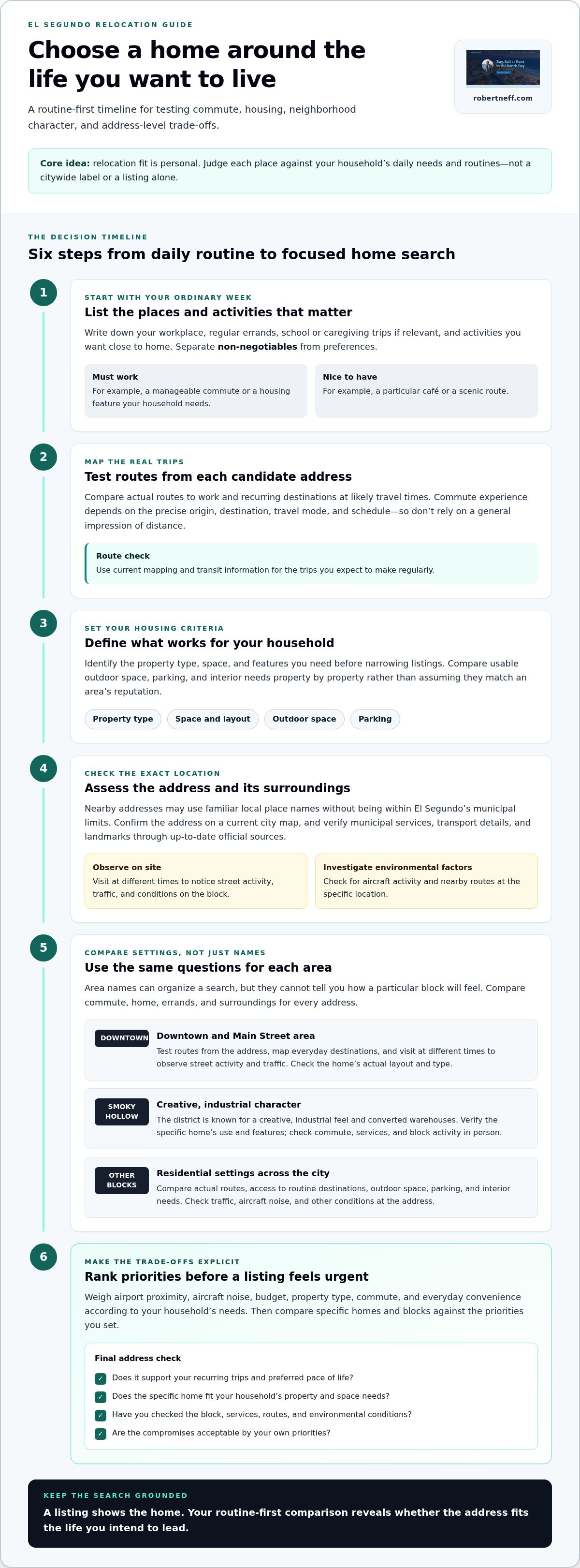
Before browsing listings, write down the destinations and activities that shape a normal week. Include your workplace, regular errands, school or caregiving trips if relevant, and the activities you want close to home. Separate non-negotiables from preferences. A manageable commute may be essential; a particular café or scenic route may be a bonus.
- Map recurring trips: Note where you need to go and when, then compare actual routes from potential homes.
- Describe your home needs: Identify the property type, space, and features that suit your household rather than starting with a neighborhood reputation.
- Test the immediate setting: Pay attention to the specific block and surroundings. Traffic, aircraft activity, and access to everyday destinations can vary by location.
- Rank trade-offs: Decide which compromises are acceptable before a promising listing makes the choice feel urgent.
This routine-first approach gives you a practical standard for comparing homes. As you begin relocating to El Segundo, assess each address against the life you intend to lead, not an assumption about the city as a whole.
Compare El Segundo Areas by Commute, Housing, and Everyday Fit
Area names can help organize a search, but they can’t tell you what living on a particular block will feel like. Compare El Segundo addresses using the same practical criteria: how you’ll travel, what kind of home suits your household, where regular errands fall, and what environmental factors you notice on site. The table is a starting point, not a substitute for assessing individual properties.
| Location or setting | Commute | Housing form | Daily errands | Environmental considerations |
|---|---|---|---|---|
| Downtown and Main Street area | Test routes from the specific address to work and regular destinations. | Compare the home’s actual layout and type; don’t infer it from the area name. | Map the places you’d visit on foot or by car and assess their practical convenience. | Visit at different times to observe street activity and traffic. |
| Smoky Hollow | Check how your commute works from the property, including your usual travel hours. | The district is known for a creative, industrial character and converted warehouses; verify the specific home’s use and features. | Assess the distance and route to the services you use most. | Look closely at the block’s activity and surroundings at different times. |
| Other residential blocks | Compare actual routes rather than assuming they match across the city. | Review outdoor space, parking, and interior needs property by property. | Measure how easily you can reach routine destinations. | Check traffic, aircraft noise, and other conditions at the address. |
Which location works best for your commute and routine?
Start with destinations, not neighborhood labels. List your work address, regular appointments, and the places you expect to visit each week. Compare routes at likely travel times from each candidate home. Commute experience depends on the precise origin, destination, travel mode, and schedule, so use current mapping and transit information rather than relying on a general impression of distance.
If you’re considering a job move, the El Segundo Economic Development site provides context about the city’s business environment. Pair that overview with your own route checks. If coastal character is central to your search, explore coastal homes for sale in the South Bay as a broader regional reference. Comparing El Segundo with nearby South Bay communities, including Redondo Beach, Hermosa Beach, Manhattan Beach, Palos Verdes, and Torrance, can also help clarify which locations suit your routines.
How to assess housing and surroundings block by block
Compare each home’s property type, usable outdoor space, parking, and access to everyday destinations. If schools, parks, or city services matter to your decision, verify details through current authoritative sources rather than relying on old listings or informal descriptions. City boundaries and service areas can differ, so confirm the address itself.
Visit promising blocks at more than one time of day when possible. Notice traffic, nearby activity, and aircraft noise at the property and in its immediate surroundings. Robert Neff provides local buyer guidance to organize a search around commute, lifestyle, and housing priorities. For South Bay buyer representation, an address-by-address comparison can help focus your search while you’re relocating to El Segundo.
Will El Segundo Suit You? Weigh Housing, Airport, and Cost Trade-Offs
El Segundo may appeal to you and still not suit your household. A city’s character can’t tell you whether a particular home works for your budget, commute, privacy needs, or tolerance for aircraft noise. Treat fit as a property-level decision: assess the address and its surroundings against the priorities you’ll live with every day.
Separate what you can adapt to from what could create ongoing strain. A longer trip to a regular destination may matter more than occasional airport noise, or a smaller home may be acceptable if it offers the location and access you value. There isn’t one correct ranking. The useful question is whether the trade-offs make sense for your household.
How to evaluate airport proximity and aircraft noise
Perceived aircraft noise can vary with a property’s location, time of day, conditions, and individual sensitivity. A quick visit may not reflect what you’d experience across a typical week. If possible, spend time at a prospective home at more than one time of day, both inside and outside. Notice how sound affects conversation, rest, or the activities you expect to do at home.
Keep your assessment specific to the address. Don’t assume that every home in the city has the same experience, and avoid relying on broad claims about noise. For technical information about airport activity or local guidance, consult current authoritative airport or municipal materials. Your own observations can help you decide how much this factor matters.
Match housing priorities to the realities of your move
Before comparing homes, rank the factors that shape your daily life. Mark each as a non-negotiable or a preference, then consider which trade-offs you’re willing to make. This makes it easier to assess a property on its merits instead of being swayed by one appealing feature.
- Budget: Set a realistic housing range for your plans and review current, property-specific information rather than relying on a citywide headline.
- Space and property type: Decide what your household needs for sleeping, working, storage, and outdoor use.
- Privacy: Consider how the home’s layout and immediate surroundings support quiet time and daily routines.
- Commute and essentials: Weigh travel to work and regular destinations alongside the home itself.
Cost comparisons deserve care. Housing choices, household circumstances, and the sources used to estimate living expenses can lead to different conclusions. Use current details for the homes you’re actually considering, including the full costs relevant to each property. Relocating to El Segundo becomes a clearer decision when you compare those details with your ranked priorities, not a general impression of the city.
Plan Your El Segundo Relocation: A Practical Timeline for Housing Decisions
A move is easier to manage when housing research and moving arrangements progress together. Use a flexible sequence rather than a fixed countdown: the right pace depends on whether you’re renting or buying, your move date, and the choices available as you search. Revisit the plan when a housing decision changes.
Prepare for a local or remote home search
Before scheduling tours, write down your location priorities, budget, timing, and preferred property type. Separate essentials from features you’d enjoy, and keep the list handy as new options come up. If you’re searching from a distance, request a video walkthrough that clearly shows the home’s layout and condition. Video can help you screen options and prepare questions, but it can’t replace a careful property evaluation or an in-person visit when one is feasible.
For a purchase, set aside time to review the property details and disclosures provided during the transaction. Organize questions as you read, and keep relevant documents together so you can follow up on points that affect your decision. For a rental, focus on the home, lease terms, move-in timing, and how the location supports your routine. The processes differ, so tailor your checklist to the type of housing you’re pursuing.
Coordinate housing decisions with the move itself
Think in stages, but keep the sequence adaptable. Buyers may begin with research and a search plan, then evaluate properties, make an offer, proceed through the transaction, and coordinate the move around confirmed dates. Renters may focus sooner on matching the lease and move-in timing to their plans. Neither path has a universal schedule. Availability, decisions, and transaction details affect how the steps fit together.
- Research: Clarify your priorities, likely travel needs, and preferred move window.
- Set a housing strategy: Define what you’re seeking as a renter or buyer and which trade-offs are acceptable.
- Evaluate properties: Compare homes, surroundings, and relevant documents against your priorities.
- Coordinate the transaction: Track key dates and decisions, understanding that plans can change.
- Prepare the move: Align packing, travel, and arrival arrangements with housing dates as they become firm.
Keep your schedule connected but flexible. Don’t treat an anticipated closing, lease start, or move date as final before it’s established. Leave room to adjust arrangements if a decision or transaction milestone shifts. That flexibility matters when relocating to El Segundo from another city, especially when property visits and moving logistics can’t happen on the same trip.
Real estate guidance can help structure the search and transaction, while legal, tax, and lending questions belong with professionals whose work covers those areas. Robert Neff provides relocation and buyer guidance to connect your housing priorities with a practical search plan. Discuss your relocation plans and map out next steps with local context.
Make Your El Segundo Move with a Local Buyer Strategy
A relocation search has more moving parts than a standard home search. You’re not only comparing properties; you’re learning a market while keeping work, timing, and household needs in view. A local buyer strategy turns those priorities into clear search criteria, so you can assess each property against what matters to you rather than judging it in isolation.
Start with the priorities you’ve identified: preferred location, commute, housing requirements, timing, and acceptable trade-offs. Use those criteria to compare homes and identify questions that need attention before a decision. This structure is especially useful if you’re searching remotely or balancing a move with other major changes.
What local buyer guidance can bring to a relocation
Local buyer representation can add market context to property comparisons and offer decisions. Market analysis helps you consider a home in relation to relevant market information, while buyer guidance keeps your location and household priorities central as you evaluate options. Neither removes uncertainty, but both can help organize a complex decision and clarify the factors behind it.
Robert Neff, Ph.D., provides relocation and first-time buyer guidance, along with residential search and negotiation support in El Segundo and the broader South Bay. He is a California-licensed Realtor® with DRE license number 02442812. His strategic buyer representation in the South Bay explains how local guidance can inform a coastal home search. For a broader framework for evaluating representation, see the El Segundo real estate agent selection guide.
Turn your priorities into clear next steps
A useful first conversation can focus on practical details: your preferred timing, work location, housing requirements, and essential features. If you’re still weighing options, say so. Those details can shape a search strategy that reflects your current plans without treating every preference as fixed.
From there, the process can move from priorities to property comparisons and, as appropriate, offer and negotiation decisions. For someone relocating to El Segundo, that steady sequence connects local context with the realities of a household’s move, while leaving room to adjust as plans develop.
If you’re ready to discuss your timeline and priorities, plan your El Segundo home search. Start with what you need from a home and what you’re still working out, then focus on practical next steps.
Take the Next Step with Confidence
A move becomes more manageable when the next decision is clear, even if every detail isn’t settled. Choose one practical starting point: identify the housing question that could most affect your plans, then gather the information you need to address it. That might mean clarifying your preferred move window, refining what you need from a home, or deciding which trade-offs deserve closer attention.
Relocating to El Segundo is a significant personal decision, and your priorities may evolve as you learn more. You don’t need every answer before you begin. A focused conversation can help turn your questions into a workable direction for the search while leaving room to adjust as your plans take shape.
Discuss your El Segundo relocation with Robert Neff and start shaping a home-search strategy around your timeline and priorities.
Frequently Asked Questions
Is El Segundo part of Los Angeles County?
Yes. El Segundo is a city in Los Angeles County and part of the South Bay. If you’re comparing it with Redondo Beach, Hermosa Beach, Manhattan Beach, Palos Verdes, or Torrance, verify the city for each specific address. Nearby place names and mailing descriptions can be confusing, and municipal services or school boundaries may not follow labels used in real estate listings.
Can I buy a home in California before I become a California resident?
Yes, you can generally buy a California home before establishing California residency. Purchasing property and determining your residency status are separate matters, and owning a home doesn’t by itself settle every tax or legal question. If you plan to finance the purchase, your lender will assess your circumstances and intended occupancy. For advice about residency, taxes, or lending, consult a professional qualified in that area.
How much should I budget for moving to El Segundo?
There’s no single reliable total without knowing your household, distance, and housing plans. Build a personalized budget with separate categories for transportation, packing or storage, temporary lodging, rental deposits or purchase-related expenses, and setting up your new home. Also consider whether your current and new housing costs could overlap, or whether a schedule change might require extra arrangements. Use current, situation-specific figures rather than a broad estimate.
What should I know about Los Angeles International Airport when choosing a home in El Segundo?
LAX’s proximity can be convenient for some residents and a consideration for others. Aircraft noise is experienced differently depending on the home’s location, conditions, time, and personal sensitivity. Visit a property at different times if possible, and note what you hear indoors and outside. For technical details about airport operations, rely on current information from authoritative airport or municipal sources rather than assuming all El Segundo homes have the same conditions.
Can I begin a home search in El Segundo while living out of state?
Yes. Relocating to El Segundo from out of state doesn’t prevent you from starting your search remotely. Share your housing needs, preferred timing, and work location with a local buyer representative, then review listing details and video walkthroughs to narrow options. A video can help you form questions, but it won’t show every feature or condition. Plan how you’ll evaluate a finalist in person or through appropriate property review.
What happens if my moving date changes after I make an offer?
The effect depends on your purchase contract and which dates or terms are affected. Don’t assume a moving-date change automatically changes a transaction deadline or that either party can alter agreed terms alone. Tell your real estate representative promptly so the relevant dates and next steps can be reviewed. If a contract change is needed, the parties may need to agree to it formally. Get legal advice for questions about your contractual rights.


