

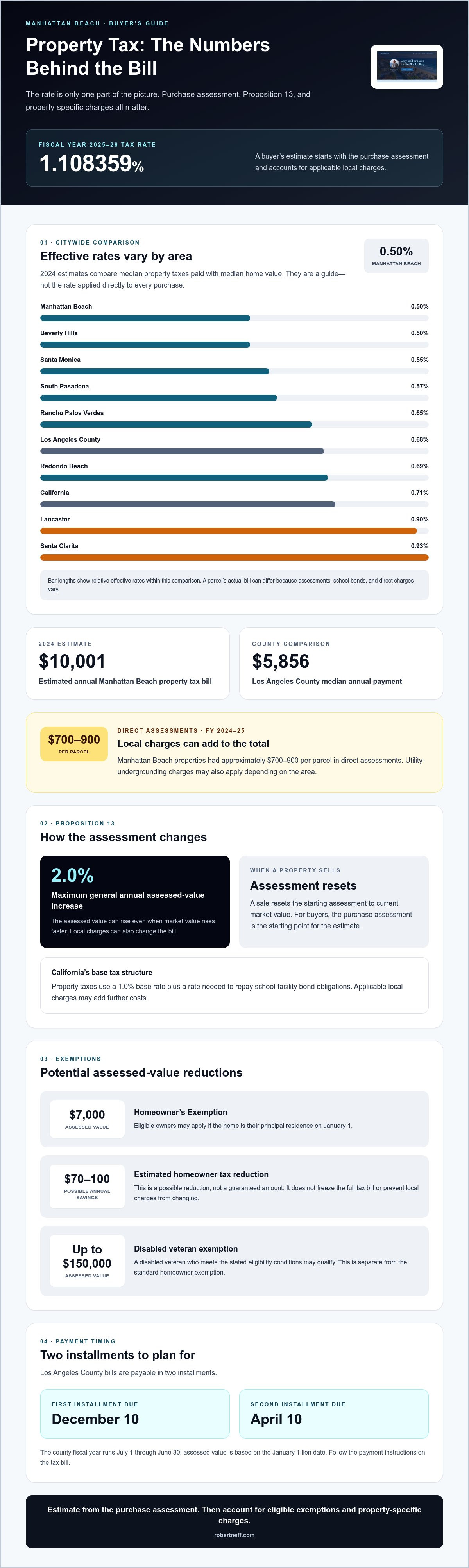
A low effective rate doesn’t necessarily mean a low tax bill. For buyers, Manhattan Beach property tax rates are shaped by Proposition 13, which caps assessed-value increases at 2% per year while voter-approved charges can add to the bill; a sale resets the assessment. The fiscal year 2025-26 tax rate is 1.108359%.
It’s easy to focus on the rate and overlook how the purchase price, assessment rules, and local charges work together. This guide explains how Proposition 13 affects your starting assessment and annual increases, what the Manhattan Beach rate means for a buyer’s budget, and how local rates compare with other Los Angeles County cities. You’ll also see why a property’s actual bill can differ from a simple rate-times-price estimate, so you can plan for ownership with a clearer picture of the costs.
Key Takeaways
- Proposition 13 generally limits annual growth in assessed value, but a purchase resets the starting point for a buyer’s tax calculation.
- Compare effective tax rates across nearby cities as a guide, while remembering that local bonds and parcel assessments can change a property’s total bill.
- Understand how a principal-residence exemption may reduce assessed value, and how the January 1 occupancy condition applies.
- Use a property’s tax budget alongside your home search and negotiation strategy to make a more informed buying decision.
How does Proposition 13 affect what I should budget when buying in Manhattan Beach?
Proposition 13 limits annual assessment growth, while a sale resets the starting assessment. For buyers, Manhattan Beach property tax rates must be understood alongside the purchase price and parcel charges.
Effective Property Tax Rates by Area
An effective property tax rate compares median property taxes paid with median home value. Manhattan Beach’s effective rate was 0.50% in a 2024 estimate, compared with 0.68% for Los Angeles County and 0.71% for California. These figures help compare places, but they aren’t the rate applied directly to every new purchase.
The Manhattan Beach property tax rate for fiscal year 2025-26 is 1.108359%. A buyer’s estimate starts with the purchase assessment and accounts for applicable local charges. Sales tax is separate: Manhattan Beach’s combined sales tax rate is 10.75% for 2026. Sales tax rates can vary within a county, city, or ZIP code, so it isn’t a measure of homeownership tax.
Property Tax Payments
Property tax payments are installments billed against a parcel’s assessed value. Los Angeles County bills are payable in two installments due December 10 and April 10. Use the payment instructions on the tax bill to submit payment. These dates help buyers plan their cash flow after closing, alongside any tax amounts handled during the transaction.
To look up a Manhattan Beach address, use the L.A. County Assessor’s website to estimate property taxes or view assessed values in its mapping viewer. Homeowners may appeal an assessed value to the Assessor if the property’s value declines. When comparing Manhattan Beach property tax rates, consider the specific property and its parcel charges, not just a citywide estimate.
Will my property taxes go up every year?
An assessment is the value used to calculate a property’s taxable amount. Proposition 13 generally limits increases to assessed value to no more than 2.0% per year, so a home’s assessed value can rise even when its market value rises faster. The tax bill may also change when voter-approved charges or local assessments change. A yearly increase is therefore possible, but it doesn’t automatically match the home’s market-price growth.
The Homeowner’s Exemption reduces assessed value for eligible owners who use the property as their principal residence. According to the Los Angeles County Assessor, a homeowner who occupies a home as their principal residence on January 1 may apply for a $7000 assessed-value exemption. The January 1 occupancy condition matters: owners should consider whether the home is their principal residence on that date when estimating eligibility.
California’s Homeowner’s Exemption can save homeowners roughly $70 to $100 per year. That estimate describes a possible tax reduction, not a guaranteed change to every tax bill. The exemption affects the assessed-value calculation; it does not freeze the property’s entire tax bill or prevent local charges from changing. Keep the exemption separate from Proposition 13’s limit when estimating future costs.
A disabled veteran who meets the stated eligibility conditions may qualify for an exemption of up to $150,000 off the home’s assessed value. This is a separate exemption, not an automatic increase to the standard homeowner exemption. Owners should identify which exemption fits their circumstances and include only eligible reductions in their estimate. For a buyer, the practical step is to budget from the purchase assessment first, then account for any applicable exemption and local charges.
Property tax rates in Los Angeles County cities
Effective rates help compare cities, while a parcel’s actual bill reflects its assessment and local charges. That difference helps explain why neighboring homes can have different tax totals.
Local and District Taxes
Local and district taxes are charges added for specific community or public purposes. Effective property tax rates compare median property taxes paid with median home value. Rates are 0.50% in Manhattan Beach and Beverly Hills, 0.55% in Santa Monica, and 0.65% in Rancho Palos Verdes. South Pasadena is 0.57%, while Santa Clarita is 0.93% and Lancaster is 0.90%.
These comparisons don’t describe every parcel’s full tax bill. Voter-approved bonds, school charges, and direct assessments can vary by district and property. Redondo Beach’s effective rate is 0.69%; its parcel charges may differ from Manhattan Beach’s. Compare the specific property’s tax components, not only the citywide rate.
Base Tax Rate and Assessment Rules
The base tax rate is the general levy applied to assessed value before special-purpose charges. California property taxes use a 1.0% base rate plus a rate needed to repay school-facility bond obligations. Los Angeles County assesses property taxes for a fiscal year running July 1 through June 30, using assessed value as of the January 1 lien date.
Those rules answer the county-rate question: the 1.0% base is not the full rate when applicable bond obligations and local charges are added. Assessment generally begins with the property’s purchase price, then Proposition 13 limits annual assessed-value increases to 2.0%. A sale resets the assessment to current market value.
Manhattan Beach Property Tax Bills
A property tax bill is the amount charged to a parcel for its assessed value and applicable local costs. The estimated annual Manhattan Beach property tax bill is $10,001, based on a 2024 estimate; Los Angeles County’s median annual payment is $5,856.
Parcel totals vary with assessed value, school bonds, and direct assessments. Manhattan Beach properties had approximately $700-900 per parcel in direct assessments for fiscal year 2024-2025, with possible utility-undergrounding charges depending on the area. Homeowners may appeal an assessed value to the L.A. County Assessor if the property’s value declines.
California’s Proposition 13 property tax limits
Proposition 13 is California’s constitutional framework for limiting property assessments and general property taxes. To calculate a Manhattan Beach property tax bill, start with the purchase price as the initial assessed value, apply the general tax rate, then account for voter-approved bonds and other applicable charges.
California’s general property tax is limited to 1% of a property’s market value, excluding taxes collected for special purposes. Proposition 13 also limits assessed-value increases to 2.0% per year. These rules mean a home’s tax assessment can rise more slowly than its real estate market value while the same owner holds it.
Consider the stated example: a home bought for $100,000 has a first-year property tax of $1,000. If its value reaches $150,000 the second year, the assessment rises to $102,000 under the 2.0% cap. The resulting $1,020 tax is less than $1,500 based on the home’s full market value. The example shows how assessed value, rather than current market value alone, shapes the tax calculation.
A sale changes the calculation because California properties are reassessed at current market value when ownership changes. Buyers should estimate their initial assessment using the expected purchase price, not the seller’s long-held assessment. If the seller owned the property under earlier limits, their tax bill may not reflect the buyer’s future bill.
Manhattan Beach’s fiscal year 2025-26 property tax rate is 1.108359%, reflecting more than the 1.0% general rate. The difference includes local charges; special-purpose taxes sit outside Proposition 13’s general-tax limit. Compare the assessed value and each parcel’s charges to estimate the full bill, rather than applying only the 1% limit.
For buyers comparing California cities, the takeaway is practical: Proposition 13 limits annual assessment growth after purchase, but it doesn’t preserve the seller’s assessment. Build your estimate from the purchase price, the applicable local rate, and parcel-specific charges.
Robert Neff, Ph.D., Realtor®: Buyer Search & Negotiation Services
Robert Neff, Ph.D., Realtor® helps buyers compare Manhattan Beach homes and ownership costs through Buyer Search & Negotiation Services. Include property-tax estimates alongside purchase price, assessed value, and parcel charges as you compare homes. This gives you a clearer picture of ongoing costs and can help you prepare for negotiations.
First-time buyers and people relocating to the South Bay can get step-by-step support through Relocation & First-Time Buyer Guidance. Sellers can use Residential Property Listing & Marketing to prepare and present a home to the market. The right next step depends on whether you’re buying, selling, relocating, or searching for a coastal rental in communities such as Redondo Beach, Hermosa Beach, Manhattan Beach, El Segundo, Palos Verdes, and Torrance.
To discuss your real estate plans, contact Robert Neff, Ph.D., Realtor®.
Make your next move with a clear budget
Use your property-tax estimate as part of the decision, not as a figure separate from the home itself. Consider how the tax obligation fits your priorities, preferred neighborhood, and plans for the property. This can help you compare options carefully and focus on homes that suit your next move.
Manhattan Beach property tax rates are one piece of a larger purchase decision. The next step is to connect the numbers with your search strategy, negotiation priorities, or relocation plans. A thoughtful real estate conversation can help you organize those considerations around the move you want to make.
For guidance on buying, selling, or relocating, contact Robert Neff, Ph.D., Realtor®. Take the next step at a pace that feels right for you, with a clearer sense of the choices ahead.
Frequently Asked Questions
What triggers a reassessment in California?
A change in ownership or completed new construction triggers reassessment to current market value in California. For example, when a Manhattan Beach home sells, the new assessment generally reflects its market value at the ownership change, rather than simply continuing the seller’s assessment. This can reset the buyer’s starting point for future tax calculations. Ordinary annual assessment increases follow a separate rule under Proposition 13.
What is the current property tax rate in Manhattan Beach, California?
Manhattan Beach’s property tax rate is 1.108359% for fiscal year 2025-26. This is the local rate applied to assessed value, before considering charges that may be billed separately or depend on a particular parcel. A buyer estimating a home’s bill should use the assessment associated with the purchase and account for property-specific charges, rather than assuming the seller’s tax bill will carry over.
What additional local assessments and parcel taxes apply to Manhattan Beach properties?
Manhattan Beach parcels may include local assessments, bond charges, and parcel taxes. Measure MB levies a $225 annual parcel tax for six years. For fiscal year 2024-2025, properties had approximately $700-900 per parcel in direct assessments, with possible utility-undergrounding assessments depending on area.
Are property tax exemptions or relief programs available to Manhattan Beach homeowners?
Yes. A Los Angeles County homeowner occupying a home as their principal residence on January 1 may apply for a $7000 assessed-value exemption, according to the Los Angeles County Assessor. A disabled veteran who meets the stated eligibility conditions may qualify for an exemption of up to $150,000 off the home’s assessed value. These reduce taxable assessed value; they don’t erase every charge on a property’s bill.
How do Manhattan Beach property taxes compare with nearby cities such as Hermosa Beach and Redondo Beach?
Reported rates and additional charges differ across these South Bay cities. Hermosa Beach homeowners pay a 0.6% property tax rate, with additional fees totaling about 1.03%. Redondo Beach’s rate is 0.7%, with additional fees totaling about 1.1%. Manhattan Beach’s fiscal year 2025-26 rate is 1.108359%. Compare the applicable assessment and parcel charges, since citywide figures may not match an individual property’s total.


