

A low appraisal can change the terms of a Redondo Beach purchase, but it doesn’t automatically end the deal. In the Redondo Beach home appraisal process, the lender uses the appraised value to assess whether the property supports the loan and won’t fund a loan above that value. The buyer and seller may negotiate a price adjustment, the buyer may pay the difference in cash, the appraisal may be challenged with stronger comparable sales, or the parties may cancel.
The gap between the contract price and appraised value can feel unsettling, especially when you’re coordinating a move or financing. Knowing what the appraiser evaluates and what options follow a low result can make your next decision clearer.
This guide explains how fair market value is estimated for Redondo Beach homes, condos, and small multi-unit properties, how to prepare for an appraisal visit, and how an appraisal differs from an inspection or comparative market analysis. You’ll also learn how lender timelines fit into the transaction and what to review if the report contains an error.
Key Takeaways
- Appraisers weigh comparable sales alongside a property’s condition, layout, location, and features to form an independent value opinion.
- Prepare for the visit by making key areas accessible and organizing records of upgrades, maintenance, permits, and receipts.
- An appraisal estimates value, while an inspection evaluates accessible structural and mechanical systems; a CMA serves a different role in pricing decisions.
- Local market knowledge helps an appraiser interpret how a home’s setting and characteristics compare with nearby sales.
- Build the appraisal into the lender’s schedule: the walkthrough is often arranged within 3-7 days of contract, and the report usually takes 5-10 business days.
Fair market value for homes, condos, and 2-4 unit properties
Fair market value is the most probable price in a competitive, open market under fair-sale conditions. For buyers and sellers, an appraisal is an independent opinion based on the property and market evidence, not a pass-or-fail test.
Value Estimates and Comparable Sales
Appraisers commonly use the sales comparison approach, studying nearby properties that recently sold and resemble the subject home. They consider differences in property condition, layout, square footage, lot size, views, privacy, outdoor space, and upgrades. For a condo, the complex and comparable units matter; for a 2-4 unit property, the appraiser evaluates the property’s relevant characteristics and available market evidence.
Comparable sales ground a value estimate in completed transactions rather than a seller’s asking price or a buyer’s offer. Appraisers independently verify information and aren’t required to use sales or documents shared with them. Property records and local sales data can inform the analysis; the U.S. Environmental Protection Agency describes property-value analyses that use sale prices and property characteristics.
Location and Neighborhood Influences
Location affects how a property compares with alternatives buyers may consider. In Redondo Beach, beach proximity, neighborhood conditions, views, privacy, and outdoor space can distinguish otherwise similar homes. The U.S. Environmental Protection Agency’s Los Angeles-area housing-value analysis treated beach distance, neighborhood conditions, and air quality as factors in home sale prices.
These influences are assessed alongside the home itself, not as a fixed premium applied across the city. A nearby sale may be a poor comparison if its setting or property characteristics differ. When buying or setting a listing strategy, this context helps explain why homes with similar square footage can receive different value opinions.
Renovations, Upgrades, and Legal Bedrooms
Renovations can affect an appraisal, but their cost doesn’t automatically translate into equal added value. High-end finishes may not raise the estimate if local buyers don’t support that level of improvement; some luxury upgrades may be over-improvements for the neighborhood. Appraisers compare the work with local sales and the property’s overall condition.
A national survey cited in the research reports an average 88% return on investment for kitchen remodeling, while bathroom renovations return 85%. Those figures describe averages, not guaranteed appraisal adjustments. A legal basement bedroom may count toward room count and square footage if it meets local building-code requirements for ventilation and egress. Permits, receipts, and dated improvement records can help document work, while public records may also inform the review.
Steps in the Appraisal Process
The Redondo Beach home appraisal process typically starts when a mortgage lender orders an appraisal to assess whether the property supports the financing. During the visit, the appraiser inspects and measures the property, reviews its layout and general condition, and takes photographs. The appraiser then analyzes relevant market data and prepares a report describing the value opinion and supporting information.
Appraisers may consider inspection observations, MLS sales information, public records, FEMA flood-zone data, and local market experience. They independently verify data, so supplied documents inform the review but don’t determine its conclusions. What permits and records do Redondo Beach appraisers review? They may use public records and verified property information. Permits, receipts, and improvement records can document upgrades, but the appraiser independently assesses relevant data.
How much does a home appraisal cost in Redondo Beach? The fee depends on property type, assignment purpose, scope, and complexity, and is provided after a quote request. What are the steps in a home appraisal in Redondo Beach, California? The lender orders it, the appraiser inspects and measures the property, analyzes evidence, and prepares a report. What comparable home sales are used for Redondo Beach appraisals? Appraisers commonly analyze nearby, recently sold properties with similar characteristics, adjusting their analysis for differences. How do Redondo Beach location, beach proximity, and neighborhood affect appraised value? They shape how the property compares with relevant sales, alongside its condition, features, and market context.
Preparing a home for an appraisal
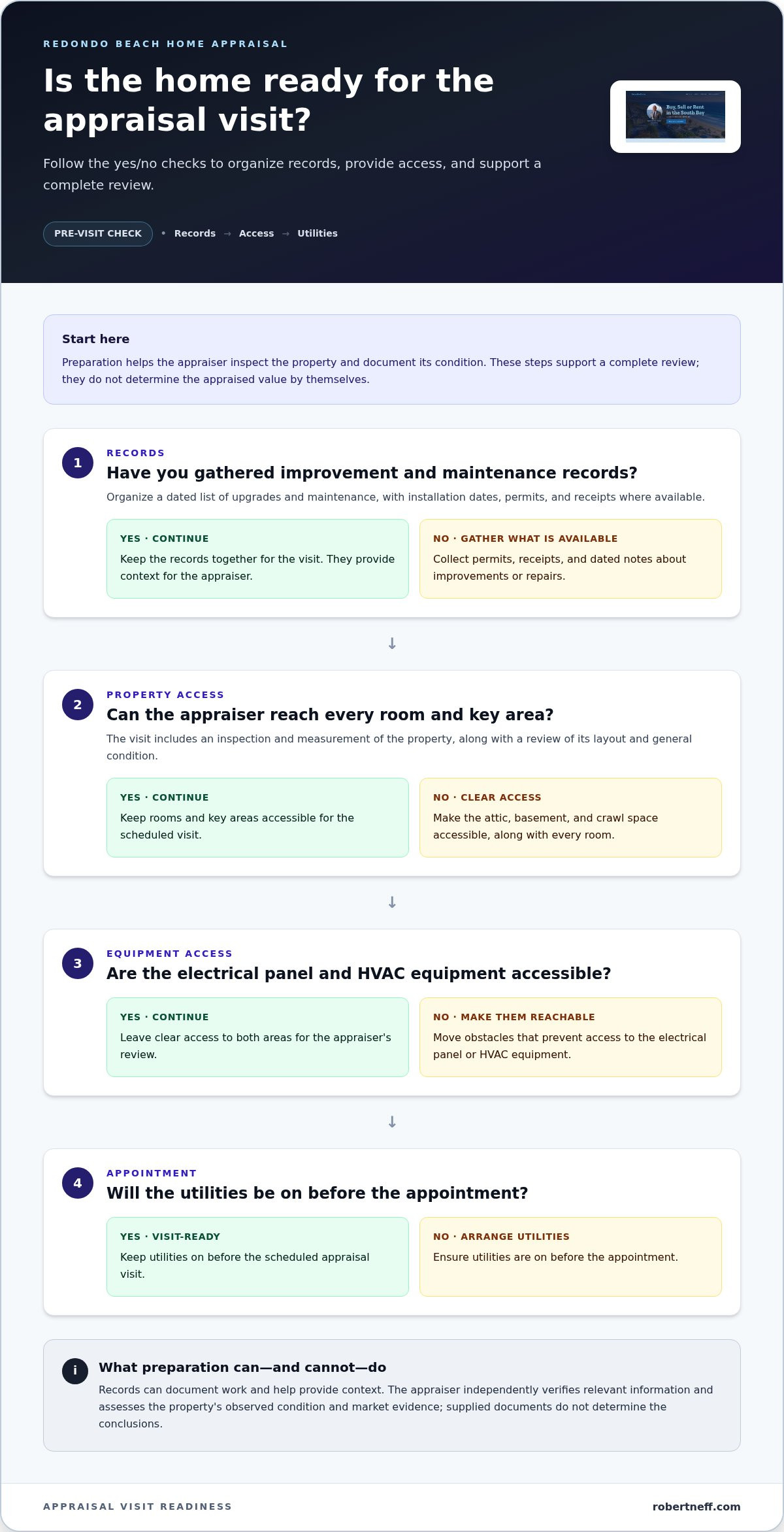
Preparation helps the appraiser inspect the property and document its condition accurately. In Redondo Beach, sellers can organize records, clear access, and take care of minor maintenance before the scheduled visit. These steps support a complete review; they don’t determine the appraised value by themselves.
Start with the property records. Prepare a dated list of upgrades and maintenance, with installation dates, permits, and receipts where available. For example, note when a kitchen renovation was completed and keep its permit documents together. These details give the appraiser context, while the report still reflects independently verified information and the home’s observed condition.
- Gather permits, receipts, and dated notes about improvements or repairs.
- Make every room and key area accessible, including the attic, basement, and crawl space.
- Clear access to the electrical panel and HVAC equipment.
- Ensure utilities are on before the appointment.
Access can help the appraiser review the home’s relevant areas. A locked attic hatch or blocked electrical panel can limit what the appraiser observes during the visit. If square footage, room count, or a finished area may be unclear, keep related records available. The appraiser independently evaluates the information and property.
Clean, uncluttered, well-lit rooms make it easier to move through the home and view its features. Cleanliness doesn’t add value, but an unobstructed view of a repaired window, updated flooring, or maintained outdoor area helps the appraiser observe the property. Fix minor issues where practical, such as a loose doorknob or dripping faucet, and accurately document completed work.
How can homeowners prepare for a Redondo Beach home appraisal or challenge a low valuation? Organize improvement records, provide access to all areas, and make sure utilities are on. If the report contains factual errors, such as incorrect square footage or room counts, request a reconsideration of value through the lender with corrected information or stronger comparable sales.
A low opinion isn’t corrected by presentation alone; relevant evidence matters. Review the report for factual mistakes and note comparable sales that better reflect the home’s location and features. For a seller planning a listing, Redondo Beach listing guidance can help connect property preparation with a broader marketing and pricing strategy before closing.
Appraisals compared with home inspections and CMAs
A Redondo Beach purchase can involve an appraisal, a home inspection, and a comparative market analysis, or CMA. Each serves a different purpose: an appraisal estimates market value, an inspection evaluates accessible building systems, and a CMA helps inform pricing decisions. Knowing which question each answers helps buyers and sellers interpret the results.
What an Appraisal Measures
For a mortgage transaction, the lender usually orders an appraisal to assess whether the property supports the financing. The appraiser develops an independent opinion of value using market evidence and relevant property characteristics. The report isn’t a complete assessment of every defect or a promise that the agreed purchase price will be supported.
For example, an appraiser may note a home’s condition, layout, and comparable sales while estimating its value. The appraiser doesn’t conduct a complete home inspection of structural and mechanical systems. A buyer should read the appraisal as a valuation report, not a substitute for a dedicated inspection.
What a Home Inspection Evaluates
A home inspection focuses on accessible structural and mechanical systems, not fair market value. The inspector’s observations can help a buyer understand the home’s physical condition and identify issues for further consideration. A roof concern or plumbing issue, for instance, belongs in the inspection discussion, even if it doesn’t directly establish the property’s market value.
The two assessments may describe the same home from different angles. An appraiser records characteristics relevant to valuation; an inspector examines accessible systems and components. For a seller, completing improvements before listing may affect presentation or condition, but neither an inspection nor an appraisal guarantees a sale price.
What a CMA Is Used For
A CMA compares a property with relevant local listings and sales to guide a pricing strategy. A real estate professional may use similar homes, their features, and market activity to advise a seller setting an asking price or a buyer evaluating an offer. Unlike a lender-ordered appraisal, a CMA isn’t the appraiser’s independent value opinion for mortgage underwriting.
Consider a Redondo Beach home with outdoor space and a recent kitchen update. A CMA can help assess how those features compare with nearby properties and current competition. An appraisal, by contrast, independently evaluates market evidence for its intended use. Different conclusions can reflect distinct purposes, data, and analysis, not necessarily an error.
Which Result Answers Your Question?
Use the appraisal to understand the lender’s valuation, the inspection to assess accessible systems, and the CMA to inform a buying or selling strategy. If a report has an incorrect bedroom count or square footage, focus on correcting that factual record. If the inspection identifies a repair issue, address it through the purchase process rather than treating it as a direct valuation adjustment.
These distinctions matter before closing. A buyer relying on an appraisal to identify every maintenance concern may miss issues the valuation wasn’t designed to assess. A seller treating a CMA as the lender’s appraisal may misunderstand financing risk. Keep each document tied to its purpose, and compare its findings with the decision you need to make.
Choosing a licensed or certified appraiser with local experience
In California, appraisers are generally required to hold a state license or certification, meet education and experience requirements, and comply with the Uniform Standards of Professional Appraisal Practice (USPAP). These qualifications support a structured valuation process. Local familiarity also matters: Redondo Beach properties include coastal homes, condominiums, and small multi-unit buildings with distinct features.
Local experience helps an appraiser interpret comparisons rather than simply select nearby sales. A property near the beach may differ from another home in its view, privacy, outdoor space, or neighborhood conditions. A condo’s complex can affect which sales offer meaningful comparisons. For a 2-4 unit property, relevant characteristics and local market evidence shape the analysis.
What Local Knowledge Adds
An appraiser familiar with Redondo Beach can recognize when two nearby addresses aren’t true substitutes. Street setting, property type, layout, lot size, and condition all affect how useful a comparable sale may be. Local knowledge helps frame those differences, while the appraiser must still independently verify information and develop an impartial opinion.
Experience doesn’t mean favoring a target value. The appraiser’s role is to analyze evidence for the assignment’s intended use. In a mortgage transaction, the lender orders the appraisal to assess whether the property supports the financing. The appraiser’s independence matters to both buyer and seller because the report informs a lending decision.
Credentials, Scope, and Communication
Credentials are one part of understanding an appraisal assignment. The report identifies its client, intended users, intended use, purpose, type and definition of value, effective date, property characteristics, and scope of work. These details show what the valuation addresses and help readers distinguish a mortgage appraisal from an estate, tax, or investment assignment.
Clear communication can help keep an assignment focused on accurate property information. For example, the owner may provide records about upgrades, permits, or a finished area. The appraiser can consider relevant material but isn’t required to use documents or comparable sales supplied by others. Independent verification remains part of the valuation.
Review the report’s factual details, including square footage, bedroom and bathroom counts, condition, and comparable sales. If an error affects the analysis, corrected records can support a reconsideration request through the lender. A different opinion alone doesn’t establish a factual error; a stronger request identifies a specific mistake or relevant comparable evidence.
For Redondo Beach buyers and sellers, the practical standard is straightforward: qualifications support professional work, local knowledge provides context, and independent analysis protects the report’s purpose. Understanding these roles helps readers interpret the valuation without confusing local familiarity with a promise of a particular result.
Coordinating appraisal timelines with the lender
The lender’s appraisal schedule affects underwriting and the path to closing. In a Redondo Beach purchase, the lender usually orders the appraisal to assess whether the property supports the mortgage amount. Knowing the usual sequence helps buyers plan access, track the report, and understand when the valuation becomes relevant to loan approval.
A walkthrough is often scheduled within 3-7 days of contract. The property visit for a typical appraisal takes under an hour, depending on the home’s size. The appraiser inspects, measures, reviews the layout and condition, and photographs the property. Keep rooms and key areas accessible so the visit can proceed without avoidable delays.
After the visit, the appraisal report is usually completed within 5-10 business days. An official appraisal typically takes around one to two weeks overall, including inspection and reporting. These timeframes describe different parts of the process: the appointment, report preparation, and total sequence. Complex properties may take longer to report. An FHA appraisal report can take from a few days to a few weeks after the visit.
How long does a Redondo Beach home appraisal take and how soon is the report delivered? A typical walkthrough takes under an hour, and the report usually arrives within 5-10 business days. The complete process commonly spans around one to two weeks, while complex properties and FHA assignments can have longer report timelines.
Coordinate the appointment around the contract schedule. Keep the lender informed about access arrangements and any scheduling changes. Confirm whether an adult aged over 18 must be present to provide access. Before the appointment, ensure utilities are on and have records about improvements ready. These details help the appraiser inspect the property and document its characteristics.
Once the lender receives the report, the appraisal becomes part of the underwriting review. If the value meets or exceeds the purchase contract price, the lender typically continues underwriting and final loan approval. A lender won’t fund a home loan above the appraised value, so a lower result can affect financing and timing. The buyer and seller may need to address the gap before closing.
The lender retains the right to use its appraisal report or information in it. The buyer is entitled to receive a copy, but may not use it for another purpose without the lender’s permission. If a report contains a factual error, such as incorrect square footage, submit corrected information or stronger comparable sales through the lender as a reconsideration request.
For help keeping a purchase or sale strategy aligned with appraisal timing, coordinate your Redondo Beach home search with the contract milestones.
Robert Neff, Ph.D., Realtor®: Buyer Search & Negotiation Services
Robert Neff, Ph.D., Realtor® offers Buyer Search & Negotiation Services for buyers weighing a home’s appraised value against its contract price. When an appraisal comes in below the agreed amount, he can guide buyers through their purchase strategy and negotiation decisions. Sellers preparing to list can use Residential Property Listing & Marketing to shape a pricing and presentation strategy informed by local market conditions.
Relocation & First-Time Buyer Guidance can help buyers understand the steps and decisions involved in a Redondo Beach transaction. The right support depends on whether you’re buying, selling, relocating, or searching for a coastal rental.
To discuss your real estate plans, contact Robert Neff, Ph.D., Realtor®, or visit robertneff.com.
Move Forward With a Clear Property Strategy
An appraisal is one part of a real estate decision, not the decision itself. Use its findings to clarify your priorities, understand the questions that remain, and choose a practical next step for your purchase or sale. The Redondo Beach home appraisal process can inform your strategy, while your goals, timing, and understanding of the property shape what you do next.
For buyers, that may mean refining what you’re willing to offer or identifying property details that need closer attention. For sellers, it may mean considering how to position the home for the market. Relocating and first-time buyers may also benefit from thoughtful guidance as they weigh unfamiliar decisions.
Robert Neff, Ph.D., Realtor® offers Buyer Search & Negotiation Services, Residential Property Listing & Marketing, and Relocation & First-Time Buyer Guidance. Contact Robert Neff, Ph.D., Realtor® to discuss your next real estate step and move ahead with a plan that fits your goals.
Frequently Asked Questions
What Happens If the Appraisal Comes In Low?
A low appraisal creates a financing gap between the contract price and the lender’s valuation. The buyer and seller can negotiate a price adjustment, or the buyer can pay the difference in cash. They can also submit stronger comparable sales through the lender and request reconsideration, or cancel the deal. Before deciding, compare the report’s property details and sales with the home’s actual characteristics and contract terms.
After completing the report, what assurance is there that the value indicated is valid?
An appraisal is a supported opinion of value, not a guarantee that a property will sell for that amount. The report follows USPAP and documents its intended use, effective date, property characteristics, and scope of work. Appraisers must independently verify relevant data, though they aren’t required to use information supplied by others. Readers can assess the report’s reasoning and flag factual errors, but market value remains an estimate.
Can I share comps with the appraiser?
Yes, you can share relevant sales information, such as a nearby home with a similar layout or lot. Treat it as context, not an instruction: the appraiser independently verifies data and isn’t required to use submitted sales. A useful comparison includes details that explain its similarity, such as property type, condition, and location. The appraiser decides which evidence fits the assignment and supports the valuation.
Do basement bedrooms count on an appraisal?
A basement bedroom may count toward room count and square footage when it meets local building-code requirements for ventilation and egress. A finished room alone doesn’t establish that it qualifies as a legal bedroom. Provide records about the space and its improvements, then let the appraiser assess the property and applicable requirements. Accurate documentation can help distinguish a legal bedroom from unfinished or nonqualifying space.
Do high-end finishes always increase appraised value?
No. A luxury kitchen or custom finish doesn’t automatically add value equal to its cost. The appraiser considers whether comparable Redondo Beach sales support that feature and whether it fits the local market. An upgrade that stands well above neighborhood expectations may be treated as an over-improvement. A premium finish can make a home distinctive without producing a value adjustment equal to its installation expense.
How do I get ready for the appraiser?
Make the home easy to access and gather useful records in one place. Include dated notes about improvements and maintenance, plus permits and receipts when available. Clear routes to areas such as the attic, crawl space, electrical panel, and HVAC equipment. Make sure utilities are on. A tidy, well-lit space supports a smooth visit, but cleaning alone doesn’t increase appraised value.
How do appraisers determine home value in Redondo Beach?
Appraisers typically compare the property with similar nearby homes that have sold, then analyze differences that matter to value. For example, a condo is considered in relation to its complex and comparable units, while a detached home may be compared by lot, layout, and outdoor space. The appraiser also considers condition and market context, then independently verifies information before forming a value opinion.
What property features and condition issues affect a Redondo Beach home appraisal?
Relevant features include property type, square footage, layout, lot size, views, privacy, outdoor living areas, and upgrades. Condition matters too: an appraiser observes the home’s general state and records its characteristics. Two homes with similar interior space may differ in lot, outdoor use, or view. Their appraised values can reflect those differences and how comparable sales support them.


