

South Bay real estate commission rates aren’t fixed by law; they’re negotiable between the agent and client. In a home sale, the seller is often responsible for commission under the listing agreement, but the parties can agree on different payment arrangements.
It’s understandable to focus on the rate: commission can shape a seller’s net proceeds and a buyer’s costs. But the percentage alone doesn’t explain what the fee covers or who ultimately pays. This guide explains what can influence commission, how negotiation works, what changed for buyer-agent agreements, and how California’s average compares with the national figure.
Understanding the payment arrangements helps you assess the full transaction instead of relying on one percentage. With a clearer picture of the terms and responsibilities, it’s easier to discuss representation and plan your next move.
Key Takeaways
- Commission rates are negotiable, so compare the proposed rate with the services and representation it covers.
- Understand how buyer-agent compensation is arranged and what a written agreement sets out before touring homes.
- California’s average total commission is below the national average, but averages don’t determine the rate for an individual sale.
- Clarify who is responsible for payment and how it affects the transaction before finalizing an offer or listing plan.
Commission negotiability
California real estate commissions are negotiable between the agent and client, not fixed rates. South Bay sellers can discuss the rate, included services, and payment terms. Other closing costs may include escrow or title charges, loan payoff expenses, and prorated property costs, depending on the transaction and its agreements.
Negotiating Agent Commission Rates
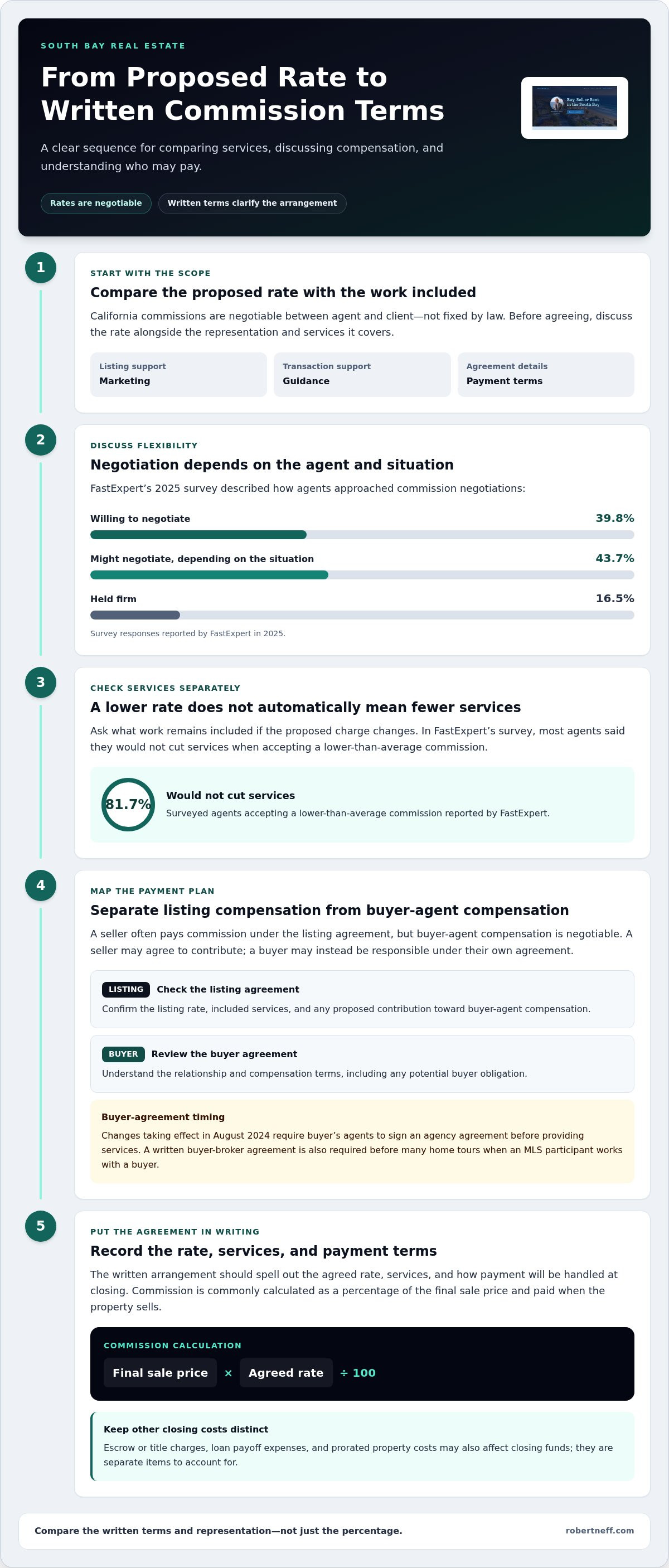
Negotiating an agent’s commission means agreeing on the rate and representation before signing a listing arrangement. Compare the proposed charge with the listing agent’s marketing, transaction guidance, and other included services. FastExpert’s 2025 survey found 39.8% of agents were willing to negotiate, 43.7% might negotiate depending on the situation, and 16.5% held firm. These results show why a clear discussion matters.
Commission Payment Arrangements
The written commission arrangement should state the agreed rate, services, and how payment will be handled at closing. Commission is commonly calculated as a percentage of the final sale price and paid when the property sells. Clarify whether the proposed rate covers only the listing agent or includes a contribution toward buyer-agent compensation. Agree on the terms in writing before proceeding.
For a practical negotiation, ask the real estate agent to explain the work covered by the proposed rate. Then compare the scope, not just the percentage. A lower charge may involve different services or terms, so discuss what remains included before choosing. FastExpert reported that 81.7% of surveyed agents would not cut services when accepting a lower-than-average commission. That makes the service details especially important.
Commission is not automatically 6%, even though that figure has historically been cited as a national benchmark. Treat it as a point for discussion, not a required rate. Sellers can negotiate the listing agreement and separately discuss buyer-agent compensation. The final arrangement shapes expected proceeds and closing funds, while escrow, title, loan, and prorated property expenses remain separate items to account for.
Who pays the buyer's agent after the NAR settlement
Buyer-agent compensation is negotiable, not automatically assigned to one party. A seller may agree to contribute, or a buyer may be responsible under their agreement. The payment plan should be clear before closing.
Changes taking effect in August 2024 require buyer’s agents to sign an agency agreement before providing services. A written buyer-broker agreement is also required before many home tours when an MLS participant works with a buyer. It sets out the relationship and compensation terms, helping buyers understand their potential obligation before touring a listing.
South Bay sellers should read the listing agreement for the listing agent’s rate, included services, and any proposed contribution toward buyer-agent compensation. Check whether the terms list separate amounts or a combined commission, and how changes must be agreed. This helps clarify the seller’s potential payment and distinguish it from the buyer’s separate agreement.
The calculation uses the final sale price multiplied by the agreed rate, then divided by 100. A 5% rate on the same sale would produce a different total, so the written rate matters.
Agent compensation may also be divided with a broker, so the agent’s eventual share can differ from the amount allocated to that side of the transaction. The market, negotiated services, and written agreements shape the arrangement; there is no universal split. Buyers and sellers should distinguish the agent’s compensation from the brokerage’s share.
For buyers weighing representation and negotiation, buyer search and negotiation guidance can help clarify how compensation fits into an offer.
California and national average commission rates
In 2026, the average total real estate commission was 5.47% in California and 5.70% nationwide. California’s average was 0.23 percentage points lower. These figures offer context for South Bay real estate commission rates, but they don’t set a required rate or determine an individual transaction’s terms.
The national average included approximately 2.88% for the listing agent and 2.82% for the buyer’s agent. Together, those averages total 5.70%. Actual arrangements can differ: each agent’s compensation is negotiable, and the parties can agree on different rates or payment terms.
For South Bay homeowners preparing to sell, an average commission rate can provide context for a discussion, but it doesn’t determine what an agent may charge. The agreed rate, sale price, and services covered shape the transaction. Compare the written terms and representation offered instead of treating a national average as a local standard.
California’s 5.47% average also doesn’t mean every seller pays that rate. It describes an average across transactions, while a particular agreement reflects its own negotiated terms. A realtor’s commission may be divided between listing and buyer representation, but the percentages allocated to each side can vary from the national averages.
Use averages as context when deciding how to sell your home, not as a substitute for reviewing the agreement. The 2026 figures show California’s total average below the national one, but neither figure sets a seller’s obligation. For people comparing South Bay real estate commission rates, the payment terms depend on the agreement. Local housing conditions and the services included can inform that discussion.
Who typically pays real estate commissions
In a South Bay home sale, the seller is often responsible for commission under the listing agreement. But that doesn’t make every payment arrangement automatic: the amount and any contribution toward buyer-agent compensation depend on the parties’ agreements. Separate who has agreed to pay from how the final cost affects the deal.
Buyers may still bear some of the economic cost indirectly. Sellers often consider commission when setting an asking price, along with the home’s condition and comparable properties. That doesn’t mean buyers directly pay an agent commission in every transaction. It means expected costs can influence negotiations and the price a buyer agrees to pay.
For example, a seller may agree to pay a listing agent under the listing agreement, then separately consider contributing toward buyer representation. The buyer’s agreement sets out buyer-agent compensation. If the seller doesn’t cover the full amount contemplated in that agreement, the buyer’s potential responsibility depends on its terms. The signed agreements clarify each party’s obligations.
The percentage is generally applied to the property’s final sale price, rather than treated as a flat amount regardless of the outcome. An accepted offer below the asking price can therefore change the commission calculated at closing. Sellers can use the final sale price and agreed percentage to estimate the commission and their net proceeds.
Before accepting an offer, compare its price with the payment terms and any requested contribution toward buyer representation. This shows how the proposed arrangement affects the seller’s proceeds and the buyer’s funds. For South Bay buyers weighing representation and offer terms, buyer search and negotiation services can help bring those questions into the purchase discussion.
Robert Neff, Ph.D., Realtor®: Buyer Search & Negotiation Services
Robert Neff, Ph.D., Realtor® offers buyer search and negotiation support for people weighing representation, offer terms, and commission arrangements. This guidance helps buyers understand how compensation fits into a purchase and approach negotiations with a plan.
For sellers preparing to list, Residential Property Listing & Marketing includes professional market analysis, strategic pricing, and home staging. Relocation & First-Time Buyer Guidance helps people working through a move or navigating a purchase for the first time. Coastal Rental Search supports those looking for a rental near the coast.
Choose the support that matches your next step: buying, selling, relocating, or searching for a coastal rental. Visit robertneff.com to discuss your real estate plans.
Plan Your Next Real Estate Move
Turn general commission information into a plan for your own move. Start by considering your priorities: the proceeds you hope to retain, the representation you need, and how compensation fits your broader goals. Keeping these clear can focus discussions and help you compare proposed terms with the services involved.
South Bay real estate commission rates are one part of a larger transaction strategy. Whether you’re preparing to sell, buying a home, or relocating, Robert Neff, Ph.D., Realtor® can guide you through buyer search, listing, and relocation support.
Contact Robert Neff, Ph.D., Realtor® to discuss your plans and the guidance that fits your situation. A thoughtful plan can help you move forward with greater clarity.
Frequently Asked Questions
What Goes into Realtor Commission?
A real estate commission compensates agents for work that supports a property sale, not just the closing. A listing agent may coordinate marketing, showings, negotiations, and transaction guidance. For a Redondo Beach home, the agreed scope may include preparing the listing and helping manage offers. The agent’s share may differ from the gross commission because the brokerage may receive a portion.
Can agents negotiate a higher split?
Agents and brokerages may agree to different compensation-sharing arrangements. An agent’s share with a brokerage doesn’t change the amount the buyer or seller agreed to pay. For example, the split between an agent and brokerage is separate from the commission rate negotiated for a Manhattan Beach transaction.
Can an Agent Rebate Part of Their Commission?
In California, an agent may rebate or share part of a commission with a buyer or seller who is a principal in the transaction. A rebate may matter when a buyer is managing offer costs or a seller is assessing net proceeds in Torrance. The parties should document the arrangement so its treatment is clear.
Should sellers pay the buyer's agent's commission?
There isn’t one answer for every sale. A seller can weigh a proposed contribution against the offer price, other terms, and the buyer’s compensation agreement. For example, a seller in Hermosa Beach can compare offers by expected proceeds after agreed payments, rather than judging the buyer-agent contribution on its own. Consider the full offer.
So who actually pays?
Payment responsibility comes from the agreements, while the economic effect can reach both sides. A seller may pay agreed commission from sale proceeds, and buyers may account for housing costs in the price they offer. In El Segundo, the listing agreement and buyer-broker agreement clarify who has agreed to pay each amount. Review both to understand the full payment structure.
What Do Agents Actually Take Home?
An agent’s take-home amount is not necessarily the full commission allocated to their side. The agent may share compensation with a brokerage, then pay business expenses and taxes. NAR has reported median net income of about $25,000 across all agents after business expenses. That profession-wide figure isn’t a prediction of an agent’s income from any single Palos Verdes sale.


