

A fast South Bay sale doesn’t start with an arbitrary discount. It starts with a price buyers can compare with current alternatives and support with relevant evidence. If you’re pricing my home to sell fast, it’s natural to wonder how much weight to give recent comparable sales, especially when an ambitious asking price could limit showings before you understand the competition.
The South Bay isn’t one uniform market. A sale in Torrance or El Segundo may offer useful context, but it won’t automatically show how buyers will value a home in Manhattan Beach, Hermosa Beach, Redondo Beach, or Palos Verdes. Property features, condition, location, and competing listings all matter. This guide explains how to build a defensible asking price from local evidence, interpret early buyer responses, and decide when a review makes sense. A professional market analysis and step-by-step listing guidance can help you evaluate your options rather than guess at the next move.
Key Takeaways
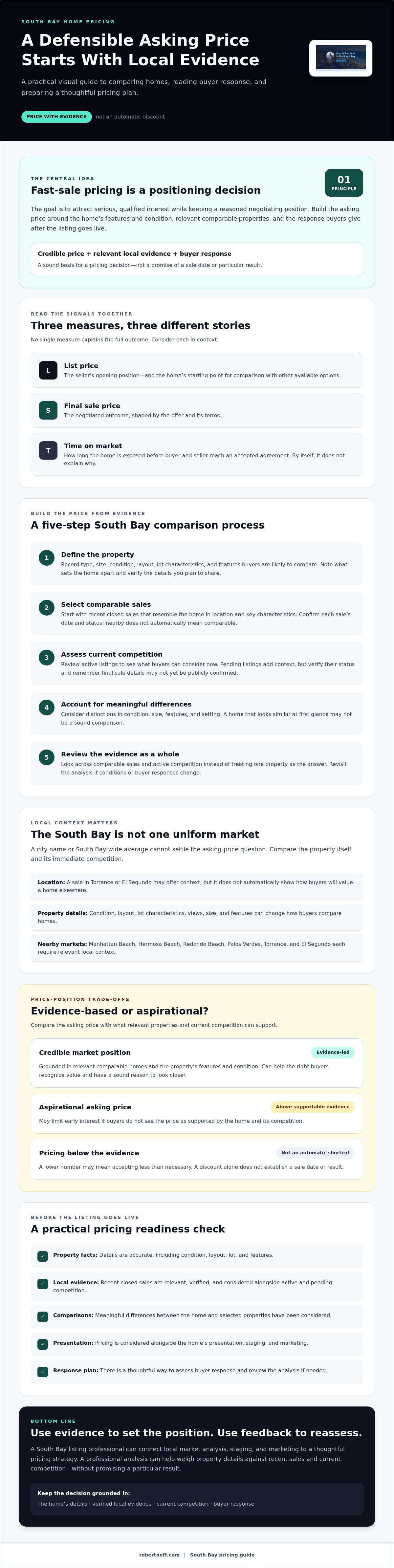
- Pricing my home to sell fast starts with a credible market position, not an automatic discount.
- Choose comparable homes carefully. Give recent closed sales weight, then check active and pending competition.
- Compare evidence-based pricing with aspirational pricing, including how each could affect buyer attention and negotiating room.
- Before launch, review property details, local evidence, presentation, and a plan for assessing buyer response.
- A South Bay listing professional can connect local market analysis, staging, and marketing to a thoughtful pricing strategy, without promising a particular result.
Pricing My Home to Sell Fast: What the Asking Price Actually Signals
Wanting a timely sale is reasonable, especially when a move or another major decision depends on it. But momentum doesn’t require a fire-sale price. An asking price positions the home against other available options. It reflects the seller’s view of the property and gives buyers a starting point for comparison. A credible price considers the home’s features and condition, relevant comparable properties, and the response buyers give after the listing goes live.
Three measures can help you assess that position, but they tell different parts of the story. The list price is the seller’s opening position. The final sale price is the negotiated outcome, shaped by the offer and its terms. Time on market indicates how long a home is exposed before a buyer and seller reach an accepted agreement; it doesn’t, by itself, explain why that happened. Consider these signals together. None guarantees a particular result.
Credible pricing can help the right buyers recognize a home’s value and give them a sound reason to take a closer look.
What does pricing a home to sell fast mean?
For sellers focused on pricing my home to sell fast, the practical goal is to attract serious, qualified interest while keeping a reasoned negotiating position. Compare the home with relevant evidence rather than choosing a low number simply to create urgency. A price well above what buyers see as supportable may limit early interest. A price below the evidence may mean accepting less than necessary. No pricing approach can promise a sale date.
Why South Bay location and property details matter
Nearby homes aren’t automatically true comparables. Condition, layout, lot characteristics, views, and exact location can influence how buyers compare one property with another. A home in Redondo Beach may compete with a different set of options than one in Manhattan Beach or Torrance. The same is true across Hermosa Beach, El Segundo, and Palos Verdes. Look beyond the city name to the property itself and its immediate competition. For background, see the process of assessing the value.
A South Bay-wide average or one nearby sale can’t settle the question. A useful comparison accounts for meaningful differences and checks current local listings alongside completed sales. The asking price should communicate a clear position to buyers, while leaving room to reassess if their response suggests the market sees the home differently.
How to Set a Defensible South Bay Asking Price Using Comparable Homes
Once you’ve decided what the asking price should communicate, build it from evidence in a consistent order. A professional market analysis can help weigh property details against recent sales and current competition. For broader context, review the South Bay real estate market trends analysis, then focus on properties most relevant to yours.
- Define the property. Record the home’s type, size, condition, layout, lot characteristics, and features buyers are likely to compare. Note what genuinely sets it apart, and verify that the details you plan to share are accurate.
- Select comparable sales. Start with recent closed sales that resemble the property in location and key characteristics. Confirm each sale’s date and status. Don’t rely on a home simply because it’s nearby.
- Assess current competition. Review active listings to understand what buyers can consider now. Pending listings can provide additional context, but verify their status and recognize that final sale details may not yet be publicly confirmed.
- Account for differences. Consider meaningful distinctions in condition, size, features, and setting. A property that appears similar at first glance may not be a sound comparison if those differences affect how buyers evaluate it.
- Review the evidence as a whole. Look across comparable sales and active competition rather than treating one property as the answer. Revisit the analysis if market conditions or buyer responses change.
Which comparable homes should inform the asking price?
Strong comparables are similar in location, property type, size, condition, and features that matter to buyers. A nearby home can still be a poor match if its layout, lot, views, or condition differ substantially. Don’t assume citywide averages apply equally across Redondo Beach, Hermosa Beach, Manhattan Beach, El Segundo, Palos Verdes, and Torrance. Use current, verified local records and ask why each selected property is a useful comparison.
How should sellers weigh active listings and online estimates?
Active listings show the alternatives buyers can see, not what those homes will ultimately sell for. Pending listings may signal buyer activity, but their final terms and price may not be available or confirmed. Automated estimates can offer a starting point, yet may not account for a home’s condition, distinctive features, or immediate competition. An automated estimate is a broad reference; a property-specific pricing analysis weighs the home’s details against verified local evidence.
A listing professional can explain how comparable market analysis informs a pricing recommendation. The National Association of REALTORS® outlines the role of pricing expertise in its guidance on the Pricing Strategy Advisor. For guidance grounded in your home and local competition, explore South Bay residential property listing and marketing.
Should You Price Lower to Sell Faster, or Hold Firm?
There isn’t one right answer for every South Bay home. Strategic pricing means weighing the evidence, the competition, and your priorities, not assuming that a fast sale requires an artificially low asking price. A well-supported price can attract serious attention while leaving room for a reasoned negotiation. An ambitious price may preserve negotiating room, but if buyers see it as difficult to support, it can limit early interest. An adjustment may renew consideration when market signals point to a mismatch.
For sellers considering pricing my home to sell fast, the key is to separate a deliberate position from a guess. A low offer doesn’t automatically prove the asking price is too high, just as strong interest doesn’t guarantee that every buyer will meet it. Review the whole pattern before deciding.
Evidence-based market positioning
Possible benefit: Aligns the asking price with relevant sales and current competition, giving buyers a clear basis for comparison.
Risk: Comparable evidence may be incomplete or interpreted too broadly.
Evidence needed: Verified closed sales, property-specific differences, and active listings.
Aspirational pricing
Possible benefit: Tests whether buyers will respond to a higher position and may preserve negotiating room.
Risk: If the price is difficult to support, qualified buyers may focus on better-positioned alternatives.
Evidence needed: Comparable properties that support the asking price and clear signs of buyer interest.
Considered adjustment
Possible benefit: Repositions the home if buyer response and current competition point to a mismatch.
Risk: A change based on one comment or an emotional reaction may move the price without addressing the underlying issue.
Evidence needed: A pattern across comparable activity, showings, offer quality, and buyer feedback.
When can an ambitious asking price work against a quick sale?
Limited qualified inquiries or repeated feedback that buyers see the value differently can be reasons to reassess the position. Neither signal alone proves the price is wrong. Consider whether the home is reaching the right buyers, how it compares with current alternatives, and whether its presentation may also affect interest. Prolonged exposure is a cue for a fresh review, not an automatic instruction to cut the price.
When might a price adjustment be worth considering?
Look at comparable activity, showing patterns, offer quality, and feedback together. One buyer’s opinion may reflect personal preferences; repeated, consistent reactions can offer more useful market information. Discuss the evidence, timing, and revised position with your listing agent before changing the price. A sound adjustment should respond to what buyers can choose today, not simply to pressure to act.
A Practical Pricing Checklist Before Your South Bay Home Goes Live
A clear checklist connects the asking price to the home buyers will actually see and the competition they’ll compare it with. Before launch, review these areas with your listing agent and agree on what new information would prompt a pricing discussion.
- Property facts: Confirm the home’s type, size, layout, lot details, condition, and notable features. Describe recent improvements accurately, and make sure comparable homes reflect the property as it stands today.
- Local evidence: Review relevant closed sales and the active and pending competition. Confirm listing dates and status, and make sure the analysis reflects the intended launch timing rather than an older snapshot. For broader context on preparing and selling a coastal property, see the South Bay coastal home selling guide.
- Presentation: Walk through the home from a buyer’s perspective. Identify practical priorities such as decluttering, addressing visible maintenance concerns, or staging key rooms. Condition and presentation shape how buyers compare a property with similar listings. Note anything that could affect their impression, but don’t treat preparation as a substitute for sound pricing.
- Launch: Confirm that the asking price, property details, and marketing materials tell a consistent story. Buyers should be able to understand the home’s features and how it compares with local options.
- Review: Before listing, agree with your agent on when you’ll review the response and what evidence you’ll consider. Set a review process, not a guaranteed outcome.
What should sellers confirm before choosing a list price?
Check that the property facts are accurate, the comparable selection fits the home, and the analysis reflects current competition near the intended listing date. Then discuss which preparation priorities could help buyers assess the home clearly. Robert Neff’s seller representation includes professional market analysis, home staging, strategic pricing, and step-by-step guidance, bringing these considerations into one coordinated listing plan.
How should sellers evaluate early buyer response?
Track qualified inquiries, showing activity, recurring feedback themes, and offer terms together. A single comment or unqualified inquiry may not represent the broader market. Repeated signals can be more useful when considered alongside current listings and comparable activity. Agree in advance on a review point with your agent, then decide whether to maintain the position, investigate another factor, or discuss an adjustment. For guidance on preparing a South Bay listing and its pricing strategy, discuss your home-selling plan with Robert Neff.
Build a Fast-Sale Pricing Plan With a South Bay Listing Agent
A pricing plan should turn local evidence into a clear decision, not a promise about how quickly a home will sell. A listing agent can review the property’s features and condition alongside relevant competition, then explain the reasoning behind a pricing recommendation. That gives you a way to weigh your goals against what buyers are likely to compare, while keeping the final decision collaborative.
Price positioning works alongside presentation and marketing. Staging can help buyers understand a home’s layout and features. Listing marketing communicates those strengths to potential buyers, while the asking price establishes how the property competes with other available options. Each part supports the overall strategy, but none guarantees a particular offer, sale price, or timeline.
What should a seller ask during a pricing consultation?
Good questions make a recommendation easier to evaluate. Ask which properties were selected as comparables and why, and how differences in condition, location, and features affect the analysis. Ask how current competition and your planned sale timing inform the recommendation. If you’re focused on pricing my home to sell fast, clarify how the agent will review buyer feedback and what evidence might prompt another strategy discussion.
How does Robert Neff support South Bay home sellers?
Robert Neff, Ph.D., is a licensed California Realtor® who provides residential property listing and marketing, professional market analysis, home staging, strategic pricing, and step-by-step guidance. His work focuses on coastal South Bay communities, including Redondo Beach, Hermosa Beach, Manhattan Beach, El Segundo, Palos Verdes, and Torrance. Buyer comparisons can differ from one community and property to another, so local knowledge helps put the evidence in context.
Choosing representation is also an opportunity to learn how an agent communicates, explains pricing decisions, and guides sellers through the process. The El Segundo real estate agent selection guide offers additional perspective on evaluating representation.
A useful conversation can follow four steps: discuss your goals, review comparable sales and current competition, agree on a launch strategy, then monitor buyer response and revisit the evidence together as needed. To discuss a thoughtful pricing approach for your property, speak with Robert Neff about South Bay home pricing.
Move Forward With a Pricing Strategy Grounded in Local Evidence
Pricing with momentum doesn’t mean defaulting to a discount. A defensible asking price reflects relevant comparable sales, current competition, and the details that make your home distinct. Once it’s listed, consider buyer inquiries, showing activity, feedback, and offer terms together before deciding whether to hold firm or revisit the strategy.
If you’re weighing how to approach pricing my home to sell fast, local guidance can help turn market evidence into clear next steps. Robert Neff is a licensed California Realtor® serving South Bay coastal communities. His seller support includes professional market analysis, home staging, and strategic pricing, coordinated with your goals and the home’s position in the market.
Discuss a thoughtful pricing strategy for your South Bay home. With a well-informed plan and steady guidance, you can move forward with greater clarity and confidence.
Frequently Asked Questions
How do I price my home to sell quickly?
To price your home to attract buyers quickly, compare recent, relevant closed sales with current listings and pending competition. Account for the property’s condition, size, features, and location, then align the asking price with your timing and priorities. A property-specific market analysis is more useful than relying on one online estimate alone. After launch, review qualified inquiries, showings, feedback, and offers together. Buyer response can guide a careful reassessment, but no price guarantees a particular sale date.
Should I price my home below market value to sell fast?
No, pricing below market evidence isn’t automatically necessary for a timely sale. The right approach depends on comparable properties, current competition, your home’s condition, and your priorities. A credible asking price can attract buyer attention without becoming an arbitrary discount. Before choosing a lower price, review which properties support the recommendation and consider the trade-offs, including negotiating room. A qualified local listing agent can help you assess the evidence and decide whether the strategy fits your goals.
How do real estate agents determine a home’s asking price?
Agents develop an asking-price recommendation by reviewing relevant closed sales, active competition, property features, condition, and local market context. Useful comparables should be similar enough to inform the analysis, while meaningful differences need to be considered rather than ignored. The recommendation reflects available evidence and professional judgment. It isn’t a guaranteed sale price or a promise of a specific timeline. Ask the agent to explain which properties informed the analysis and how each one compares with your home.
Do online home value estimates accurately reflect what my home will sell for?
Online estimates can provide a broad starting point, but they may not reflect what your home will sell for. An automated tool may miss condition, improvements, layout, or differences between nearby blocks. Its underlying data may not capture the latest listings or buyer response, either. Compare several relevant properties, then seek a local, property-specific review before setting an asking price. Treat online figures as context, not as a substitute for analyzing your home and its competition.
When should I lower my asking price if my home is not selling?
Review the full picture before changing the asking price, rather than reacting to one comment or following a fixed rule. Consider qualified inquiries, showing activity, recurring feedback, competing listings, and new comparable sales together. Also discuss whether the home’s presentation or marketing needs attention. Your listing agent can help distinguish a consistent market signal from an isolated opinion and assess whether a price change is supported by the evidence and aligned with your goals.
Does pricing strategy differ between South Bay cities?
Yes. Pricing should reflect the specific property and its relevant local competition, not just a broad South Bay average. Redondo Beach, Hermosa Beach, Manhattan Beach, El Segundo, Palos Verdes, and Torrance each include different locations and property types. Even within one city, homes may vary in condition, layout, lot, or setting. Use current, verified comparable data for your home’s area and property type so the recommendation reflects the market buyers will actually consider.
Discuss your South Bay home’s pricing strategy with Robert Neff.


