

A polished result isn’t enough to judge an agent. The decisions and local context behind it matter, too. If you’re choosing a South Bay real estate agent, look beyond a confident pitch: ask whether the agent understands the community you’re considering, how they’ll use market information, and what guidance they’ll provide at each stage.
This article takes a process-focused look at the questions a useful client case study should answer. The details available here don’t establish a particular client’s transaction, priorities, or outcome, so they shouldn’t be treated as a report of a completed sale, purchase, or rental. South Bay refers here to Los Angeles area communities including Redondo Beach, Hermosa Beach, Manhattan Beach, El Segundo, Palos Verdes, and Torrance. Local conditions and property options can differ across them.
Use the practical questions below to prepare for an initial consultation and compare an agent’s local knowledge, strategy, and communication. A documented case can show how those elements worked for one client, but your own priorities should guide your decisions.
Key Takeaways
- Look for a case study that explains the client’s priorities and decision process, not just a claimed result.
- Assess whether a South Bay real estate agent connects market analysis and neighborhood context to your specific needs.
- Compare representation by asking how options are evaluated, how decisions are communicated, and what support is provided at each stage.
- Apply case specific lessons carefully: guidance for a buyer, seller, renter, or relocating client may differ.
- Bring clear questions to an initial conversation about local experience, strategy, and the services relevant to your move.
What the South Bay client needed from a real estate agent
A reliable case study starts with a clear account of the client’s decision. The information available for this article doesn’t establish whether the client was buying, selling, renting, or relocating. It also doesn’t document their priorities, timing, preferred community, or reason for seeking representation. Those details must be confirmed before describing a specific client experience.
This matters because each transaction calls for different questions and support. A buyer may need help defining search criteria, comparing properties, and considering negotiation terms. A seller may need market analysis, pricing guidance, and listing preparation. Renters and relocating clients may have different location and search priorities. Blending these paths into one story would make it difficult to tell what the client needed or what the agent actually did.
The client’s goals, constraints, and decision point
Before presenting a case as a client story, confirm the transaction type and the client’s stated goals, constraints, and decision point with Robert and the relevant records. Establish the timing and South Bay locations involved. If privacy requires anonymizing identifying details, do so without inventing replacements. Clearly distinguish any generalized details from facts that have been confirmed.
For readers, the most useful part is the link between a need and an action. What mattered most to the client? Which options were available? What information helped them compare those options? A case that answers these questions can offer practical insight without suggesting every client will have the same experience.
Why local representation mattered in this case
“South Bay” covers a broad part of Los Angeles County rather than one uniform neighborhood. This overview of the South Bay region of Greater Los Angeles can help with geographic orientation, but it can’t establish which community mattered in this particular case. Verify the client’s actual locations before naming them as part of the story.
Local context is most useful when it connects to a documented choice. Records might show, for instance, that a client compared properties or communities against specific priorities. Without that evidence, don’t claim that a particular neighborhood feature influenced the decision. When you speak with a South Bay real estate agent, ask what local information will be relevant to your search or sale, and how the agent will distinguish verifiable information from general observations.
A useful case can show a careful process: understanding the client’s priorities, identifying decision criteria, and connecting those criteria to relevant local information. One client’s experience can help readers think through their own choices, but it cannot promise a particular result.
How Robert Neff translated the client’s priorities into a South Bay strategy
A clear strategy links a client’s priorities to research and decisions. The details available here don’t document the consultation, the client’s chosen path, or the market information used. Those facts need confirmation before they can be presented as part of this client’s story. Rather than fill gaps with a typical process, use a case study to show what actually happened.
From initial consultation to a clear client brief
To document the case, confirm what Robert asked to understand the client’s goals, constraints, preferred locations, and decision criteria. Then establish how those priorities shaped the next step. It could have involved a property search, listing preparation, rental search, relocation guidance, pricing, or negotiation, but don’t attribute any service to this client unless the records support it. For example, strategic pricing or staging may be relevant to a seller, but shouldn’t be described as part of this case without confirmation.
If the client’s needs changed, verify when the plan was revisited and what was adjusted. For your own consultation, explain which priorities are essential and which are flexible. Ask the agent to describe how those priorities will shape the search, listing plan, or next decision. Start with the client’s priorities, then use verified local information to guide the next decision. That is a practical standard for evaluating a process, not a claim about an undocumented outcome.
Using relevant South Bay market analysis
Market analysis is useful when it relates to the client’s actual decision. For a case study, confirm which comparable properties, dates, locations, and other information Robert reviewed, and how those details affected the options presented. No case specific figures or sources are available here, so none should be attributed to this client. Broader market commentary may offer context, but it can’t establish the evidence behind an individual decision. For regional context, see this South Bay real estate market trends analysis.
When discussing market analysis for your own move, ask which properties or data the agent considers relevant, how recent the information is, and what its limits are. A comparison is more useful when it reflects the location and property type you’re considering, rather than relying on general regional statements. Readers can also check professional information through the California Department of Real Estate. That resource is separate from case evidence and doesn’t verify which steps took place in a particular transaction.
Robert’s confirmed services include market analysis, buyer search and negotiation, residential listing and marketing, and coastal rental search. To assess whether his representation fits your needs, review Robert Neff’s real estate services and ask which services apply to your situation.
The decisions that shaped the client’s South Bay real estate outcome
A credible account of a real estate decision explains which options the client considered, what criteria mattered, and what happened next. The case information available here doesn’t identify the client’s property type, choices, negotiation, or final outcome. Without those records, it would be misleading to describe a specific trade off or claim that Robert’s advice produced a particular result.
How the client weighed local property options
Before describing the decision, confirm the options and criteria with Robert and the transaction records. Depending on the documented case, relevant considerations might include location, property condition, timing, pricing, or terms. These are examples, not established details about this client. A fair comparison explains how each documented option measured against the client’s stated priorities. It doesn’t assume one South Bay community or property type is right for everyone.
For your own choices, use these questions to structure a conversation:
- Which criteria are essential, and which are flexible?
- What information supports the comparison between these specific options?
- What trade offs would accepting or declining each option involve?
A South Bay real estate agent can help organize information, explain relevant considerations, and negotiate on a client’s behalf. The client remains the decision maker. Any account of Robert’s role in this case should distinguish his documented advice or negotiation from the choices the client made.
What the documented outcome does, and doesn’t, show
No verified case outcome has been provided for this section, so there is no sale, purchase, rental, negotiation result, or timeline to report. Before publication, confirm the result and its context, protect the client’s privacy, and avoid treating one experience as a forecast for another transaction. Market conditions and a client’s own decisions also shape an outcome.
For broader perspective, the National Association of REALTORS® publishes an annual survey of recent home buyers and sellers. It can help readers consider general buyer and seller experiences, but it can’t verify what happened in this individual case.
If records confirm this was a buyer case, readers seeking purchase focused context can explore strategic buyer representation in the South Bay. Until the case type and outcome are verified, focus on how to evaluate the decision process: ask which options were considered, what information informed the advice, and which choices remained yours.
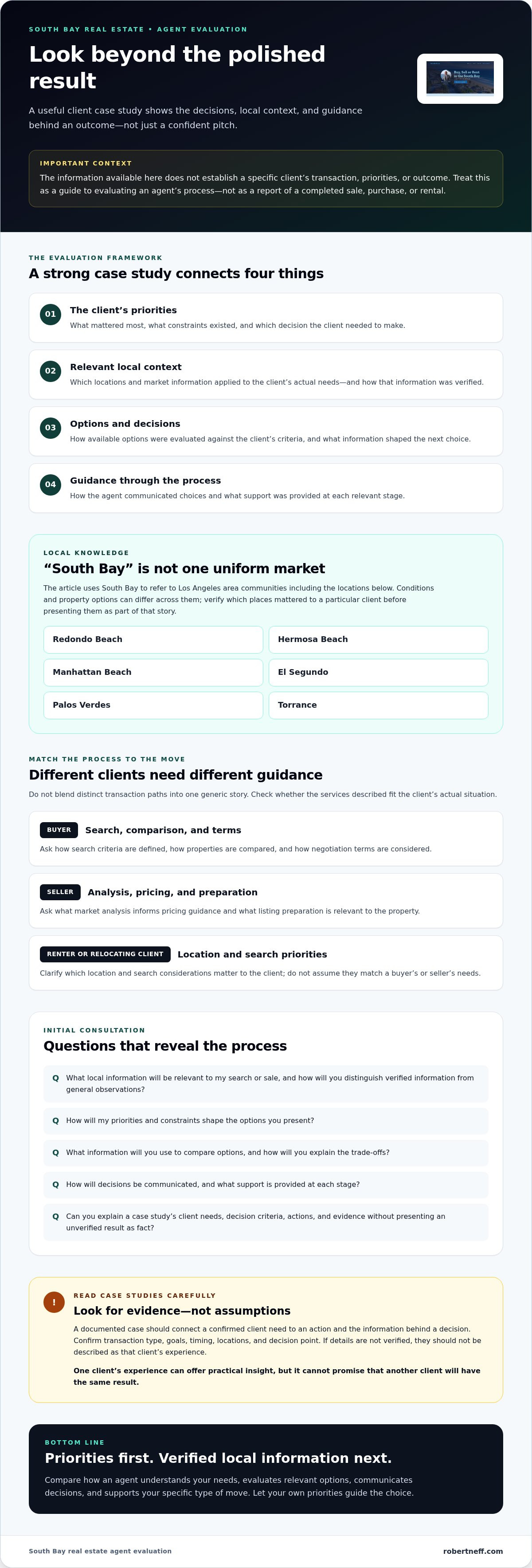
What South Bay buyers and sellers can learn from this case
A case study is valuable when it helps you make a better decision, not when it implies every client should follow the same path. The details available here don’t establish whether the client was buying, selling, renting, or relocating. The questions below can be adapted to your situation. The right process depends on your transaction type, target communities, priorities, and timing.
Questions to ask a prospective South Bay real estate agent
Ask about experience with your type of transaction and the South Bay communities you’re considering. Then discuss how the agent will explain market information and help you evaluate choices. A useful answer connects the proposed work to your needs. General claims and promises of a particular result don’t tell you how the agent will approach your situation.
- Local experience: What work have you done with clients whose needs and target locations are similar to mine?
- Market analysis: What information will you use, how current is it, and how will you explain its limits?
- Options and trade offs: How will you help me compare choices against my priorities without deciding for me?
- Communication: How will you share updates and explain significant decisions? What should I expect from that communication?
- Negotiation: How will you prepare me to consider terms and alternatives, and what decisions will remain mine?
- Scope and responsibilities: What support is included, what will I handle, and what representation terms should I understand before proceeding?
How to assess whether the agent’s approach fits
Compare the proposed process with your priorities and timing. A buyer may need a different sequence of guidance from a seller preparing a listing. Rental and relocation needs differ as well. Listen for a specific explanation of how research, communication, and negotiation would apply to your circumstances. Broad assurances can’t replace a clear discussion of choices and responsibilities.
Before moving forward, make sure you understand the representation terms and have a chance to ask questions. The National Association of REALTORS® offers an annual survey of recent home buyers and sellers for broader context, but national findings can’t determine which approach suits your individual decision.
Use a case study as a prompt to ask for evidence: what information will inform the strategy, how will options be compared, and how will your preferences guide the next step? If you’re considering a South Bay real estate agent, discuss your South Bay representation needs with Robert Neff.
Working with Robert Neff as your South Bay real estate agent
Choose representation based on your needs rather than assuming there is one plan for every move. Robert Neff is a licensed California real estate agent who represents buyers, sellers, first time buyers, relocating clients, and renters in South Bay coastal communities, including Redondo Beach, Hermosa Beach, Manhattan Beach, El Segundo, Palos Verdes, and Torrance. His services include buyer search and negotiation, residential property listing and marketing, relocation and first time buyer guidance, and coastal rental search.
Representation shaped around your South Bay goals
An initial conversation can clarify what you’re looking for, which locations you’re considering, and what kind of representation may fit. Buyers can discuss search priorities and negotiation. Sellers can ask how market analysis, strategic pricing, and staging may relate to preparing a listing. First time buyers and people relocating to the area can explain what they need help understanding. The conversation should address your circumstances rather than assume every client needs the same steps.
If you’re comparing professionals, Robert’s El Segundo agent selection guide offers a broader framework for evaluating fit. Consider how an agent’s local experience relates to your target community and transaction type, and ask how the reasoning behind recommendations will be explained.
A clear next step for buyers, sellers, and relocating clients
You don’t need a complete plan before starting a conversation. It can help to bring a few basics:
- The South Bay communities you’re considering, or the location of your property.
- Your goals and the factors that matter most, such as property type, timing, or location.
- Questions about market analysis, search or listing strategy, negotiation, or relocation guidance.
The discussion can clarify your needs, which services may be relevant, and what questions remain open. You can ask about the scope of representation, communication expectations, and how decisions will be discussed before proceeding. No transaction result should be assumed. The purpose of the conversation is to understand the available support and decide whether the approach fits your priorities.
If you’re considering a South Bay real estate agent, you’re welcome to discuss your South Bay real estate goals with Robert. Start with what you know, raise what you don’t, and use the conversation to choose a sensible next step.
Choose representation grounded in your priorities
A useful case study explains how a client’s goals shaped the strategy, what information informed decisions, and where the client’s judgment remained central. The specific transaction details and outcome for this case still need verification, so the practical lesson is to ask for evidence rather than rely on broad claims. Look for an agent who can explain local context, market analysis, communication, and negotiation in terms that fit your situation.
Robert Neff represents buyers, sellers, first time buyers, relocating clients, and renters in South Bay coastal communities. He is a licensed California real estate agent with DRE #02442812 and operates under the Kaminsky Real Estate Group umbrella at eXp Realty.
If you’re considering a South Bay real estate agent, a conversation can clarify your priorities, the representation you need, and the questions you still have. Discuss your South Bay real estate goals with Robert Neff. A thoughtful next step can make a complex decision feel more manageable.
Frequently Asked Questions
What does a South Bay real estate agent do for buyers?
A South Bay real estate agent can help buyers clarify priorities, search for suitable properties, assess available information, and negotiate. Robert Neff’s buyer services include search and negotiation, with step by step guidance for first time and relocating buyers. Ask how the agent will explain property options and market analysis, and which decisions remain yours. The process should reflect your needs and the communities you’re considering.
How do I choose a real estate agent in the South Bay?
Choose an agent whose experience and process fit your transaction type, target locations, and communication preferences. Ask about relevant work in communities such as Redondo Beach, Hermosa Beach, or Torrance, and how the agent explains market analysis, trade offs, and negotiation. Clarify what representation includes and how responsibilities are divided. Look for specific, transparent answers rather than broad claims or promises of a particular result.
Does Robert Neff help first-time and relocating home buyers?
Yes. Robert Neff offers guidance for first time and relocating buyers, along with buyer search and negotiation services. An initial discussion can identify the communities, property needs, and questions most relevant to your move. Ask how he’ll explain the search process, compare available options, and adapt guidance to your priorities. The right plan depends on your circumstances, so clarify the support you’re seeking before proceeding.
Which South Bay areas does Robert Neff serve?
Robert Neff serves South Bay coastal communities including Redondo Beach, Hermosa Beach, Manhattan Beach, El Segundo, Palos Verdes, and Torrance. If you’re considering a particular neighborhood or have a property in one of these locations, confirm that your specific needs fit the representation you’re seeking. Local context matters, but an agent should explain how it applies to your situation rather than make unsupported assumptions about a community.
Can a real estate agent help me price a South Bay home?
Yes. Robert Neff’s residential listing services include market analysis and strategic pricing. A pricing discussion should connect relevant market information to your home and explain the reasoning behind the proposed approach. Sellers can also ask whether staging is relevant to their property and what listing and marketing support is included. Analysis can inform a decision, but it can’t guarantee a particular sale price or outcome.
What should a real estate agent case study include?
A useful case study explains the client’s transaction type, priorities, constraints, and decision criteria, then shows which options and information informed the process. It should protect privacy, verify details, and distinguish the agent’s documented role from the client’s choices and broader market conditions. Report any outcome with context, not as a promise. If facts aren’t confirmed, say so instead of filling the gaps.
How can I verify a California real estate agent’s license?
Use the California Department of Real Estate’s official website to look up an agent by name or license number, then check the record’s current status and details. Robert Neff’s license number is DRE #02442812. Verify its current status before relying on it. You can also confirm that the name on the record matches the professional you’re considering and ask about any details you don’t understand.


