

What if two South Bay homes both advertised with an ocean view offered completely different everyday experiences? South Bay CA homes with ocean view can range from a broad, open vista to a partial glimpse from one room. A coastal neighborhood alone doesn’t guarantee a view.
Look beyond the listing description. The view’s direction, how much ocean you can see, and whether nearby development could affect it all matter, alongside the home’s condition and location. Photos and neighborhood names often don’t give enough information to compare those details.
This guide explains how to distinguish panoramic, partial, and distant views; compare coastal communities without making assumptions; and assess a property’s orientation, condition, and potential view limitations. You’ll also learn what to check in person and how a local professional can help you evaluate property-specific details and plan next steps. The goal isn’t simply to find a home near the coast. It’s to understand what each view offers and whether the home fits your priorities.
Key Takeaways
- Compare South Bay communities as places to investigate, not as guarantees of an ocean view. The sightline depends on the individual property.
- For South Bay CA homes with ocean view, consider the view’s scale, distance, and visibility from the living spaces you use most.
- Use illustrative home scenarios to clarify whether you value a broad distant vista, outdoor space, or an elevated sightline most.
- Build your search in stages: define your view priorities, choose areas to explore, review property examples, verify details, and refine your criteria with local guidance.
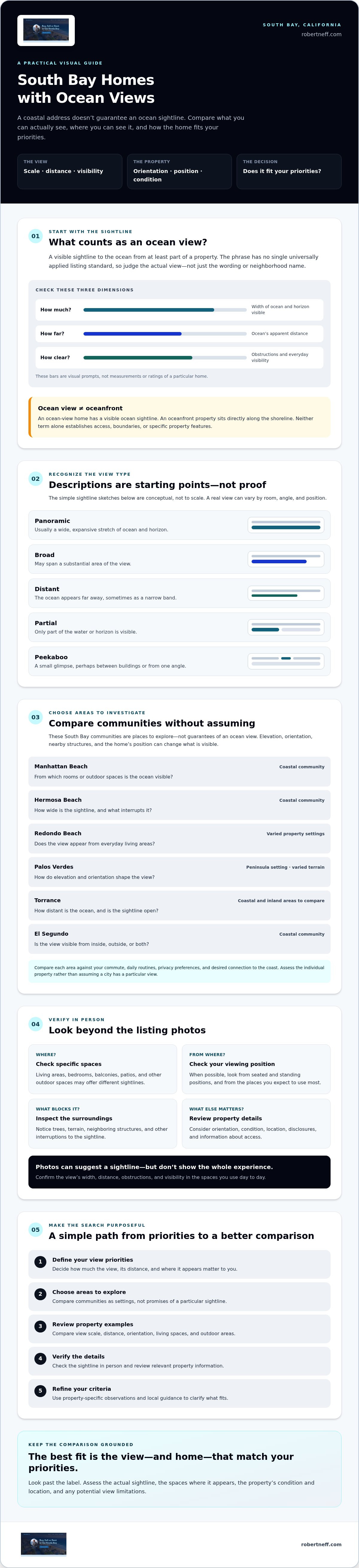
What Counts as an Ocean View in South Bay CA Homes?
An ocean-view home has a visible sightline to the ocean from at least part of the property. That view is a feature of the specific home, not a promise that every property in a coastal neighborhood offers one. In the geographically varied South Bay, elevation, orientation, nearby buildings, and the viewer’s position can all affect what’s visible.
There’s no single universally applied standard behind the phrase “ocean view” in listing language. When comparing South Bay CA homes with ocean view, assess the sightline itself: how much ocean appears, how far away it looks, and whether anything interrupts it. A view from one balcony may differ considerably from what you can see across the main living areas.
How to Describe Panoramic, Partial, and Peekaboo Views
A panoramic view usually suggests a wide, expansive stretch of ocean and horizon. A broad view may also span a substantial area, while a distant view shows the ocean far away, sometimes as a narrow band. A partial view reveals only part of the water or horizon. A peekaboo view is a small glimpse, perhaps between buildings or from a particular angle.
These descriptions are useful starting points, not substitutes for checking the actual sightline. For example, an illustrative home might show the ocean from an upstairs bedroom window but not from its living room or outdoor area. Another might offer a modest view from several rooms. If possible, visit and look from the specific spaces where you expect to spend time.
Ocean View Versus Oceanfront: Why the Difference Matters
An ocean-view home has a visible ocean sightline; an oceanfront property sits directly along the shoreline. The terms describe different relationships to the coast. An inland home on elevated ground might look toward the water without being beside it, while a shoreline property has a different immediate setting. Neither description alone establishes property access, boundaries, or particular features.
Before relying on a listing’s wording, confirm the home’s location and review relevant property details, disclosures, and information about access. Compare the view’s width, distance, obstructions, and visibility from everyday living spaces. That gives you a clearer basis for deciding whether it suits your priorities.
Where to Compare South Bay CA Homes with Ocean View Options
Compare Manhattan Beach, Hermosa Beach, Redondo Beach, Palos Verdes, Torrance, and El Segundo as places to investigate, not as guarantees of an ocean sightline. Within any city, a home’s elevation, orientation, surrounding structures, and position can change what the ocean looks like, or whether it’s visible at all. Broader South Bay coastal home search guidance can help frame the comparison, but each property still needs its own assessment.
Comparing Coastal Communities by Setting and Buyer Priorities
South Bay searches can span coastal, peninsula, and more inland settings. Rather than assume a city has a particular kind of view, weigh how each area might fit your commute, daily routines, privacy preferences, and desired connection to the coast. Decide whether you’d prioritize a visible ocean horizon, an outdoor area, or a location that better supports your regular activities. Then assess actual properties against those priorities.
The table is a starting framework, not a claim about current homes or typical views in each community.
| Area to explore | Setting to consider | View questions to verify |
|---|---|---|
| Manhattan Beach | Coastal community | From which rooms or outdoor spaces is the ocean visible? |
| Hermosa Beach | Coastal community | How wide is the sightline, and what interrupts it? |
| Redondo Beach | Coastal community with varied property settings | Does the view appear from everyday living areas? |
| Palos Verdes | Peninsula setting with varied terrain | How do elevation and orientation shape the view? |
| Torrance | Community with coastal and inland areas to compare | How distant is the ocean, and is the sightline open? |
| El Segundo | Coastal community | Is the view visible from inside, outside, or both? |
Questions to Ask About a Specific View
For South Bay CA homes with ocean view, ask exactly where the view appears and whether it changes between rooms, balconies, patios, or other outdoor spaces. If possible, visit and check from seated and standing positions. Listing photos can help you spot a potential sightline, but they may not convey its scale, distance, or visibility in daily use.
Look for trees, terrain, and neighboring structures that may interrupt the view. Confirm property boundaries and access rather than assuming a view means direct beach access. The California Coastal Commission explains public coastal access; consult property-specific disclosures and records for details about an individual home. A local buyer representative can help you compare listings and coordinate questions. For broader search guidance, explore South Bay buyer representation.
How to Judge an Ocean View Beyond the Listing Photos
A listing photo can suggest a view, but it may not show how wide or distant the ocean appears in person. Camera angle, framing, and the position from which a photo is taken can make a narrow sightline seem more expansive. Photos also can’t tell you whether you’ll see the water from the rooms you use most.
For South Bay CA homes with ocean view, treat images as an introduction, not proof of the everyday experience. A visit lets you assess the view from the property and notice how weather and time of day affect what’s visible. The marine layer, clouds, and changing light may soften or obscure a distant horizon during a particular visit.
A Practical Sightline and Orientation Check
When visiting, check windows, balconies, patios, and shared spaces separately. Note whether the ocean appears directly ahead, at an angle, far in the distance, or only through a small opening. Compare seated and standing views, especially in areas where you expect to relax or spend time. If practical and permitted, revisit under different weather or light conditions to get a fuller picture.
Before deciding, check the view’s sightline and orientation, your privacy, and any trees, terrain, or structures that could obstruct it. This checklist turns a broad marketing phrase into property-specific questions.
Potential View Changes and Property-Specific Due Diligence
A view can be affected by more than what’s visible on the day of a showing. Ask about nearby development, vegetation, and other site changes that could alter the sightline. Review available disclosures and records, and consult appropriate qualified professionals when a question calls for specialized expertise.
Planning and land-use considerations depend on the property’s location and jurisdiction. For properties within its jurisdiction, the Los Angeles County coastal planning resource can provide context on coastal planning. Verify which local agency and records apply to the specific home. Coastal hazards, insurance considerations, and land-use questions require property-specific review rather than assumptions based on a view description alone.
Market context can help frame a search, but it can’t verify a particular home’s view. Robert Neff’s South Bay real estate market trends analysis offers broader context. For help comparing property-specific details and coordinating next steps, consider South Bay buyer representation.
Which Ocean-View Home Example Fits Your Priorities?
The best fit depends on how you’d use the view, not simply how it sounds in a listing. These three illustrative scenarios are hypothetical, not active listings or claims about homes currently available. Use them to clarify what you value and which trade-offs you’d want to investigate.
Match the View to How You Plan to Live
- Illustrative example: broad, distant view. Imagine a home where the ocean and horizon appear across a wide sightline from a main living area, but at a distance. This may suit someone who values seeing the ocean indoors each day. Check which rooms share the view, how much privacy the windows offer, and whether those rooms are comfortable for regular use.
- Illustrative example: partial view with outdoor space. Picture a home with a limited ocean glimpse and a patio or balcony suited to outdoor living. The view may be secondary to the usable space. Consider how exposed or private the area feels, how often you’d use it, and what upkeep it may require.
- Illustrative example: elevated sightline. Consider a home where the ocean is visible from an upper-level room or terrace. Elevation may shape the experience, but it doesn’t tell you whether the view is private or visible elsewhere in the home. Check access to the view-facing space and whether it fits your everyday routine.
Ask yourself: Which view-facing rooms would I use often? Is ocean visibility essential, or would outdoor space, privacy, or a more practical layout matter more? Rank your must-haves separately from preferences you could compromise on.
Balance Scenic Appeal with Property Trade-Offs
Evaluate the whole property alongside the sightline. Natural light, layout, condition, access, privacy, and maintenance needs can shape daily comfort just as much as a view. A home with a striking outlook may not fit your routine if the rooms you rely on don’t suit your needs. There’s no universally superior view type; the right balance depends on your priorities.
For coastal exposure, insurance questions, or other property-specific concerns, seek current information relevant to that home and consult appropriate qualified professionals. Don’t assume that one view type guarantees stronger appreciation or resale. A thoughtful comparison weighs the property as a whole.
Search timing is another consideration, but it shouldn’t replace careful evaluation. For broader context, see this guide to the best time to buy a South Bay home. If you’re comparing South Bay CA homes with ocean view, discuss your buyer search priorities with a local representative who can help assess listings and coordinate property-specific questions.
Plan Your South Bay Ocean-View Home Search with Local Guidance
A clear process turns your preferences into criteria you can use to compare properties. For South Bay CA homes with ocean view, focus on the sightline you want, the areas that suit your routine, and the details that need verification. Refine your priorities as you learn from in-person visits.
Build a Shortlist Around View, Location, and Daily Needs
Use this five-step path to organize your search:
- Step 1: Define the view. Record what matters most, such as a broad horizon or ocean visibility from a main living area, and note acceptable compromises.
- Step 2: Choose areas to explore. Weigh location against your commute, daily routines, and preferred setting. Treat each area as a place to search, not a promise of a view.
- Step 3: Review property examples. Compare homes using consistent questions about sightline, layout, privacy, condition, and usable space.
- Step 4: Verify property details. Check the view in person when possible, and follow up on property-specific questions using current information and available records.
- Step 5: Refine your criteria. After touring, identify which features are essential and where you’re comfortable being flexible.
Keep notes after each visit. A view that looks compelling online may matter less than one visible from a room you use every day. Revisit your shortlist based on what each property actually offers.
Get Guidance for Comparing Specific South Bay Properties
A buyer representative can help assess listings against your priorities, compare property-specific details, and coordinate questions that need follow-up. Robert Neff, Ph.D., Realtor®, represents buyers in the South Bay through buyer search and negotiation services. His market analysis can add context to property comparisons, while tailored guidance can help you consider next steps without assuming every listing or view is alike.
For a broader look at the buyer-representation process, read this South Bay buyer representation strategy. If you’d like to discuss your priorities and search, discuss your South Bay home search.
Move Forward with a Clearer South Bay Home Search
The right ocean view is the one that fits how you want to live, not simply the one described most impressively in a listing. As you compare South Bay CA homes with ocean view, remember that a neighborhood doesn’t guarantee a sightline. A home’s value to you depends on how its setting and features meet your priorities.
Robert Neff, Ph.D., Realtor®, is a California-licensed Realtor® (DRE #02442812) who represents South Bay buyers. His services include buyer search and negotiation, professional market analysis, and tailored guidance. That support can help you compare options carefully and consider informed next steps, without assuming every property is alike.
When you’re ready to discuss your priorities, discuss your South Bay home search. With a thoughtful plan and local guidance, you can move ahead with greater confidence and find the coastal home that feels right for you.
Frequently Asked Questions
What areas in South Bay CA have homes with ocean views?
Ocean-view properties may be found across parts of Manhattan Beach, Hermosa Beach, Redondo Beach, Palos Verdes, Torrance, and El Segundo, but no city guarantees a view. Sightlines depend on each property’s elevation, orientation, and surroundings. Treat these communities as areas to explore, then check individual homes rather than relying on neighborhood labels. Verify current listings and view descriptions, since availability and property conditions can change.
Are ocean-view homes the same as oceanfront homes?
No. An ocean-view home has a sightline to the ocean from some part of the property; an oceanfront home is situated directly along the shoreline. An ocean view alone doesn’t establish beach access, a particular boundary, or direct shoreline location. If those distinctions matter to your plans, review property records, disclosures, and access information carefully. Confirm the details for the specific home rather than inferring them from listing language.
How can I tell whether an ocean view will be obstructed?
Start by checking the view from the actual rooms and outdoor spaces, then look for trees, terrain, or nearby structures in the sightline. Ask about neighboring development and review available disclosures and relevant records. Depending on the property, local planning or building information may help clarify possible changes, but it can’t guarantee a view will remain unchanged. For South Bay CA homes with ocean view, assess obstruction risk property by property.
Do ocean-view homes in South Bay have higher value?
An ocean view may influence a home’s appeal, but it doesn’t guarantee a higher value or stronger future resale. The view’s width, distance, privacy, and visibility from useful living spaces can differ, as can the property’s condition, layout, and location. To evaluate a specific home, compare it with relevant properties and consider the complete set of features. A current market analysis can provide context without treating the view as a guarantee.
What should I look for when touring a South Bay ocean-view home?
Check the sightline from the living room, bedrooms, windows, balcony, and patio, including seated and standing positions. Note whether the ocean appears directly, at an angle, or through a narrow opening. Also assess privacy, layout, natural light, condition, access, and likely maintenance needs. Ask what details require follow-up, including potential obstructions and property-specific coastal or insurance considerations, and use current information from appropriate sources.
Can I find ocean-view homes in Torrance or El Segundo?
It’s possible to find properties marketed with ocean views in Torrance or El Segundo, but a city name alone doesn’t confirm that a particular home has a view. Local terrain, elevation, orientation, and surrounding buildings affect what’s visible. Check current listings, then verify the claimed sightline in person when possible. Look from the rooms you’d use regularly and confirm whether the view is partial, distant, or more expansive.
Are ocean views visible every day in South Bay?
No. Even where a home has a genuine ocean sightline, weather and visibility conditions can affect how clearly the water or horizon appears. Marine layer, clouds, haze, and changing light may make a distant view less distinct at times. A showing captures one moment, not every day’s conditions. Consider how much visibility matters to your routine, and assess the view’s position and scale rather than expecting constant clarity.


