

What makes the quietest streets in El Segundo quieter: a neighborhood name, or the terrain and traffic corridors around a particular home? Buyers are right to look beyond polished listing photos. LAX flight paths, major roads, and industrial activity can shape daily sound, sometimes changing noticeably from one block to the next.
Finding a peaceful home site takes more than guessing which area feels residential. Consider where through-traffic thins, how the terrain and nearby buildings may affect sound, and what to check before weighing a property’s long-term appeal. No street is guaranteed to be silent, but a careful comparison can make the trade-offs clearer.
This guide highlights residential pockets and streets to investigate, including West El Segundo, The Hill, and Sycamore Canyon. Robert Neff helps buyers compare South Bay coastal properties using market analysis and step-by-step guidance. Below, you’ll find practical ways to assess how flight paths, the Imperial corridor, and eastern industrial areas may affect a home’s surroundings before you decide.
Key Takeaways
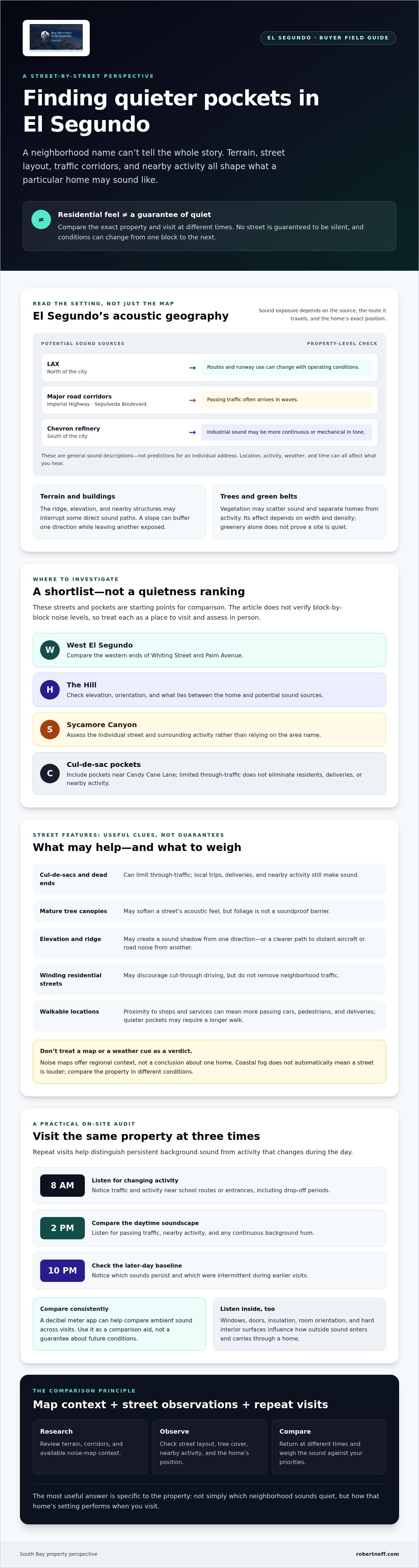
- Use this shortlist to compare locations such as the western ends of Whiting Street and Palm Avenue, and cul-de-sac pockets near Candy Cane Lane.
- Assess street layout and tree cover alongside nearby activity. A residential feel alone doesn’t tell the whole acoustic story.
- Visit a potential home site at 8 AM, 2 PM, and 10 PM. A decibel meter app can help you compare ambient sound across visits.
- Combine neighborhood research with on-site observations when narrowing your home search.
Understanding El Segundo’s Acoustic Geography
Acoustic geography describes how urban layout and physical terrain affect the way sound travels. In El Segundo, consider more than a home’s distance from a noise source. Street orientation, elevation, buildings, and traffic routes can all influence what residents hear. The city sits beside LAX to the north and the Chevron refinery to the south, while Imperial Highway and Sepulveda Boulevard are major traffic corridors. For broader geographic context, see El Segundo's geography and history.
Topography matters, too. The local ridge may interrupt direct sound paths and buffer some streets from coastal winds, but it is not a sound barrier. A slope may soften noise from one direction while leaving a home exposed to aircraft or road sound from another. Nearby blocks can therefore feel different. Evaluate a property’s exact position instead of relying on its neighborhood label.
The LAX Flight Path Factor
LAX’s runway configuration and aircraft routes can change with operating conditions. Don’t assume planes always take off in one direction or follow a fixed path. The North End’s proximity to the airport makes it especially important to check current flight activity and the specific property location. There is no verified block-by-block departure-path information here, so naming particular blocks as being directly beneath the most frequent departures would be misleading.
A noise contour map is a planning map that plots modeled aircraft-noise exposure around an airport in lines or zones representing different noise levels.
Industrial Buffers and the Refinery Zone
Near El Segundo’s southern edge, consider the refinery as a potential sound source alongside road traffic. Industrial sound may register as a more continuous hum or mechanical tone, while traffic often comes in waves as vehicles pass. These are general descriptions, not a prediction of what you’ll hear at a particular address. Sound varies with location, activity, weather, and time of day. Visit at more than one hour to distinguish persistent background sound from intermittent noise.
Vegetated strips and green belts may soften sound by scattering it and separating homes from roads or industrial edges. Their effect depends on width, density, and what lies beyond them. Greenery alone is not proof that a property is quiet. Use maps to identify possible buffers, then listen on site. This gives you a more useful basis for comparing residential pockets than distance alone.
The Science of Silence: What Makes a Street Truly Quiet?
A quiet-feeling street usually combines several advantages. Cul-de-sacs and dead ends limit through-traffic, but residents, deliveries, and nearby activity still create sound. Mature tree canopies in the Tree Section may scatter some sound and soften a street’s visual and acoustic feel. They are not soundproof barriers, and their effect depends on how dense and continuous the foliage is.
Elevation can help or hurt. A home higher on a slope may sit above nearby traffic or buildings, but it may also have a clearer path to distant aircraft or road noise. The ridge and surrounding structures can create areas with less direct sound, sometimes called sound shadows. The effect depends on the direction of the source and the property’s position. Coastal fog does not automatically make a street louder. Atmospheric conditions can affect sound transmission, so compare a site in different weather rather than treating fog as a reliable indicator.
Topography and Sound Shadowing
The western ridge may shield some locations from sound traveling from lower ground, while streets with an open view toward a noise source may receive it more directly. Identifying which streets benefit requires checking their elevation, orientation, and surroundings. For a first-pass comparison, consult the U.S. Department of Transportation’s National Transportation Noise Map, then listen at the property itself. A regional map provides context, not a verdict on an individual home.
Traffic Flow and Residential Density
El Segundo’s grid streets can provide direct routes for local and through-traffic. Winding streets in southern residential tracts may discourage cut-through driving, though they do not eliminate neighborhood traffic. School drop-offs and pick-ups can also create predictable activity near school routes and entrances. Check a candidate block at those times rather than assuming a generally calm street stays quiet all day.
Walkability involves a trade-off. Homes near shops, services, and well-used routes may have more passing cars, pedestrians, and deliveries. Quieter pockets may require a longer walk. The right balance depends on how you plan to use the neighborhood.
Indoor comfort depends on the home as well as the street. Windows, doors, insulation, room orientation, and hard interior surfaces influence how outside sound enters and carries through a home. Ask about materials and construction details, and assess rooms facing the street as well as more sheltered spaces. Buyers comparing the quietest streets in El Segundo can use Robert Neff’s local buyer guidance to weigh street-level observations alongside a home’s setting and features.
Quietest Streets in El Segundo: Streets and Cul-de-Sacs to Check
There is no official street-by-street ranking of the quietest streets in El Segundo, and conditions can change from one block to the next. Treat the locations below as a shortlist for closer listening, not a promise of silence. Through-traffic, nearby activity, distance from major roads, and a property’s position all matter.
The West-of-Main Tranquility Zone
Start by comparing the western ends of Whiting Street and Palm Avenue in the Lower West Side. These blocks are worth checking because residential streets farther from commercial routes may see less cut-through traffic. The ocean is nearby, and surf or wind can sometimes blend into the soundscape. Neither reliably masks aircraft or road noise. Walk each block and note whether traffic appears local or passing through. Don’t assume the full length of either street has the same feel.
West of Main Street, look for a quieter residential character rather than treating “west of Main” as a guarantee. Your experience will depend on the specific block, time of day, and surrounding activity.
South Hill and Cul-de-Sac Pockets
The South Hill pockets near Candy Cane Lane are worth an in-person check, particularly if you prefer a street with limited through-traffic. A dead end or cul-de-sac can reduce pass-through driving, but vehicles belonging to residents, visitors, and service providers still use the street. “No Outlet” signage tells drivers that a street does not connect through. It may discourage mistaken turns, but it is not a safety guarantee.
Mariposa and short residential stubs branching off Grand can also be checked for limited traffic. The available information does not confirm that specific cul-de-sacs on those streets are consistently quiet. Verify the exact address and street layout before relying on a map label.
Hidden East and Tree Section Outliers
In the Hidden East, compare residential blocks set back from Rosecrans Boulevard rather than choosing a home based only on its neighborhood name. Greater distance from a busy corridor may reduce direct traffic exposure, but side streets can still receive nearby sound. In the Tree Section, explore Sycamore and Acacia for blocks with mature canopy and a sheltered residential setting. Trees may soften the acoustic feel, but they do not block sound completely.
Balance quiet with access to daily destinations as you compare these options. This strategic guide to coastal homes for sale in South Bay offers broader context for weighing location and lifestyle. Revisit each candidate street at different times, and assess the home itself as well as the surrounding area.
Beyond the Map: How to Audit Noise Levels
A map can help narrow your search, but it cannot tell you what a street sounds like during the hours you’ll be there. Use a simple three-visit audit: listen at 8 AM, 2 PM, and 10 PM. Note traffic, aircraft, nearby activity, and whether sound is steady or comes in bursts. If possible, repeat the visits on both a weekday and a weekend.
A decibel meter app can help compare locations, but phone readings are a rough reference, not a certified acoustic measurement. Use the same device in the same way for each visit. Record conditions such as wind, open windows, and nearby activity. Listen indoors, too. Air-conditioning equipment, pool pumps, ventilation, and school bells may be more noticeable from a yard or a particular room than from the sidewalk.
The Weekend vs. Weekday Audit
Commuter traffic and school-related activity can make a weekday morning feel different from an afternoon or evening. Weekends have their own pattern. Check whether events or recreation activity near Recreation Park affect the specific block you’re considering. Don’t assume every event creates noticeable noise. Verify the schedule and listen during a relevant period.
Also investigate possible future changes. Review City planning agendas, project notices, and zoning materials for the area. As of September 18, 2026, a draft update to LAX’s Noise Exposure Maps was available for public review, with open houses scheduled for October 21 and October 22, 2026. These materials can inform your research, but they do not predict the sound at a particular home. For broader local market context, read the South Bay Real Estate Market Trends: 2026 Strategic Analysis.
Leveraging Local Intelligence
Speak with nearby residents, including people who regularly walk a dog or spend time outdoors. Ask which sounds stand out, when they are most noticeable, and whether aircraft patterns seem different in particular weather conditions. Treat personal accounts as useful observations, not a guarantee that conditions will stay the same. Cross-check flight-path concerns with current airport information and available noise maps.
A methodical buyer search can help organize these observations alongside a home’s location and features. Explore how a real estate agent in El Segundo CA approaches buyer representation, or discuss your El Segundo home search with Robert Neff. A consistent audit gives you a stronger basis for comparing the quietest streets in El Segundo than a single visit.
Strategic Buyer Representation for Peaceful South Bay Living
Finding a quieter home takes more than choosing a street from a list. Robert Neff, Ph.D., works with buyers to understand their priorities, compare neighborhood context, and consider street-level observations. His analytical approach can help organize details such as nearby traffic routes, a home’s orientation, and the times when noise is most noticeable. This can support a more considered comparison, but it cannot guarantee a silent property.
For buyers seeking the quietest streets in El Segundo, clear criteria make the search more useful. You might prioritize limited through-traffic, distance from major corridors, mature tree cover, or a home layout that places bedrooms away from street activity. Robert can use those preferences to guide the buyer search and negotiation process, while helping relocating clients weigh quiet alongside commute, walkability, and daily routines.
A Research-Driven Search Process
There is no confirmed, named “Quiet Search” product or guaranteed off-market inventory. Instead, define practical preferences and assess each home against them. That can include revisiting a street at different times, noting persistent and intermittent sounds, and considering how the property’s location fits your household’s priorities.
Relocation decisions involve more than sound. Reviewing cost of living in El Segundo, CA, alongside lifestyle needs can help you assess the broader fit of a neighborhood. Robert is part of Kaminsky Real Estate Group at eXp Realty. His research-driven approach supports a measured search in the 2026 market, with attention to each client’s needs and long-term fit.
Your Next Steps Toward Tranquility
Start with a short list of priorities: traffic levels, aircraft exposure, indoor comfort, proximity to daily destinations, and the times you’re usually at home. Bring those priorities into conversations about buying, selling, or renting a South Bay coastal home. Sellers can also use thoughtful presentation to help prospective buyers understand a home’s setting without overstating its quietness.
Robert’s guidance can help you assess trade-offs, but no agent can guarantee a quiet property or access to off-market listings. For guidance on a South Bay buyer search or home sale, explore real estate services with Robert Neff.
Choose Your El Segundo Home With Confidence
Finding the quietest streets in El Segundo is less about locating a universally silent block and more about choosing a sound profile that suits your everyday life. The city’s terrain, nearby corridors, street layout, and a home’s construction all shape that experience. Comparing neighborhood context with on-site observations can help you make a more informed decision.
Noise is one part of a property’s appeal, alongside access, lifestyle, and your long-term plans. Robert Neff, Ph.D., provides professional market analysis and guidance for clients navigating the South Bay coastal property market. As a licensed Realtor® with Kaminsky Real Estate Group at eXp Realty, DRE #02442812, he can help you approach a South Bay search with clear priorities.
Ready to discuss what a peaceful home site means for you? Contact Robert Neff, Ph.D., to discuss your South Bay home search.
Frequently Asked Questions
Is El Segundo too noisy because of LAX?
No, LAX proximity does not make every part of El Segundo equally noisy, but aircraft sound is an important factor to assess. Exposure can vary with a home’s location, flight activity, weather, and the building itself. Visit at different times, listen indoors and outside, and review available noise information. A street that feels peaceful during one showing may sound different at another time of day.
Which part of El Segundo is furthest from the flight path?
There is no reliably furthest neighborhood because aircraft routes and operating conditions can vary. West El Segundo, The Hill, and Sycamore Canyon are often described as residential pockets with less through-traffic, but that does not establish lower aircraft exposure for every block. Compare current airport noise information with the specific address, then visit more than once. The quietest streets in El Segundo depend on both the noise source and the home’s exact position.
Are the streets near the refinery noisy?
Some homes near the refinery may experience industrial sound, but its level and character can vary by location and conditions. Industrial noise may be a steady background hum, while nearby traffic tends to arrive in passing waves. Don’t assume proximity alone tells you what a home sounds like. Visit at different times, listen from the yard and indoors, and note nearby roads, equipment, and any landscape or building buffers.
Does noise affect home values in El Segundo?
Noise can matter to buyers because it affects comfort and may shape how appealing a specific home feels. The information available here does not establish a fixed price impact or show that aircraft exposure changes every property’s value by a predictable amount. Evaluate the home’s location, sound indoors and outside, and buyer demand for comparable properties. A local market analysis can help put those property-specific factors in context.
Where can I find a map of flight paths over El Segundo?
For current airport noise information, start with Los Angeles World Airports (LAWA) and its LAX noise resources. As of September 18, 2026, a draft update of LAX’s Noise Exposure Maps was available for public review. These maps show modeled noise exposure, not a guarantee of the sound at an individual home. Check the map’s date and guidance, then compare it with on-site visits and current flight information.
What are the quietest neighborhoods for families in the South Bay?
There is no single quietest neighborhood for every family. In El Segundo, West El Segundo, The Hill, and Sycamore Canyon are described as residential areas with less through-traffic, though conditions still vary by street. Families comparing Redondo Beach, Hermosa Beach, Manhattan Beach, El Segundo, Palos Verdes, and Torrance should weigh traffic, aircraft, school activity, and access to daily needs. Visit candidate blocks at the times your household will use them most.
How has the 2026 LAX modernization affected noise in the city?
The available information does not confirm a specific noise change caused by LAX modernization in 2026. A draft update of LAX’s Noise Exposure Maps was released for public review on September 18, 2026, with community open houses scheduled for October 21 and October 22, 2026. A map update is not proof that noise has increased or decreased. Review the official materials for confirmed findings, and verify aircraft activity near a particular home.
Can soundproofing a home effectively block airport noise?
Sound insulation can reduce some indoor aircraft noise, but it should not be expected to block all sound. Results depend on the home’s windows, doors, construction, and other paths where sound can enter. LAWA’s Residential Sound Insulation Program seeks at least a five-decibel interior noise reduction in eligible homes. That is a program target, not a guarantee for every property. Check current eligibility and assess the home both indoors and outdoors before deciding.


