

A home near the beach can still leave everyday errands out of reach on foot. Coastal appeal may make a neighborhood seem more convenient than a particular block or route really is. That’s why the best walkable neighborhoods South Bay buyers consider aren’t defined by a citywide label alone.
For many homebuyers, walkability means more than a pleasant stroll. It means being able to reach the places you use through routes that feel practical, with beach access, errands, and transit fitting your routine. A destination district may be enjoyable to explore without making every nearby home equally convenient.
This guide compares South Bay communities worth exploring on foot and explains how walkability varies from block to block. You’ll learn what to consider when weighing coastal access, daily destinations, and transit, then use a repeatable checklist to assess an exact property and its routes. Comparing routes alongside your other priorities can help you judge a home’s fit for your life, not just its neighborhood’s reputation.
Key Takeaways
- Compare walkable neighborhoods South Bay by the daily destinations and routes that matter to you, not by a citywide score alone.
- Explore coastal districts such as the area around Manhattan Beach Pier, while remembering that convenience can change from block to block.
- Look beyond the beach to districts in El Segundo, Torrance, and Palos Verdes, and consider how terrain may shape your routine.
- Test a home’s routes by choosing destinations, mapping and walking the paths, then revisiting them on weekdays and weekends at your usual travel times.
- Turn what you observe into ranked home-search priorities so you can compare specific properties against your lifestyle needs.
What Makes a South Bay Neighborhood Truly Walkable?
Walkability is how easily and comfortably you can reach the places you use on foot through direct, connected routes. It depends on more than distance: destinations need to suit your routine, and the streets between home and those destinations need to feel practical to walk. This is a useful way to compare walkable neighborhoods South Bay buyers may be considering, but it still needs to be tested at the property level.
The South Bay includes a range of cities and neighborhood layouts, rather than one uniform urban pattern. The South Bay (Los Angeles County) Wikipedia overview offers regional context, but a broad geographic label can’t tell you whether a particular home has a comfortable route to your everyday stops. A lively commercial district may cluster cafes and services together, while nearby residential streets can differ in distance, crossings, and pedestrian access.
Which daily destinations matter most to South Bay buyers?
Start with your own routine, not a generic idea of what a walkable neighborhood should include. Rank the destinations you’d want to reach on foot:
- Groceries and other regular errands
- Cafes and places to meet friends
- Parks and, for households that need them, schools
- Work or a useful connection to your commute
- Coastal access and other leisure destinations
The order will vary. A family may value a comfortable route to a park or school, while a commuter may care more about reaching work or a transit stop. A relocating buyer may first need to understand where daily services are in relation to potential homes. Separate routes you’d use several times a week from occasional leisure walks. A scenic beach stroll can be a welcome benefit, but it won’t replace a convenient grocery trip if errands are your priority.
Why does walkability change from block to block?
Two homes with the same neighborhood name can offer very different walking experiences. One may be close to useful destinations on a connected street grid; another may be separated from them by a longer route, a steep slope, or crossings that feel less comfortable. Check sidewalk continuity, shade, street layout, and the number and type of crossings. These details affect whether a trip feels direct and manageable, especially when carrying bags or walking with children.
A map can show distance without revealing the full experience. A short straight-line measurement may not reflect the actual route if streets don’t connect directly or a suitable crossing is farther away. Terrain matters, too: a gentle walk one way can feel more demanding on the return. Look at the route itself, not just the destination pin.
Walk the route in person at the times you expect to use it. Traffic, shade, and street activity can change during the day, and a weekend visit may not represent a weekday commute or errand. Notice where the sidewalk ends, how crossings work, and whether the route still feels comfortable at your usual pace. This street-level check turns a neighborhood impression into a more useful assessment of a specific home.
South Bay Coastal Walkable Pockets: Manhattan Beach, Hermosa Beach, and Redondo Beach
The South Bay’s coastal districts offer useful places to begin a home search on foot, but a well-known destination doesn’t make every nearby address equally convenient. Manhattan Beach Pier and its surrounding downtown, Hermosa Beach Pier and downtown, and Redondo Beach’s Riviera Village each provide a distinct area to investigate. Treat them as starting points for evaluating walkable neighborhoods South Bay buyers may be considering, then test routes from an exact property to the places that matter in your routine.
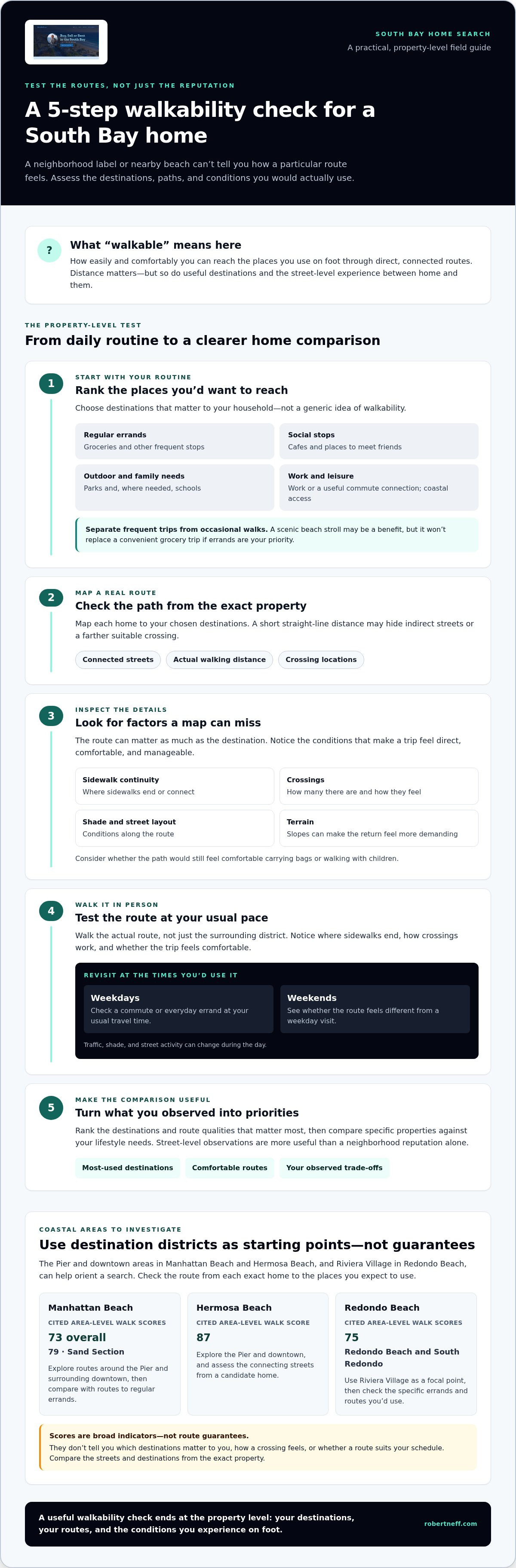
Area-level Walk Scores can help identify where to look more closely. Scores cited for Manhattan Beach are 73 overall and 79 for its Sand Section, with 87 for Hermosa Beach and 75 for Redondo Beach and South Redondo. These are broad indicators, not guarantees of a comfortable route or direct comparisons between two homes. They don’t tell you which destinations you’ll use, how a crossing feels, or whether a route suits your schedule.
- Manhattan Beach: Use the Pier and surrounding downtown as a recognizable coastal reference point. Compare the route from a candidate home to this destination with routes to your regular errands. A home near downtown and one farther into a residential area may have very different everyday patterns.
- Hermosa Beach: The Pier and downtown form another destination area to explore. Assess the streets connecting a home to that district separately from the residential blocks around it, and walk the route to check pedestrian access and conditions.
- Redondo Beach: Riviera Village can be a useful focal point for a search. Its proximity doesn’t establish that every routine errand is walkable, so check the specific destinations and routes you expect to use.
How do Manhattan Beach and Hermosa Beach differ for walking routines?
Compare the routes, not the city names. In each place, coastal destination streets may offer a different walking experience from surrounding residential blocks. Map a candidate home to your chosen destinations, then walk the actual route and note crossings, sidewalk continuity, and how comfortable it feels at your usual pace. Comparable observations from the routes you’d use are more useful than declaring one city more walkable based on its overall score.
Where does Riviera Village fit into a Redondo Beach search?
Measure convenience from the home to the specific Riviera Village destinations you’d visit, not just to the district’s general outline. Then consider whether separate routes serve your other regular needs. Check the businesses, pedestrian access, crossings, and route conditions as part of your visit. A pleasant trip to a commercial area can be a meaningful benefit, but it doesn’t automatically make all weekly errands convenient on foot.
For a focused comparison, record each destination, route, and condition you observe. That makes it easier to weigh coastal access against everyday practicality as your search develops. Buyer guidance can also help connect these lifestyle priorities with specific streets and properties; South Bay home search guidance is one way to continue that comparison.
Beyond the Beach: Everyday Walkability in El Segundo, Torrance, and Palos Verdes
Inland and peninsula searches call for a different lens than a stroll-focused coastal district. A compact commercial area may make some trips easy while leaving other daily needs farther away. For walkable neighborhoods South Bay buyers are considering beyond the beach, assess the address, the destinations you’d actually use, and the route connecting them. The table offers a starting framework, not a guarantee about any property.
| District | Likely walking priorities | Terrain to consider | Details to verify |
|---|---|---|---|
| Old Town El Segundo | Nearby errands and preferred destinations | Route slope and length | Current destinations, sidewalks, and crossings |
| Olde Torrance or Walteria | Trips relevant to that specific district | Changes in grade along each route | Distance to your chosen stops and route continuity |
| Palos Verdes Peninsula | Selected local destinations and outdoor access | Hills and elevation changes | Direct pedestrian access, crossings, and actual route distance |
What should buyers investigate around Old Town El Segundo?
Treat Old Town as a district to explore, then map a candidate home to the destinations you personally expect to visit. Consider separate routes for routine errands, a café stop, a park, or other preferred places. A home may be convenient for a concentrated district without making a wider range of daily needs practical to reach on foot. That distinction matters if you hope to rely less on driving.
Walk the routes rather than assuming a nearby map pin tells the whole story. Look for direct paths, continuous sidewalks, crossings that feel manageable, and detours that lengthen the trip. If El Segundo is part of a relocation decision, the El Segundo relocation cost analysis can help place neighborhood considerations within a broader move-planning picture.
How should readers assess Torrance and Palos Verdes separately?
Start with a particular Torrance district, not a citywide assumption. Olde Torrance and Walteria, for example, are distinct places to investigate. The useful question is how a specific address connects to your selected destinations. Compare the same kinds of trips between candidate homes, and note whether each route feels direct and comfortable rather than relying on a neighborhood label.
On the Palos Verdes Peninsula, elevation can make a short-looking trip feel more demanding. Check the slope in both directions, the crossings, and whether sidewalks continue where you need them. A walk to one destination may work well while another involves a longer or steeper journey. Visit on foot at a time that reflects your likely routine, and record what you observe instead of assuming scenic surroundings mean everyday errands are close.
These distinctions help keep a home search grounded. Comparing addresses, routes, and daily priorities can reveal which trade-offs matter most, especially for buyers new to the area or weighing communities from Redondo Beach and Hermosa Beach to El Segundo, Torrance, and Palos Verdes.
How to Test a South Bay Home’s Walkability Before You Buy
A mapped score or nearby destination can point you toward a home, but the route itself tells you whether walking fits your routine. Use the same process for each property: choose destinations, map routes, walk them, then reassess what you observed. Walkability depends on both the destinations you need and the routes you can comfortably use to reach them.
- Choose destinations. Pick a grocery store, a public space you’d enjoy using, and one frequent personal destination, such as work or a regular errand. Separate essentials from places you’d visit only occasionally.
- Map the actual routes. Follow streets and pedestrian paths rather than measuring straight-line distance. Note crossings, potential detours, and alternate routes.
- Walk each route. Pay attention to hills, sidewalk continuity, crossing conditions, lighting, and shade. Consider whether the route would still feel manageable carrying groceries or walking with others.
- Reassess at different times. Revisit key journeys on a weekday and weekend, at the times you expect to travel. Record what changes and which routes you’d realistically use.
Transit may also shape a home’s usefulness on foot. If you expect to walk to a stop or connect a walking trip with public transportation, confirm current routes, stops, and schedules before relying on them. Service details can change, so treat an old map or listing description as a starting point, not a travel plan.
Which routes should you walk before making an offer?
Choose trips that reflect your likely week, not simply the most appealing nearby destination. Walk to a grocery store, a preferred public space, and one frequent personal stop. Check where sidewalks begin and end, whether crossings feel comfortable, and whether a more direct alternative exists. Record the route’s practical feel as well as its mapped distance, then revisit it at your usual travel time.
How can you compare two homes consistently?
Use the same destinations and criteria for each property. Compare route continuity, crossings, slope, shade, and how comfortable the trip feels. Mark walking access as a must-have or a preference, so an occasional lifestyle walk doesn’t outweigh an essential errand. This consistent approach makes differences between homes clearer. For more context as you compare coastal properties, consider how each route fits your daily routine and broader purchase priorities.
These observations can also sharpen a property search. If you’re weighing specific South Bay homes against your daily routes, get guidance with your South Bay home search.
Match South Bay Walkability to Your Home Search and Daily Life
Route observations become more useful when you turn them into clear priorities. Instead of asking whether a home is “walkable,” decide which trips should work on foot, how often you’ll make them, and what trade-offs you’re comfortable accepting. That gives your search a practical filter alongside property features and budget.
How should walkability fit alongside other home priorities?
Separate essential routes from appealing extras. A regular grocery trip, a commute connection, or a route that supports your household’s daily needs may matter more than an enjoyable walk you’d take occasionally. Consider who will use each route, including children or household members with mobility needs, and whether it feels manageable in the conditions you expect to encounter.
A simple ranking can keep priorities in view as you compare homes:
- Essential: Routes you expect to use frequently and need to feel practical.
- Valuable: Destinations that would improve your routine but aren’t required every day.
- Optional: Leisure walks or neighborhood features you’d enjoy when convenient.
Then weigh those rankings against commute patterns, the home’s layout and condition, and your budget. A property may strongly match one priority but require a compromise on another. Naming that compromise helps you decide deliberately rather than letting a high walkability score or desirable neighborhood label make the decision for you. A considered purchase strategy can help you balance lifestyle goals with the practical details of buying.
What can local buyer representation add to the search?
For first-time and relocating buyers, it can be challenging to translate an idea such as “close to daily needs” into the right streets and properties. Robert Neff guides buyers through home searches, market analysis, and purchase strategy in South Bay coastal communities. Buyer search and negotiation support can connect your ranked priorities with individual homes, while relocation guidance can help you assess how a location may fit an unfamiliar routine.
A deliberate search treats routes as part of the property comparison, not as a detail to consider after choosing a neighborhood. For each potential home, weigh the routes you’ve observed alongside property fit, budget, and other purchase priorities. This creates a clearer basis for deciding where flexibility makes sense and where daily convenience is central to your choice.
If you’re ready to compare specific properties against your routine, you can discuss your South Bay home search with Robert Neff.
Make Your Next Home Search More Intentional
Use what you’ve learned about your daily routine to shape the next stage of your search. Instead of chasing the idea of a perfect neighborhood, focus on the fit between your priorities, a specific property, and the life you want to build there. That perspective can help you weigh walkable neighborhoods South Bay options with greater confidence, whether you’re buying your first home or relocating to the coast.
Robert Neff is a California-licensed Realtor® (DRE #02442812) who supports buyers with representation, negotiation, and relocation guidance. He can help you bring lifestyle priorities into a deliberate South Bay property search, keeping the questions that matter connected to the homes you consider.
When you’re ready to explore your next steps, discuss your South Bay home search. A thoughtful plan can turn local insight into a home that feels right for your everyday life.
Frequently Asked Questions
Is the South Bay walkable without a car?
Some South Bay residents can manage many local trips on foot, but going car-free depends on the home’s location, daily destinations, and available transportation. A routine based around one compact area in Manhattan Beach, Hermosa Beach, or El Segundo may differ from one that spans Torrance, Palos Verdes, and Redondo Beach. Before deciding, list the trips you’d need to make in a typical week and identify which could realistically be completed without driving.
Can I rely on a neighborhood’s walkability score when choosing a home?
Use a walkability score as an initial comparison tool, not a verdict on a particular property. A score can’t tell you whether its destinations match your priorities or whether you’ll feel comfortable walking there with a stroller, mobility aid, or heavy bags. Compare homes using the same errands and personal destinations, then check how the routes work for your circumstances. The most useful score prompts better questions rather than making the decision for you.
How do I check whether a South Bay home is close enough to daily errands?
Start with the errands you repeat most, such as grocery shopping, then consider whether you’d make each trip on foot in ordinary conditions. Check whether the route lets you combine stops or requires a separate outing for each one. Think about the return journey, too: carrying purchases, walking uphill, or managing bags can change what feels convenient. For each property, note the route you’d actually take and whether it suits your weekly routine.
Are South Bay coastal neighborhoods walkable year-round?
Walking can be part of daily life in coastal areas throughout the year, but your comfort on a route may change with weather, daylight, and how busy the streets are. A path that feels pleasant during a daytime visit may feel different after dark or during a crowded period. Check the same important trip at the times you expect to use it, and consider whether you’d still choose to walk under less comfortable conditions.
Does living near a South Bay downtown mean I can walk everywhere?
No. Living near a downtown can put some destinations within reach without making every errand practical on foot. A café, park, or local service may be nearby while a store or another regular destination requires a longer trip or an inconvenient route. Think about your whole routine, not just the most visible commercial streets. Consider whether the location supports several useful trips or mainly one appealing outing.
What should relocating buyers check on a South Bay neighborhood visit?
Relocating buyers should use a visit to test ordinary routines, not just tour homes. In Redondo Beach, Hermosa Beach, Manhattan Beach, El Segundo, Torrance, or Palos Verdes, try a likely commute connection and one errand at the time you’d normally make it. Notice how easy it is to find your way, where a route feels uncomfortable, and whether the area’s pace suits your household. Keep observations for each home so impressions don’t blur together.


