

A coastal address doesn’t make a rental property a sound investment. Strong South Bay CA real estate investment advice starts with the specific home, its location, and the numbers behind it, not the appeal of the region’s name. In a market where acquisition costs are high, a weak rent estimate or overlooked expense can quickly change the picture.
It’s understandable to look for a simple citywide benchmark, but averages can hide important differences between neighborhoods and individual properties. Rental demand, ongoing costs, applicable regulations, and potential resale appeal all deserve careful attention. Weigh them against your goals and tolerance for risk.
This 2026 buyer’s guide offers a consistent framework for evaluating South Bay rental opportunities before making an offer. Learn how to compare coastal locations and residential property types, assess property fundamentals, and identify risks that warrant closer review. We’ll also cover how local market analysis can help clarify comparable properties and neighborhood trade-offs, so you can make a more informed decision without relying on promises of income or appreciation.
Key Takeaways
- Use South Bay CA real estate investment advice to assess each property on its own merits, rather than relying on a citywide average or coastal appeal.
- Build a clear underwriting sequence: define your goals, research comparable rents, estimate expenses, and stress-test your assumptions.
- Compare coastal and inland locations, as well as property types, against your intended renter profile and ownership priorities.
- Before making an offer, review inspections, ownership costs, title, disclosures, and any HOA rules or rental restrictions that apply.
- Use local market analysis and buyer representation to inform your search and negotiation, while treating projections as estimates rather than promises.
Why South Bay CA Real Estate Investment Advice Starts with the Local Context
A residential investment property is a home purchased primarily to earn rental income, pursue potential long-term value growth, or both. That purpose changes how you assess a purchase. A primary residence is chosen around your own needs and preferences. A rental purchase must also make sense in light of likely tenant demand, ownership expenses, property condition, and your investment goals.
Coastal appeal may influence renter interest, but it can’t establish an individual home’s performance. South Bay communities include El Segundo, Torrance, Redondo Beach, Hermosa Beach, Manhattan Beach, and Palos Verdes. Their settings, housing options, and access to services differ. Regional reputation provides context, not proof that a particular property will rent readily or appreciate.
What makes the South Bay market distinct?
Coastal and inland locations are different contexts, not interchangeable investment categories. Consider a property’s proximity to employment centers, transportation, and everyday amenities. Then investigate how those features compare with nearby rental properties. A short distance on a map may not show how a renter experiences the location or whether a specific home meets their needs.
Even regional statistics require careful interpretation. Scherb Homes reported a South Bay median sold price of $1.279 million in October 2026, approximately flat over the prior 12 months. Redfin reported a $1.3 million median sale price for its Rancho Palos Verdes focus over the three months ending August 2026, up 1.4% year over year. These figures cover different geographic areas and time periods, so they aren’t a direct neighborhood comparison. Use them as context, then examine evidence for the property and its immediate area. For a broader geographic overview, see the South Bay Los Angeles County overview.
Which investor goals should shape the search?
Start by defining what you want the property to do. An income-focused buyer may prioritize current rent evidence and recurring ownership costs. Someone with a longer horizon may give more weight to location, property condition, and potential resale appeal. Neither approach guarantees a particular result. Both depend on assumptions that should be tested against property-level evidence.
Set practical boundaries before comparing homes: your intended holding period, acceptable level of risk, and how involved you want to be in rental ownership. These choices help clarify which trade-offs deserve attention during the search. South Bay CA real estate investment advice is most useful when it connects your goals to local comparable properties, rather than treating the region as one uniform market.
Market analysis can help identify neighborhood-level differences and comparable sales or rents, but it can’t replace advice tailored to your circumstances. Your finances, lending decisions, and tax situation may affect whether a purchase fits your plan. Discuss those questions with the relevant qualified financial, lending, or tax professionals before committing.
How to Underwrite a South Bay Rental Property Without Guessing
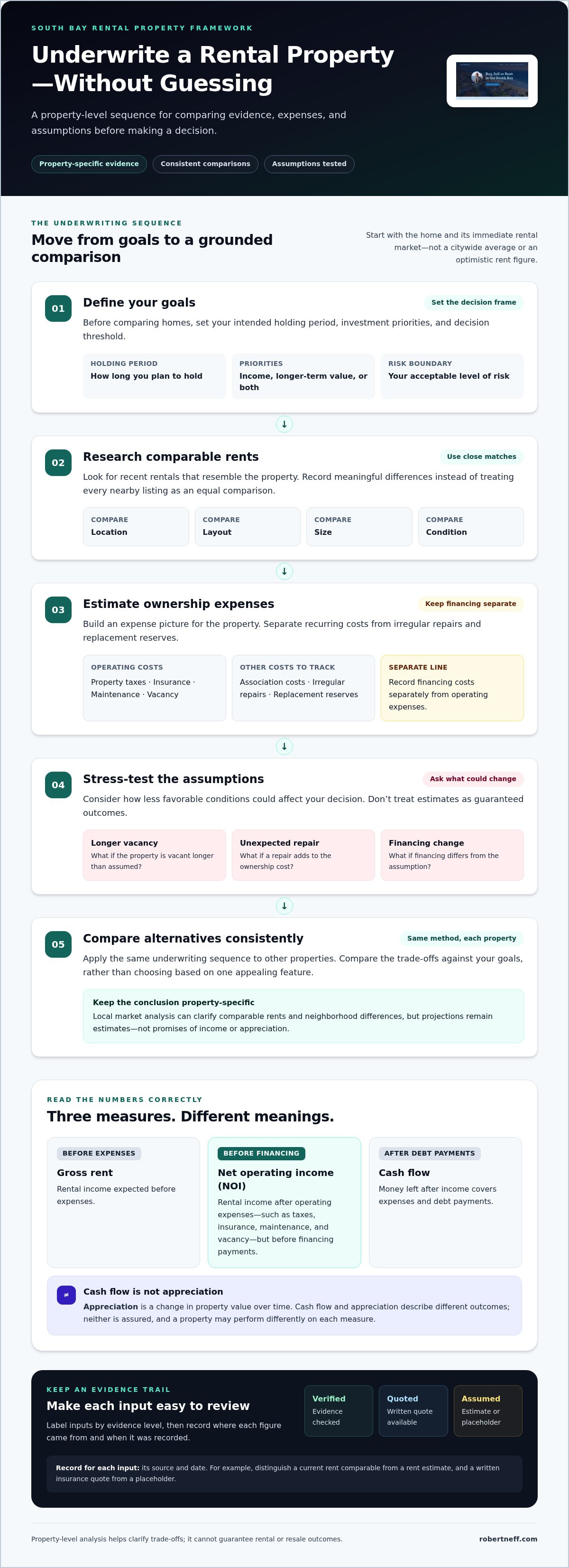
A useful first-pass analysis separates what you can verify from what you’re assuming. Don’t start with an optimistic rent figure and work backward. Build the picture in stages, using evidence tied to the property and its immediate rental market.
Which figures belong in a first-pass analysis?
Use this sequence to evaluate each property consistently:
- Define your goals. Set your intended holding period, investment priorities, and decision threshold before comparing properties.
- Research comparable rents. Look for recent rentals with similar locations, layouts, sizes, and conditions. Note meaningful differences instead of treating every nearby listing as an equal comparison.
- Estimate expenses. Track property taxes, insurance, maintenance, vacancy, and any association costs. Separate recurring expenses from irregular repairs and replacement reserves. Record financing costs separately.
- Stress-test assumptions. Consider how a longer vacancy, an unexpected repair, or a change in financing could affect your decision.
- Compare alternatives. Apply the same method to other properties. This makes it easier to see which trade-offs fit your goals, rather than choosing based on one appealing feature.
Gross rent is the rental income expected before expenses. Net operating income (NOI) is rental income after operating expenses, such as taxes, insurance, maintenance, and vacancy, but before financing payments. Keep the figures distinct: adding mortgage costs to an NOI calculation changes the measure.
Cash flow and appreciation describe different outcomes. Cash flow is the money left over after income is used to cover expenses and debt payments; appreciation is a change in the property’s value over time. Neither is assured, and a property may perform differently on each measure.
How should an investor test the assumptions?
Label each input as verified, quoted, or assumed, and record its source and date. For example, distinguish a current rent comparable from a rent estimate, and a written insurance quote from a placeholder. The Los Angeles County Assessor's Office can help you review property assessment information in Los Angeles County. Confirm other expenses through relevant records and quotes.
Run conservative, baseline, and more favorable scenarios without treating any of them as a forecast. For each scenario, change one or more inputs, such as vacancy, maintenance, or financing, and ask whether the result still meets your own threshold. If a modest change makes the purchase unacceptable, that sensitivity matters.
For broader context on changing local conditions, compare your property-level evidence with this South Bay real estate market trends analysis. This is where South Bay CA real estate investment advice becomes practical: assumptions are visible, comparable, and easier to challenge. Buyers evaluating a specific home can also explore Robert Neff’s buyer search and negotiation guidance.
How South Bay Locations and Property Types Change the Investment Picture
A city name is only a starting point for comparison. Redondo Beach, Hermosa Beach, Manhattan Beach, El Segundo, Palos Verdes, and Torrance span coastal and more inland settings, but conditions can also vary from one neighborhood or property to another. Compare the address, home, and relevant rental evidence together. Two properties in the same city can have different investment profiles because location, condition, layout, and ownership obligations differ.
What should buyers compare across South Bay cities?
Assess each location on its own terms. Compare access to transportation, employment, and everyday amenities, then review the property’s condition and rental comparables at the address level. When comparing coastal homes, consider how the specific setting and property features relate to the renter profile you’re investigating. General coastal appeal isn’t a substitute for evaluating a specific home.
| Location | Property type to assess | Renter profile to investigate | Ownership considerations | Evidence to verify |
|---|---|---|---|---|
| Redondo Beach | Single-family, condo, or residential multifamily | Which location and home features prospective renters value | Condition, shared areas, and association obligations if applicable | Nearby rentals with similar layout and condition |
| Hermosa Beach | Compare the specific home type and configuration | Whether comparable renters prioritize the address or property features | Maintenance needs and any shared systems or rules | Recent, relevant rental listings and property records |
| Manhattan Beach | Evaluate each residential type individually | Likely tenant needs based on comparable properties | Physical condition and ongoing ownership responsibilities | Rental comparables matched by location and features |
| El Segundo | Single-family or other residential property | Potential demand associated with the home’s access and amenities | Building condition and recurring or irregular costs | Address-level rental evidence and expense records |
| Palos Verdes | Assess the property’s layout and condition | Tenant preferences shown by comparable rentals | Property-specific maintenance and access considerations | Comparable rentals and relevant property documentation |
| Torrance | Compare single-family and residential multifamily options | Needs indicated by nearby rental comparables | Maintenance scope, shared systems, and association terms | Recent rentals with similar location, size, and condition |
How does property type affect the decision?
With a single-family home, focus on that property’s condition, systems, and maintenance needs. Residential multifamily may involve more units and shared building components, so examine how those systems are maintained and what the records show. Neither type is automatically preferable. Compare the work and costs associated with the particular property.
For condos or other association-governed homes, review governing documents, reserves, assessment history, and rental restrictions. These can affect ownership obligations and whether the property aligns with your plans. South Bay CA real estate investment advice here means comparing residential properties using residential evidence. Commercial real estate requires a distinct evaluation and shouldn’t be folded into this residential comparison.
What to Verify Before Making a South Bay Investment Property Offer
A pre-offer review can surface issues that may change your assumptions before you commit to terms. Gather property-specific evidence, note unanswered questions, and consider how each finding affects your intended use and decision threshold. This checklist organizes the review; it isn’t a substitute for legal, tax, insurance, or building advice tailored to your circumstances.
Which physical and financial risks deserve early review?
- Inspections and condition: Review available inspection findings, deferred maintenance, and the condition of major building systems. Identify items that may need further evaluation and consider how they could affect near-term ownership plans.
- Rental evidence: Compare projected rent with relevant local rental comparables, accounting for differences in location, layout, condition, and features. Asking rents and broad regional averages aren’t proof of the rent a particular property can command.
- Ownership expenses: Organize known expenses such as taxes, insurance, association dues, and maintenance. Separate documented amounts from estimates, and identify irregular repairs or replacement needs that may not appear in routine monthly costs.
- Title and disclosures: Review available title information and applicable seller disclosures. Record issues that need clarification or professional review before deciding whether the property fits your plans.
For a property governed by an HOA or another association, examine the governing documents, budget, reserves, assessment history, and rental restrictions. Look for obligations that could affect your intended use or add costs beyond the unit itself. If records raise concerns, note the specific issue and its potential effect on your assumptions.
How should buyers handle regulations and ownership readiness?
Regulatory questions deserve property-specific review. AB 1482, SB 721, and other state or local requirements may be relevant in some circumstances, but a law’s name alone doesn’t establish how it applies to a particular property or planned use. Verify current state and local requirements with qualified legal or compliance professionals. A regional rule does not automatically apply identically to every property.
Ask whether the intended rental use involves restrictions, permits, or building obligations, and identify which records or professional assessments can address those questions. Applicability can depend on details such as the property, its configuration, and the planned use. Don’t treat general online summaries as a final determination. Keep legal and compliance findings separate from market analysis, then incorporate confirmed obligations into your ownership assumptions.
Before setting offer terms, bring the findings together: inspection concerns, comparable rents, ownership expenses, title information, disclosures, and association or regulatory questions. Flag what remains unresolved and consider whether the uncertainty changes your willingness to proceed. This is where South Bay CA real estate investment advice becomes concrete: it supports a disciplined buyer decision, not a promise about rental income or returns.
For structured help with property search, evaluation, and negotiation, explore Robert Neff’s buyer representation.
How Robert Neff Helps Buyers Apply South Bay Investment Advice
Turning research into a purchase decision takes a clear process. Robert Neff, Ph.D., is a licensed California Realtor® who represents buyers in South Bay coastal residential markets. He helps buyers define what they’re seeking, navigate the property search, consider local market context, and negotiate. The focus stays on your priorities and the evidence available for each property.
What does buyer representation add to an investment search?
A focused search connects your preferred locations and property characteristics with your holding goals and acceptable trade-offs. Market analysis can help compare relevant properties, neighborhood differences, and offer considerations. It supports a more informed decision, but it can’t guarantee rental income, appreciation, occupancy, or investment performance. For more on purchase strategy, see this strategic South Bay buyer representation overview.
That distinction matters. A comparable sale or rent can inform your analysis, but it doesn’t determine what a particular property will earn or be worth later. Robert’s buyer-side guidance helps organize local context around the home under consideration, so you can weigh its features and trade-offs against your objectives instead of treating regional trends as a prediction.
What should a first conversation establish?
Begin with the purpose of the purchase, your timeline, preferred South Bay locations, and the compromises you’re prepared to make. Clarify whether current income, a longer holding period, or another priority will guide your search. This gives the evaluation a useful frame and helps distinguish must-haves from preferences.
Then identify which assumptions need fresh market research and which questions call for another qualified professional. Lending, tax, legal, and investment matters may require guidance specific to your circumstances. Buyer representation can bring market and property information into focus, but it doesn’t replace that advice or determine your financial readiness.
A clear next-step process can keep a complex decision manageable:
- Clarify goals: Establish your intended use, timeline, location preferences, and decision criteria.
- Compare suitable properties: Focus the search around those priorities and review meaningful differences between options.
- Review the evidence: Examine local market context, property details, and unanswered questions before deciding on offer terms.
- Choose whether to proceed: Move forward only when the available information and remaining uncertainty fit your own threshold.
This is the practical value of South Bay CA real estate investment advice: informed buyer support can make the search and negotiation more structured without promising an outcome. If you’re considering a residential purchase, discuss a South Bay property search with Robert Neff and start by outlining the goals and trade-offs that matter to you.
Make Your Next Move With a Clear Investment Thesis
A sound purchase decision doesn’t always mean making an offer. Sometimes the most useful outcome is recognizing that a property doesn’t fit your criteria and keeping your options open. Treat that discipline as part of your investment strategy: it can help you distinguish an appealing home from a compelling case for buying it.
Make your next step a focused conversation about what you want the property to accomplish and which trade-offs you’re willing to accept. South Bay CA real estate investment advice is most valuable when it helps you assess a real opportunity against your priorities, without pressure to predict what the market will do.
Robert Neff provides buyer search, local market analysis, and negotiation support for South Bay coastal residential purchases. Discuss your South Bay property search with Robert Neff and take the next step with a clearer sense of what you’re looking for. A measured decision is progress, whether it leads to an offer or a more suitable opportunity ahead.
Frequently Asked Questions
Is South Bay, California, a good place to buy investment property?
It can be, but whether it suits you depends on your goals, purchase assumptions, property condition, and evidence from nearby rentals. Redondo Beach, Hermosa Beach, Manhattan Beach, El Segundo, Palos Verdes, and Torrance offer varied coastal and inland settings, not a universal ranking. Compare specific homes and current rental comparables. Regional appeal alone can’t promise income or appreciation. Good South Bay CA real estate investment advice starts by asking whether a property fits your criteria.
What is the 1% rule in real estate investing?
The 1% rule is a rough screening shortcut: compare a property’s monthly rent with its purchase price, with the rule of thumb suggesting rent equal to about 1% of the price. It isn’t a full investment analysis and doesn’t account for expenses, financing, property condition, vacancy, or location-specific factors. Treat it only as an initial filter. For a South Bay home, assess the property and relevant rental evidence instead of assuming the rule is achievable or appropriate.
How much should I budget for repairs on a South Bay rental property?
There’s no single repair reserve that fits every property. A home’s age, condition, major systems, insurance considerations, and inspection findings all affect planning. Review the inspection evidence, then estimate routine maintenance separately from larger capital needs, such as significant system work or replacements. Consider how those estimates affect your willingness to buy. A reserve is a planning assumption, not a substitute for an inspection or a prediction of exact future costs.
Can I live in an investment property and rent out part of it?
It may be possible, but the answer depends on the specific home and your situation. Review financing terms, insurance conditions, HOA rules, and applicable local requirements for the intended arrangement. For example, a property’s association documents may restrict rentals, while financing terms may set occupancy conditions. Verify those details before relying on projected rent or deciding how you’ll use the home. Owner-occupancy with a partial rental isn’t automatically approved for every property.
Do I need a property inspection before buying a rental home?
An inspection can help you understand a home’s visible condition and flag issues that may need further evaluation, but it can’t guarantee every defect will be found. Depending on the property, consider whether specialist assessments are appropriate for particular systems or features. Use findings to refine offer considerations and ownership assumptions, not as a precise forecast of future costs. Review the inspection’s scope and limitations so you understand what it does and doesn’t cover.
Are rental income and property appreciation guaranteed in the South Bay?
No. Neither rental income nor appreciation is guaranteed. Rents, vacancy, expenses, financing, property condition, and broader market conditions can change, affecting an investment over time. A desirable South Bay location alone doesn’t establish how a particular property will perform. Consider how the purchase looks under different plausible scenarios, and treat projections as estimates rather than promises. Your decision should account for uncertainty and your own financial circumstances, not depend on a single optimistic outcome.
What is the difference between cash flow and return on investment?
Cash flow is the money remaining after the income and expenses included in your analysis are counted. Return on investment is a broader measure comparing selected costs with selected gains, and its result depends on what you include and how you calculate it. Methods can differ, so state your assumptions consistently when comparing properties. Neither measure alone determines suitability: consider your goals, time horizon, risk tolerance, and the evidence supporting each estimate.


